









In 1947, the leaders of India had a gargantuan task ahead of them. They had to create a modern state, forge a nation, transform a hierarchical society, rapidly industrialise, and create a vibrant economy. Many post-World War II modern states were borne out of violent mass mobilisations. Societies were reshaped in cataclysmic purges of the old, or people disciplined into a new consciousness with an iron fist.
In India, there was a semblance of a “macro-order’, however tenuous, even as a hundred fires raged in towns and cities. In this macro-order, the political vanguard embraced a high modernist philosophy for national development. In many ways, A Sixth Of Humanity: India’s Developmental Odyssey, by Devesh Kapur and Arvind Subramanian, traces the consequences of their fateful choices.
The high modernist god that failed
That an invisible hand could not be relied upon to rapidly industrialise India was beyond dispute. State enterprises would be the vessels for industrialisation and the source of revenue. Critically, capital-intensive heavy industry was prioritised over labour-intensive low-skill manufacturing under the Nehru-Mahalanobis model. To fuel industrialisation, food prices and wages were kept low by putting agriculture on the bench. The authors use a global comparative lens to demonstrate that this foreclosed the possibility of rural savings, rural enterprise and the eventual growth of large-scale manufacturing that achieved export-competitiveness.
The book challenges the characterisation of the socialist era of India as one of “import substitution”, and finds “scarcity economy” a better fit. Overbearing regulations, arbitrary licensing and a deliberate policy against the attainment of scale rendered the domestic private sector incapable of substituting imports. While entry into the market was difficult for large domestic firms, exit was impossible, with all firms with more than 100 workers requiring government authorisation to fire workers. These factors foreclosed private sector investment and put structural transformation well out of reach of the labour force of millions of Indians. Two classes of workers were created – a tiny minority class of formal workers (at no point more than 10% of the total workforce) with numerous protections, and the majority of informal workers in the unorganised sector with no protections.
On the other hand, a large number of small-scale, inefficient private firms were encouraged, despite their shortcomings, to sate the Gandhian spirit. Attaining efficiency was pointless, as firms could not expand beyond a certain size without, ironically, inviting anti-competitive regulations. Later, as many of these small firms would run into debts and become unviable (notably in textiles), the government would nationalise them to protect the workers. Indirect taxes and other revenues raised from millions of unorganised sector workers and their households would pay the salaries of formal workers of unviable firms on ventilators.
The book reveals how revenues forever eluded the public sector enterprises, raising questions about the foundational assumptions of the Nehru development model. Between 1970 and the present, not in a single year have state public sector enterprises yielded a net profit, and annual losses often plummeted lower than -5%.
Debates on development often devolve into a tussle between growth and equity. While present-day thinkers are rightfully distrustful of this dichotomy, understanding that both must coincide, the book’s assessment of Planning Raj suggests that both coincided in their absence rather than in their presence. Socialist countries around the world have been praised, if not for rapid growth, then for their revolutionary mass education and public health programmes. In India, however, the “socialistic” pattern of development eluded the urgency for mass education and sanitation. Even land reform, which pays dividends in states like Kerala and Jammu and Kashmir to this day in the form of (relatively) exceptional health indicators, was mostly a failure under state Congress governments, which were dominated by the landed class. Kapur and Subramanian discern a “caste-like hierarchy” of choices made with regard to human capital. Physical capital was chosen over human capital. Education was privileged over health. Tertiary education was privileged over primary education.
Most importantly, there were, as the authors describe, “elite carve-outs” for the urban-settled, formally employed government servants, from Kendriya Vidyalayas to Indian Railways schools, Army Public Schools, etc. More than a mass spread of literacy, India privileged the perpetuation of a technocratic class. It is telling, for example, that in mid-20th-century Bengal, the proportion of college-going students was as high as that of the UK and Germany and higher than that of Japan – yet the proportion of school-going students in Japan was six times higher than in India. Between 1950 and 1980, adult literacy in India increased from 16% to 36%, while in China it increased from 20% to 66% – more than twice the gains in India.
The book explores in detail how, in the absence of social mobilisation for public goods like literacy and sanitation, the absence of a common notion of good civic life, the painfully slow creep of industrialisation and modernity (even in 2000, only 54% of Indian villages were electrified) and hideous displays of caste dominance and bureaucratic authority created a toxic cocktail of “precocious democracy” where political accountability was sought through the “subsidy-concession-quota” triumvirate, instead of through provision of law and order, broad based public goods and infrastructure. In the absence of socio-economic mobility for “non-Brahmin-Baidya” castes and non-English-speaking classes, concessionary and discriminatory demands became the means of “reclamation”.
Dominant farmer castes negotiated wasteful subsidies on electricity and fertilisers, even as state power utilities were financially haemorrhaging and cross-subsidising by charging industries. Diversion of resources and exercise of power by members of one’s own caste at the local level became the means of commanding social respect, as evidenced by Mayawati’s campaign slogan “Nahi chahiye CM-PM, humein chahiye SP-DM” (Hindi for “we don’t want a (Bahujan) CM or PM, we need a (Bahujan) superintendent or police or district commissioner”), which led to further staffing of SPSUs with members of the caste groups in power. Raises determined by successive Pay Commissions outpaced real growth in wages in other sectors, adding to the government job premium. Priority sector lending kept large farmers, formal workers and the public sector middle class happy, as enterprise shrivelled. At the same time, concessions and subsidies bled the same enterprises dry. The book uses the allegory of the “Kamadhenu state”, suckling the clamouring political constituencies, with no sight of weaning on the horizon. The political cost of weaning remains prohibitively high.
The N-word – Neoliberal or Neo-Welfarist?
There is a perversely delicious irony in the fact that India began to do well on most counts of development only as the Indian economy liberalised and entered what many academics call the “neoliberal” phase. As Louise Tillin had argued in her book Making India Work, the “neoliberal” phase witnessed a rapid expansion of social welfare coverage. The left characterises the post-liberalisation period as one of creeping cronyism, as the focus of rents shifted from licenses to the allocation of assets like land and airwaves. But the rising tide did lift many boats, as Kapur and Subramanian show. As it became clear that state governments were incapable, even unwilling, to do anything about health and education, the latter was brought into the Concurrent List, and centrally sponsored programmes were launched for both in “mission mode”, buoyed by increased revenue earnings. Between 1980 and 2010, government spending on primary education increased by a factor of 8, even though enrolment only increased by a factor of 1.7. Spending on health increased by a factor of 30.
The post-liberalisation revolution in telecommunications, ushered in by ruthlessly efficient private telecom giants and IT sector yuppies (much reviled by the social sciences crowd), provided India with the Jan Dhan-Aadhaar-Mobile (JAM) architecture, which enabled direct benefit transfers, bypassing touts and rent-seekers, while also eliminating ghost beneficiaries that funnelled money away from developmental ends. As telecom was opened up to private players, data costs plummeted, making way for a digitally-driven New Welfarism. Between 2011 and 2021, the number of adults aged 25 or above with a bank account rose from 38% to 81%. This rate of decadal growth is globally unprecedented. On the other hand, state monopoly on power continues to make electricity prohibitively expensive even for medium-sized firms, even as large farmers wastefully draw subsidised electricity and deplete groundwater.
The authors argue that with the fiscal resources alone that went into keeping SOEs on the ventilator, the central government could have increased its infrastructure spending at least by 50% every year since independence, and state governments could have increased their health expenditures by the same amount every year. Laudably, the authors call out academic stalwarts for their failure to draw attention to the elephant in the room. Despite the massive financial haemorrhaging characteristic of SOEs right from the planning era, most assessments by contemporary economists gave a “not great, not terrible” verdict – reminiscent of Anatoly Dyatlov from the HBO series Chernobyl. The ideological Geiger counter was stuck at 3.6 Roentgen.
The Indian development story has hitherto been judged more on the intent and coherence of its theoretical design instead of level-headed consequentialism, and assessed more favourably than it ought to have been. Kapur and Subramanian sprinkle some much-needed cold water on the Indian development consciousness. That India did well, “despite the circumstances”, is hard to accept when keeping in mind that other countries had their circumstances, often far harsher. The ‘East India Company Syndrome’ that kept globalisation, competition and privatisation at arm’s length is difficult to condone when looking at the East Asian economies that embraced mass manufacturing and global competition, despite decades and centuries of imperialist humiliation. As the new Indian labour codes enter public debate, it would be wise to remember that throughout history, widespread structural transformation enabled by simpler legal contracts has done more to provide social security to the poor millions than centralised legal over-engineering. The latter protects a small minority in a sea of precarity, while the former adds another rung on the ladder of socio-economic mobility for millions, however minimal the protections. In the ladder of the Indian dream, as A Sixth of Humanity: Independent India’s Development Odyssey shows, the middle rungs are missing.
Ronit Hazarika is a PhD Scholar (Development Studies) at the Department of Humanities and Social Sciences, Indian Institute of Technology, Guwahati.
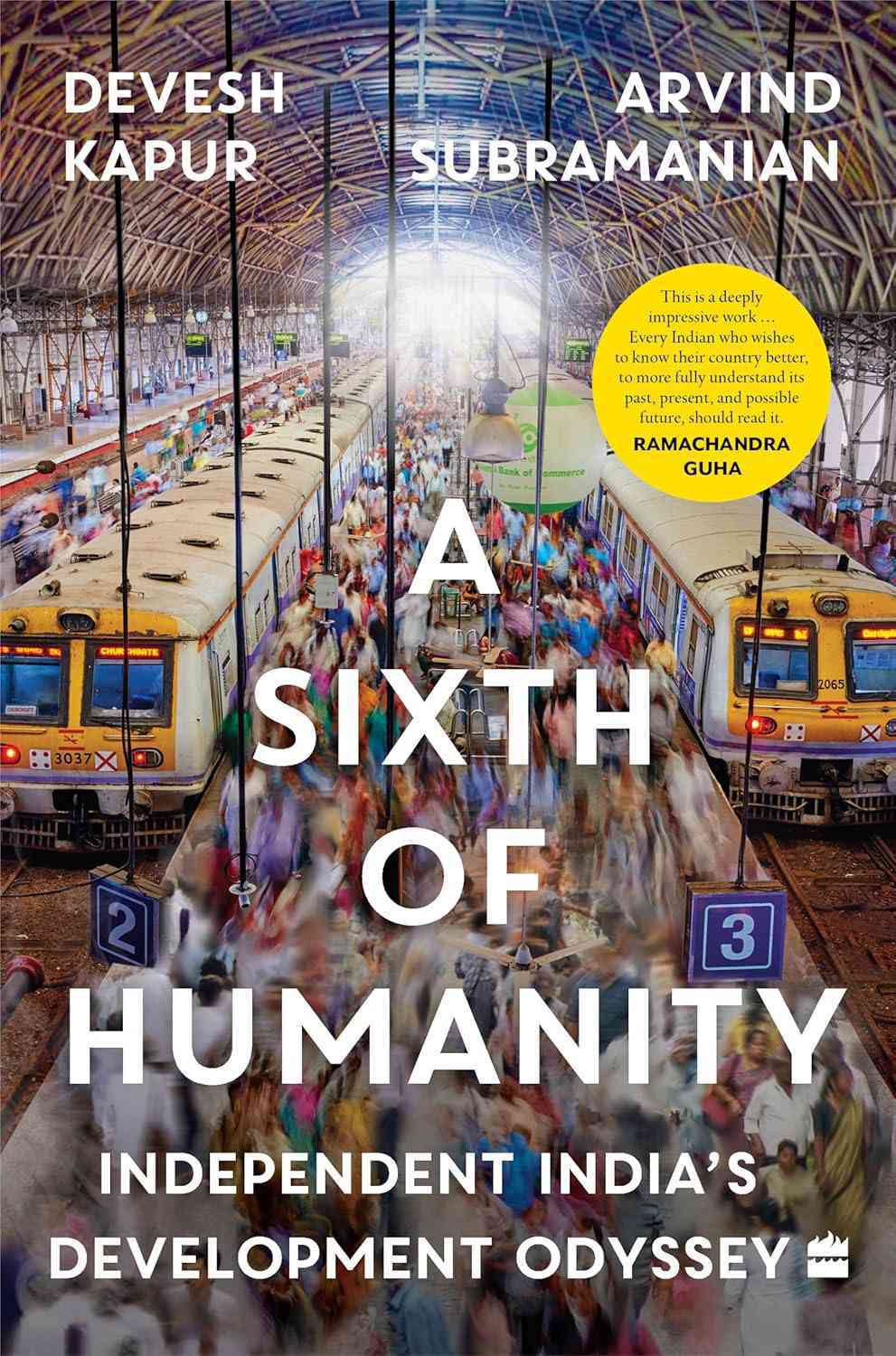
A Sixth Of Humanity: Independent India’s Development Odyssey, Devesh Kapur and Arvind Subramanian, HarperCollins India.
