


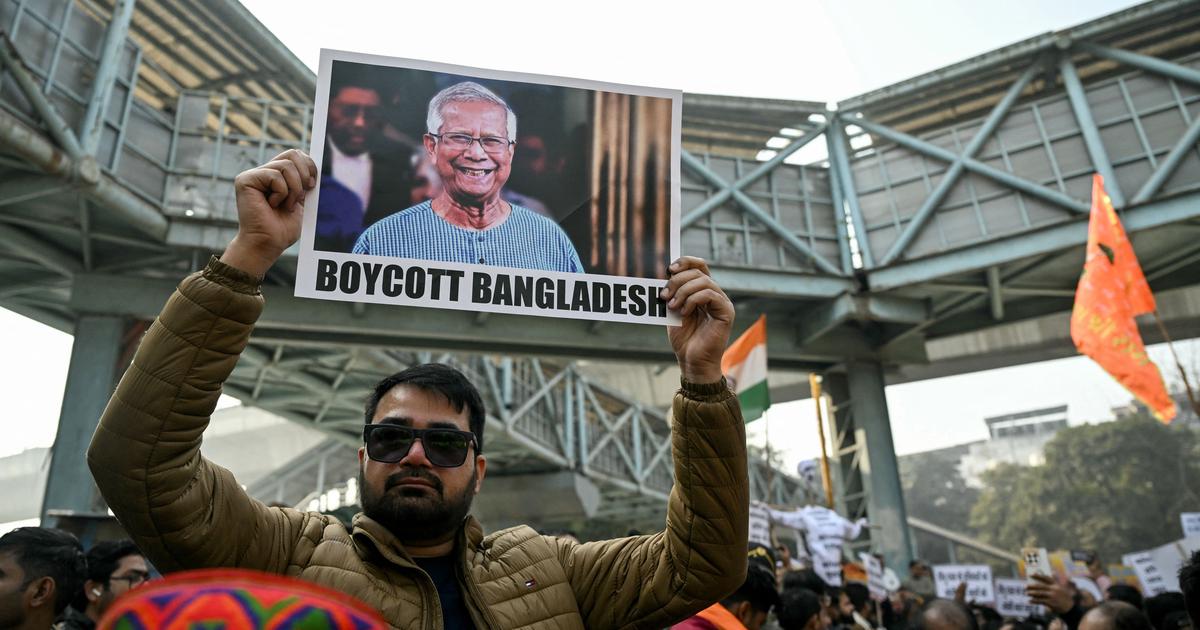
The Indian cricket board last week instructed the Indian Premier League’s Kolkata Knight Riders team to drop Mustafizur Rahman from its squad. It cited “recent developments that are going on all across” but the reason was evident: he is a Bangladeshi.
In response, the interim Bangladeshi government banned the broadcast of the 2026 IPL tournament, saying that no reason had been communicated for excluding Rahman. The Bangladesh Cricket Board on its part declared that its team would not travel to India for the Twenty20 World Cup scheduled to begin in February, citing the purportedly “violent communal policy” of the Indian cricket board.
After the International Cricket Council rejected Bangladesh’s request to play its matches in co-host Sri Lanka (just like Pakistan will do), Dhaka said that it was concerned about the safety of its team in India.
The world cup matches will take place around the time Bangladesh heads for its first national election since the ouster of the Sheikh Hasina government in August 2024. A tense political situation could cause passions on both sides of the border to run high.
The removal of Rahman – the only Bangladeshi picked in the 2026 IPL edition – was not abrupt. It came amid diplomatic tensions between New Delhi and Dhaka after the killing of a Hindu man in Bangladesh in December.
The decision was reportedly taken at the highest level of the Board of Control for Cricket in India.
Kolkata Knight Riders, whose co-owners include actor Shah Rukh Khan, had faced sharp criticism for picking Rahman from some in the ruling Bharatiya Janata Party, spiritual leaders and others in the Hindutva ecosystem.
BJP leader Sangeet Som had on December 31 called co-owner Shah Rukh Khan a “traitor” for recruiting Rahman despite the attacks on Hindus in Bangladesh.
The Opposition Shiv Sena (Uddhav Balasaheb Thackeray) party described Bangladeshis as “enemies” and said that Khan did not understand the country’s sentiments.
There was a time when such grievances were reserved for Pakistan, which has not played a cricket match in Mumbai in 46 years and none in India – barring world championships – since 2012 following objections from Hindutva groups. Pakistanis have also not played in the IPL except for the inaugural season in 2008.
Dhaka’s manoeuvres
The public resentment, it seems, is mutual. Shifts in Bangladeshi sentiment about India have been starkly visible since the Hasina government was ousted.
Some public hostility against India has been fuelled by the fact that Hasina, who faces a death sentence in Bangladesh, has been allowed to live in Delhi. Her seeming impunity adds to the friction in recent years between a more Islamised Bangladeshi society and strident Hindutva in India.
Religious minorities in Bangladesh are being attacked in a manner that New Delhi has described as “systematic persecution”. The attacks include the lynching in December of a Hindu man, which triggered the latest diplomatic crisis.
New Delhi has also been troubled by strategic moves by the Muhammad Yunus government to improve military cooperation and cultural ties with Pakistan – the country against which Bangladesh fought for freedom. Dhaka’s talks to purchase the JF-17 fighter jets from Pakistan (jointly developed with China) have only added to India’s anxieties.
In New Delhi’s view, this could hurt regional balance and possibly open up another front that is unstable, if not outright hostile, for India to tackle.
‘Bangladesh is not Pakistan’
But there is a contrary view: despite Dhaka’s decisions, Bangladesh is not Pakistan.
Shashi Tharoor, the chairperson of India’s parliamentary committee on external affairs, wrote in The Indian Express that what differentiates Bangladesh from Pakistan is that Dhaka has not made “the export of terror a pillar of state policy”. Imposing a “‘Pakistan-like’ isolation” on it means ignoring the nuances of geopolitics, he contended.
“To conflate the complex internal dynamics of Bangladesh with something like the state-sponsored hostility of Pakistan is not merely a visceral overreaction; it is a diplomatic blunder that reveals a profound failure of imagination,” the Congress leader said.
While there are groups in Bangladesh whose actions deserve condemnation, a blanket boycott of their cricketers “is to play into the hands of the extremists” and a “troubling departure from…strategic common sense”, Tharoor said.
Even some among BJP’s key allies understand this.
Here is a summary of last week’s top stories.
No bail. The Supreme Court denied bail to activists Umar Khalid and Sharjeel Imam, who are accused of being part of an alleged larger conspiracy behind the 2020 Delhi riots. The bench, however, allowed the bail applications of Gulfisha Fatima, Meeran Haider, Shifa-ur-Rehman, Shadab Ahmed and Muhammad Saleem Khan.
The court said that Khalid and Imam can file bail applications after all protected witnesses are examined or after one year. It said that there were reasonable grounds to believe that the conduct of the two men was prima facie a terrorist act as defined under the Unlawful Activities Prevention Act.
The activists were arrested between January 2020 and September 2020. The police have claimed that the February 2020 violence in North East Delhi, between supporters of the contentious Citizenship Amendment Act and those opposing it, was part of a larger conspiracy to defame the Narendra Modi government and planned by those who organised the protests against the amended law.
Ratna Singh explains why the Supreme Court denied bail to Khalid and Imam, but granted it to the five other activists.
The state of India-US relations. The proposed trade deal between India and the United States was not finalised because Prime Minister Narendra Modi did not call US President Donald Trump, the country’s Commerce Secretary Howard Lutnick claimed. He claimed that India was “uncomfortable” with this step and that the call never happened.
Lutnick said that the conditions under which India and the US had earlier appeared close to finalising a deal were no longer available. However, he added that “India will work it out”.
New Delhi said that Lutnick’s characterisation of the trade discussions was not accurate.
Without a trade deal with Washington, Indian goods are facing a combined US tariff rate of 50%. The punitive levies on India and others had been introduced as part of Trump’s pressure campaign against countries buying discounted Russia oil amid Moscow’s war on Ukraine.
Lutnick’s comment came a day after Senator Lindsey Graham said that Trump had approved a bill that could pave the way for tariffs of up to 500% on countries such as India for buying Russian oil. The bill could be put to vote in the Congress next week.
To argue that the tariffs worked as intended, Graham had on January 4 quoted the Indian ambassador as having told him in a private conversation that India was buying less Russian oil, and had urged him to request Trump to relax tariffs linked to such imports. Reacting to Graham’s comments, Trump said that the US could raise tariffs on India if New Delhi does not cut Russian oil imports.
Strange alliances. Maharashtra Chief Minister Devendra Fadnavis said that the Bharatiya Janata Party’s post-poll alliances with the Congress in Thane district’s Ambernath and the All India Majlis-e-Ittehadul Muslimeen in Akola district’s Akot were unacceptable. “It will have to be broken,” he said.
The local alliances were formed after the municipal council elections in December. Fadnavis said that disciplinary action will be taken if party workers are found to have violated orders.
The Congress dissolved its Ambernath block committee and suspended 12 of its corporators for allying with the BJP without the approval of the party’s state leadership.
Tabassum Barnagarwala writes about why Opposition workers are crying foul in Maharashtra civic polls.
Also on Scroll last week
- India repeatedly forced 14 members of Bengali Muslim family from Odisha into Bangladesh, says kin
- ‘As helpless as a common man’: Why Jammu and Kashmir’s MLAs say they are powerless in the new regime
- On the road to Chardham, a landslide every two kilometres
- India’s car-first cities should prioritise walking to help tackle smog
- The spectacle of justice in the Delhi riots case is cover for polarisation and violence
- Ramachandra Guha: In praise of Dr Umar Khalid, from one historian to another
- MGNREGA gone, Centre is puppet master of new scheme with no guarantees
- What the US invasion of Venezuela reveals about international law
- US intervention in Venezuela was wrong – but now, a Japan-style rebuilding plan must unfold
- Sriram Raghavan interview: The ‘certain ache in the heart’ that led to ‘Ikkis’
Follow the Scroll channel on WhatsApp for a curated selection of the news that matters throughout the day, and a round-up of major developments in India and around the world every evening. What you won’t get: spam.
And, if you haven’t already, sign up for our Daily Brief newsletter.
