






Hasan Ali spends days worrying about his father, Taher Ali.
How is the 58-year-old fending for himself in a foreign country? What might be doing in the bitter January cold? What dangers might he be facing?
In the last eight months, Taher Ali, a peasant from Assam’s Nagaon district has been forced out of India and into the no man’s land abutting Bangladesh not once – but three times.
Twice, he was sent back by Bangladesh border officials, Hasan Ali, a 31-year-old vegetable vendor, told Scroll.
Taher Ali is a “declared foreigner”, someone who has failed to prove that he is an Indian citizen before the state’s foreigners tribunals even though he has lived his entire life in Assam.
The tribunals are quasi-judicial bodies that have stripped thousands of Assam’s residents of their citizenship, many times through ex-parte orders that were passed without hearing the accused – as was the case with Taher Ali.
Those who lose their cases at the foreigners tribunals have the right to challenge their orders in the higher courts. In some instances, they have been sent to the state’s detention or holding centres. But, until May last year, they were rarely deported to Bangladesh, as a tribunal order is not proof that they are citizens of another country.
However, since May, the Bharatiya Janata Party government in Assam has repeatedly bypassed the legal process of deportation by “pushing back” declared foreigners across the border – in the dead of the night, and at gun point. Chief Minister Himanta Biswa Sarma has invoked a 1950 law to justify the forced deportations.
Since November, the state government has issued orders to 22 declared foreigners to “remove themselves” from the country “within 24 hours”, leaving families with no opportunity to move court.
But with Bangladesh refusing to allow them in, people like Taher Ali are trapped in a vicious cycle of “push-backs” and returns.
Taher Ali is not alone. Scroll found that since December 19, at least seven Assam residents were forced into Bangladesh. When the Border Guard Bangladesh did not allow them in, they returned five days later – only to be forced out again. Some of them were last seen in a Facebook video from Bangladesh’s Kurigram district on December 28, shot by local mediapersons.
Four of them are now in the custody of Bangladesh police, officials in the neighbouring country said. At least one other person, apart from Taher Ali, was coerced into Bangladesh three times.
Scroll contacted the Border Security Force spokesperson and the Union ministry of home affairs, asking if declared foreigners expelled under the 1950 law were repeatedly pushed into Bangladesh, and if their nationality had been verified before. The story will be updated if they respond.
Lawyers and observers told Scroll that the Assam government’s new policy violated international and constitutional norms.
“This is the manufacturing of statelessness,” said Abhishek Saha, a doctoral student at Oxford University who researches on questions of citizenship in India. “India pushed these people toward Bangladesh, only for Bangladesh to reject them… These individuals are being tossed back and forth like tennis balls between the two nations.”
Ujjaini Chatterji, an advocate based in Delhi, said such “abrupt and arbitrary” removal of persons is in direct contravention of the Constitution of India and India’s international law obligations. “Any deportation must be preceded by nationality verification and the deported individual must be formally handed over to the official authorities of the alleged country of origin,” she said. “In the present cases of so-called pushbacks, the arbitrariness is stark.”
Hasan Ali asked why his father was being shunted back and forth between two countries. “My country has declared my father a foreigner from Bangladesh,” he said. “But Bangladesh has returned him twice. Taile amader desh kunda? Amader desh ase ki?” Then, which is our country? Do we have any country at all?
A cycle of pushbacks
In December 2009, Taher Ali was declared a non-citizen by a foreigners tribunal in Nagaon district by an “ex parte opinion”.
He spent four years in Tezpur detention centre from August 2015 to December 2019, and was then released.
In May 2025, after the Pahalgam terror attack, when the Assam government began a crackdown on declared foreigners, Taher Ali was picked up from his native village Goroimari in Nagaon and taken into police custody.
As Scroll had reported, after being picked up by the police, hundreds of declared foreigners were handed over to the Border Security Force, who forced them into Bangladesh at gunpoint. Ali was among 109 such declared foreigners taken to the Matia transit camp, India’s largest detention centre. This was corroborated by an affidavit filed by the Border Security Force in the Gauhati High Court in November.
Hasan Ali told Scroll that his father had phoned him in May, saying he had been forced out.
However, the Border Guard Bangladesh did not let Taher Ali and others into the country. “He was again brought back to India and kept at the Kokrajhar holding centre,” Hasan Ali said. “We were relieved.”
This, too, was confirmed by the affidavit filed by the BSF in the Gauhati High Court. Sixty declared foreigners were sent back by the Border Guard Bangladesh within a day, the BSF told the court. Scroll has seen the affidavit.
In September, Hasan Ali filed a petition in the Gauhati High Court, seeking his father’s release from the holding centre, their lawyer Amir Hussain told Scroll.
“On November 21, the High Court disposed of his plea saying that the 2009 tribunal opinion must first be challenged,” Amir Hussain said.
In November, Hasan Ali went to the Kokrajhar holding centre to get his father’s signature on court papers needed to challenge the FT order. That was the last time he met him.
Before they could move court, on December 17, Taher Ali and 14 others from Nagaon district were issued expulsion orders by the Assam government, asking them to leave the country in 24 hours.
The three expulsions
By the time Hasan Ali got to know of the order the next day, his father had already been whisked away from the Kokrajhar holding centre.
Hasan claimed that his father was taken 500-odd km away to Sribhumi district, formerly known as Karimganj, which borders Bangladesh’s Sylhet, and forced out on December 19.
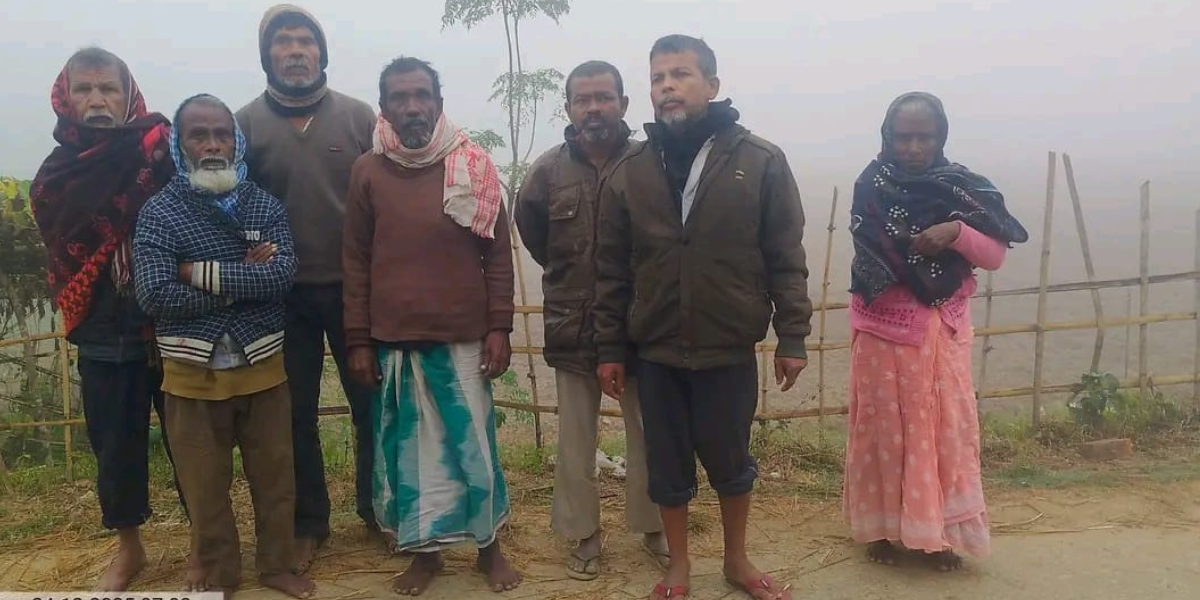
Six days later, members of a village defence party in Sribhumi stopped seven people as they were re-entering India. Taher Ali was among them, Hasan said.
Scroll has seen the photograph taken by the village volunteers of the six men and one woman they had “captured”. It included Taher.
“They were later handed over to the Border Security Force,” Hasan Ali said.
Sribhumi district police chief Leena Doley confirmed to the media that the seven people had been detained while re-entering India. When Scroll asked for more details, Doley dodged the question, saying it is a “sensitive issue” before hanging up.
But that was not the end of it.
On December 29, Hasan Ali got a call from his father.
Taher Ali told his son that on the morning of December 28, he was put in a vehicle and taken 600 km to the other end of the state – to the South Salmara-Dhubri border and forced into Bangladesh for the third time. He asked his son to rescue him and get him out of Bangladesh.
“He does not even know how to read and write,” Hasan Ali said. “How will he manage there?”
He added: “My father is not Bangladeshi, he is Indian. He is a voter and his grandfather’s name is there in the 1965 voter rolls. All his 13 brothers and sisters are Indian. How can my father alone be a Bangladeshi?”
‘We are terrified’
Another declared foreigner forced into Bangladesh three times in the last eight months is Idrish Ali, a 45-year-old daily-wage worker from Raha town in Nagaon.
Idrish had been declared a foreigner in 2016, following which he spent three years in Tezpur detention centre.
Like many declared foreigners, who do not have much awareness of the legal process they are embroiled in, Idrish did not challenge the foreigners tribunal order in the higher courts.
“He thought his case was over after he was released,” said his 21-year-old daughter Sharjina. “He kept going to the police station every week.”
No other member of Idrish Ali’s family was served a notice by foreigners’ tribunals.
In May, the daily-wage labourer was picked up from Raha and sent to the Matia detention centre during the statewide crackdown against the declared foreigners.
According to the affidavit filed by the Border Security Force in May, Idrish Ali was among the 109 declared foreigners detained at the Matia transit camp on May 26.
A few days later, Idrish was forced into Bangladesh, Sharjina said – his first expulsion.
Like Taher Ali, he snuck back to India and was handed over to the Border Security Force, who took him to the Kokrajhar holding centre.
Since then, the family has been running around trying to release him.
“First, my mother went to the Matia detention centre, and the officials said he was not there,” she said. “Then she went to the Kokrajhar holding centre. First, they said he was not there. Then they asked to obtain an order copy from Gauhati High Court to meet him.”
The family hired a lawyer to file a case in the Gauhati High Court in June. But despite being paid, the lawyer did not challenge the tribunal order. Before he moved court, Idrish Ali had been served with expulsion orders on December 17.
He was spotted in the photograph taken by village volunteers on December 24 in Sribhumi, where he is seen standing next to Taher Ali and five other declared foreigners.
Sharjina told Scroll: “A few days later, we came to know that he had re-entered India and was caught in Sribhumi district with six others.”
Days later, the family spotted him in a Facebook video from Bangladesh’s Kurigram district, Sharjina told Scroll.
A Bangladeshi journalist, Mostafizur Rahman Tara, told Scroll that Idrish Ali was among three people detained by the Border Guard Bangladesh on December 28 for entering the country without valid documents.
She said the family had “no idea where he is now”.
“Everyone at home is terrified after he was seen at the Sribhumi border once and later in Bangladesh near the Dhubri border. That is when we realised he had been pushed across a third time,” Sharjina said. “I don’t understand why he was taken from one border to another.”
The 1950 law
In both these cases, the Assam government has justified the “push-backs” by invoking a 1950 law – the Immigrants (Expulsion from Assam) Act, 1950.
The law was enacted soon after 1947 as popular discontent grew in Assam over the growing migration of Partition refugees into Assam from East Pakistan.
Since November, the Assam government has used the law to issue expulsion orders to 22 people – and effectively bypass foreigners’ tribunals and the Centre’s own deportation rules.
In Taher Ali’s case, the Nagaon district administration invoked a new “standard operating procedure” under the law, which was approved by the Assam cabinet in September.
Ujjaini Chatterji, the advocate, said the 1950 law was enacted in a vastly different historical and geopolitical context in South Asia, before foreigners tribunals were set up. “Moreover, the Act does not contemplate, nor does it authorise, arbitrary expulsions without due process,” she said.
Political scientist Sanjib Baruah, too, argued that a “lot has happened in South Asia since the passage of the law”.
He said: “It is absurd to argue that an executive official can now circumvent the procedure established by [foreigners tribunals] and the judicial appeals that their decisions are subject to, and use a 75-year-old law meant to deal with migrants from a region that no longer exists (East Pakistan), and push someone to the ‘no-man’s land’ because the person in his opinion is a foreigner.”
Chatterji pointed out that the law permits expeditious “removal” only of those people “whose presence in Assam is detrimental to the interests of the general public of India, any section thereof, or any Scheduled Tribe in Assam”.
“Neither the notices nor any clear reports establish that the expelled persons were detrimental to the interests of India,” she said.
She added that the 1950 act cannot override existing mechanisms and laws dealing with deportation of foreigners. “The guidelines clearly mandate that before any lawful deportation, a detailed enquiry must be conducted into the nationality of the suspected persons,” she said. “This is not being done.”
