



You’re Somebody’s Kink by Tanisha Rao does not try to be a manual; it says so in the very first line of the book. What it does, instead, is share stories about everyday people in their everyday pursuits, and encourage readers to empathise with the subjects’ unique journeys in intimacy and in life. It does so quite successfully, showcasing a range of narratives about a range of people who find themselves defying the mores of monogamous, cis-normative, hetero-normative intimacy that society imposes on all of us, and that leave so many of us feeling like we’re broken in some way for not fitting into it.
Rao’s writing is approachable and lucid, despite a tendency to use many, many adverbs. Her authorial voice remains largely in the background as large portions of the text are centred on the voice of her interviewees. Only in the Introduction and conclusion does her own perspective emerge. In many ways, these are the most compelling parts of the book as she writes them with an authority that makes the book feel more personal and more urgent in its purpose. They’re also the parts where Rao’s craft as a writer shines.
Excerpts from an interview with Scroll:
Where did you get the idea for the book?
The book is actually something that I’ve been working on through Sangya Project (an initiative co-founded by Rao) this entire time. I started out as a sex educator. The only effective way at the moment for people to be a part of engaging in sex ed for children is to work with NGOs that have to go above and beyond to maintain healthy relationships with the schools that they work with, which means keeping the teachers and parents appeased, right? That means they are constantly censoring themselves and limiting the amount of information they are comfortable with, and not all curiosity from the kids is necessarily encouraged. That is something that I did not want to navigate because I am also a queer person. I did not know how much that would have to keep changing and getting censored, depending on each school and each parent that I worked with.
I instead wanted to work directly with adults and figure out why we as adults are so uncomfortable with so many different aspects of sex and sexuality. So that’s how Sangya Project started, and that is how I wound up talking a lot with adults in different industries, sectors and identities, about what sexuality and intimacy have looked like for them. That also then led me to realise that people in India are not struggling with their sexuality as much as they are struggling to be able to talk about it and actually engage with it in ways that are healthy and affirming for them.
The book is a result of that. I realised we’re all just sitting with the heaviness of questions like, Why is my body changing as I’m growing older? Why are my expressions of intimacy and affection changing as I grow older? What happens when I become chronically ill or disabled in some way? What happens when age robs me of my mobility? What happens when something emotional occurs in my life that completely transforms the way I’m able to engage with my body or express and build intimacy with a partner?
This was combined with the fact that when the publisher said that they were interested in a BDSM book, I was not comfortable with focusing entirely on BDSM and producing something that fed into the notion that BDSM is this fringe lifestyle that only a handful of people really explore, that it’s the rich man’s hobby or the coping mechanism of a handful of traumatised people. BDSM is actually a far bigger bucket than we understand through its definitions or through its portrayals online. So, what I pitched instead was a book that would go beyond this idea of BDSM and look at any and all forms of sexual intimacy that felt like or looked like they fell outside of that norm.
That gave me an opportunity to talk to people, regardless of whether they identified with any BDSM labels or any kinks and fetishes at all, and just showcase the fact that intimacy is extremely complicated for all of us, and that India is not this extremely sexually conservative or shy culture that we make it out to be. Either people are extremely curious about what they can do, they’re experimenting and not finding safe resources to be able to do it without causing themselves or each other harm, or they are just not being able to get started on the process of figuring out what pleasure looks like for them, because they’ve been told time and time again that it has to be this particular default that doesn’t work for them.
You mentioned that a lot of people were eager to talk to you. What was the process of selecting interviewees like? How did you deal with issues like language barriers and class barriers? I also love that you have included the story of a Dalit couple, because I find that perspective missing a lot of the time.
I will say that this is a limiting factor in the book, because most of the trust that I’ve been able to build with people has been through Instagram, and because most of my content is in English, the only people fully engaging with me and trusting me with their stories are also English speakers. There have been a handful of situations such as in the “True Love and Hot Wives” chapter, where there was a really nice mixed language conversation, because the wife (Ananta) would only speak to me in Hindi, and wherever there were words or phrases or little nuances that I wasn’t able to fully understand, the husband (Yama) would translate and help me keep up with the conversation, and he would do the same if my question wasn’t something that I knew how to translate to Hindi.
That was a lovely experience, but I do think that this book is something that is a very, very basic first step (that includes) people who are still in primarily urban settings, who use this kind of language a lot, or see this language online a lot, and are very digitally fluent and exposed. Those are the people to whom I was primarily able to speak. But it has been really nice to see that there are people who want to engage in their own regional languages as well, and that if I fix the problem from my end, by getting translators and becoming more fluent in some of the languages I already speak, there could be potential for much, much larger dialogues around sex and sexuality.
In the “Who’s Your Daddy” chapter, the protagonist, RD, was involved in sex work. I found class to be an interesting factor in the story. Did you ever consider speaking to sex workers who come from a very different class background and deal with different challenges than RD, but also have their own sexuality to express, both professionally as well as in their personal lives?
I did and I still want to do that. I think the only thing that was on my mind here was that I was trying to not make a checklist in my head of who all I want to speak to, and then just sort of, you know, hunting that one person who will say yes to me, and then taking it off my list, saying I spoke to one Dalit person, I spoke to one trans person. I was trying to not fall into that pattern. So instead, what I was trying to do with this process was stay fluid and see who is comfortable reaching out to me and being a part of this process, because that also then tells me who trusts me enough to share their story. This then gives me an understanding of the direction in which I need to work a little harder so that I can make more contacts, acquaintances and genuine friends in that space, so they’re willing to talk to me. But yes, I didn’t want to hunt for certain demographics just to take them off my list.
Then how did you narrow the interviews into the ones you know that you wanted to put in the book?
I think time is the factor that actually helped me narrow it down, more than anything else. If it were completely up to me, I would have just kept going. Thankfully, the editors and the publishers were like, You have a deadline, please stick to it!
You chose a narrative format for the book instead of, for example, a Q and A format. Why did you make that choice?
In a Q and A format, I think there is still at least some onus on what I’m saying and how I say it and how I’m steering the conversation. The narrative format for me was more about allowing the person to speak for themselves as much as possible, and my only job really was to notice how they spoke to me and what their demeanour was like. I wanted it to feel like a character whose emotions you can hear so much of and see so much of, but you don't necessarily get details about what they look like or specifically where they’re from. So it is still possible for you to relate to the person or project some of your friends and loved ones onto this character that you’re reading and feel a sort of love for them. I wanted people to read a chapter and walk away from it being reminded of some of the people they already know, or maybe a version of themselves that they have been in the past, and be able to feel a sort of affection towards that instead of just consuming it as some alacious story.
I talk about myself in the introduction and then try to take myself out as much as I can. I wanted people to know who they are trusting as they enter the book and start hearing these stories. I needed them to understand why I (who is telling these stories) and what I’m attempting to do. But I also wanted them to feel as immersed in these other people’s stories as possible, and not go for my perspective. I think I wanted this to just be about the people that live around us and we constantly engage with, but we just never hear about what their inner lives are like because they’re not comfortable talking about it.
The introduction was very personal, as you mentioned, but the conclusion zooms out of it and focuses on the big picture of how women’s bodies or queer bodies are policed. Why did you focus on this at the end?
When I have tried to have these conversations in the past, about what the politics of our bodies and autonomy is actually like, it’s so far removed from the conversations we actually have on a day-to-day basis that it comes across as a little bit of a conspiracy theory. People are like, What do you mean the government is involved in my choice to be monogamous or (with the fact) that I’ve chosen to have three children in my family? So what I wanted to do here instead is get people to really lower their guard as they read these little snippets of how identity is playing so much of a role in the kind of intimacy a person is able to access, or how economics is something that has steered the way a person’s sex life looks. I wanted people to then really hit them with the larger issue of now, when you see that so many aspects of your sexuality are being determined by more than just your free will, or more than just circumstance at an individual level, can you actually see the big picture? Can you see how many different complicated factors are pushing you towards having a personal life that looks a certain way and is modelled by a certain structure of nuclear families and monogamy?
What kind of obstacles did you face during the interviews? Did you find people had to reckon with their trauma, so it became very emotional to talk about? Or certain topics people just would not touch?
I don’t think I had any issues with people not wanting to touch any subject, because I think the anonymity itself was a huge factor in how free-flowing the conversations ended up being. Everybody immediately said yes to being recorded. They would turn their cameras on as well. It did get very, very emotionally intense. For most of us, there were incidents of trauma coming up as we told the story. There were a few people who said, Okay, there was a traumatic event that took place when I was a child, but there’s no reason to go into it, and they would just progress with the story. But many others would pause. They would mention certain details of the traumatic event to give me more context for their story, so that was very intense. But because I’ve been doing this work for as long as I have, and because of my own experience as a survivor, I feel like I am a little used to the fact that these conversations inevitably bring up extremely difficult memories and experiences from our past. In fact, one of the people that I was speaking to escaped an assault attempt while in the middle of interviews with me. So it was difficult, yes, but I think thankfully, because I have been in the sex education space for as long as I have, there is also an understanding that these things do, unfortunately, constantly happen.
Did you find any particular story to be the most moving?
It’s very hard to choose one, but I think the “Adult Nursing Relationships” story, where there are so many different levels of agency and control that Yael is seeking in their life, and they’re trying to just find who they are outside of the very long, unhappy marriage that they were in. They were married really young and had very little exploration and experience before that marriage. So that was their entry into what intimacy is supposed to look like. And in a country like India, that is the story for so many people, so many people just do not have any experience learning what their body needs and wants, or learning what their mind feels safe with, until they’re married. The next thing you know, they’ve hit their 40s and 50s, and that’s when they get the first chance to say, I don’t know if I’m actually happy.
Also, as someone who is polyamorous and resents the idea of polyamory being talked about as just something as simple as loving multiple people and just wanting to have a great time, it was extremely heartwarming to talk to someone who said that I am polyamorous because my first love will always be my children. To see that kind of perspective on what love looks like for a person, and how it’s not necessarily about placing romantic love at the forefront, but about letting romantic love come and go because their kids will always be their one true love. That is something that really, really resonated with me and became a story that actually helped me set the tone with a lot of the other chapters once I started transcribing them, because “Adult Nursing Relationships” is the first chapter I actually wrote.
Are there writers or creators of sex education that you personally look up and take inspiration from?
This is going to sound extremely arrogant – no! Only because I think I’m not trying to emulate what I see in sex education. I am following a lot of sex workers online and watching what they talk about and the many factors that they’re bringing to the forefront when they talk about what it looks like to have intimacy as a job, but also as a very, very natural human experience to navigate. I am watching disability activists and seeing what kind of points they bring up when they talk about what the experiences of intimacy have been like for them. So, I would say that my focus is not so much about emulating sex educators, but keeping an eye on the sex work and porn industry and watching how queer rights are changing slowly in India, and trying to make those larger conversations a little more applicable for everyone on a day-to-day basis. This is so that we take those five minutes in a week to just sort of reflect and introspect on how these factors matter to us as well, and how it’s not just a fringe social cause that we need to parade around for one day in a year.
I know that there is no point in my lecturing someone about why queer rights matter. What needs to be done is for me to actually sit down with straight people and ask them as genuinely and sincerely as possible, are you actually happy with the intimacy that you have in your life? Are you actually safe? Do you actually feel like you can talk to people about it when there are moments where you have health-related issues that you worry about, or you suspect a health-related issue in your sex life? Do you have the language and the comfort and confidence to reach out to a doctor on time and have that tested or discussed? You don’t.
And queer rights are not about just same sex people engaging in same sex relationships. It’s the fact that so much of our autonomy over our bodies has just been stripped away. And that larger conversation has to be something that straight people engage in as well, that able-bodied people understand, that even someone who has never, ever met a sex worker and never even spoken to one, is also able to understand how these politics apply to their life. Then they can say, Pkay, you have an identity that makes absolutely no sense to me, because it’s vastly different from mine. But this thing you’re saying about how you don't get to control your own body and someone else is constantly policing it for you, that fundamentally is something that’s happening to me as well. What can we do about it?
What is the singular most important message that you would give to Indians regarding sex education?
Consent and accountability. I don’t think it's enough to just teach people about the relevance of asking for consent. I think what we also need is helping each other sit with the discomfort of being rejected or the discomfort of being told that something we did, whether intentionally or unintentionally, has caused discomfort or harm to the other person, and that there are several ways in which we can take responsibility for that. Either it means leaving the person alone because they don’t want to engage with us again, or it means sitting down and really doing the work of unpacking the trauma that you might have caused and helping to mend that together.
The larger work of getting people comfortable with taking accountability is not really happening. So I would say that that is something that we need to push for more in sex education and make sure that we all understand that at any given point in our relationships, emotional or sexual harm can be caused, because everyone is capable of causing harm, and when that happens, the best we can do is talk to each other and understand what repair looks like.
There’s a lot of chatter these days about kink going mainstream. It’s much more frequently portrayed in pop culture nowadays. Are there any shows, books or movies focusing on it that you really like and that you think are doing a good job? Or do you, in general, find them to be grossly inaccurate, and you wish they would do a better job?
It’s the latter. I have watched and enjoyed things or read things only because it has given me an understanding of what not to do and how not to talk about things! But again, the larger understanding of what this looks like is by talking to everyday people who are creating content for kink communities in India and abroad. It’s by seeing educators on places like FetLife (a social media website for kinksters). It’s by following sex workers who are making the effort of creating online content that explains what consent looks like around BDSM. I don’t think pop culture is anywhere close to having a fair portrayal just yet.
Finally, what do you think the kink community in India needs to work on?
I don’t know if I think the kink community in itself needs to work on something specific, because there’s so many of us, and we’re from all across the country, in tier two, tier three, tier one cities, with different languages, different microcultures, so it’s hard to see it as a monolith that has something to improve upon. What I wish we could see more of is that people who don’t see themselves as part of the kink community, I wish they could identify how much they actually share in common with the concept of kink and the concept of BDSM, or the scripts that are used in BDSM. I wish they would engage with kink discourse a lot more and recognise that they are just like us, and they can learn so much from all the experiences we have in common, instead of seeing us as this other that is just constantly covered in leather and latex and having a wild time.
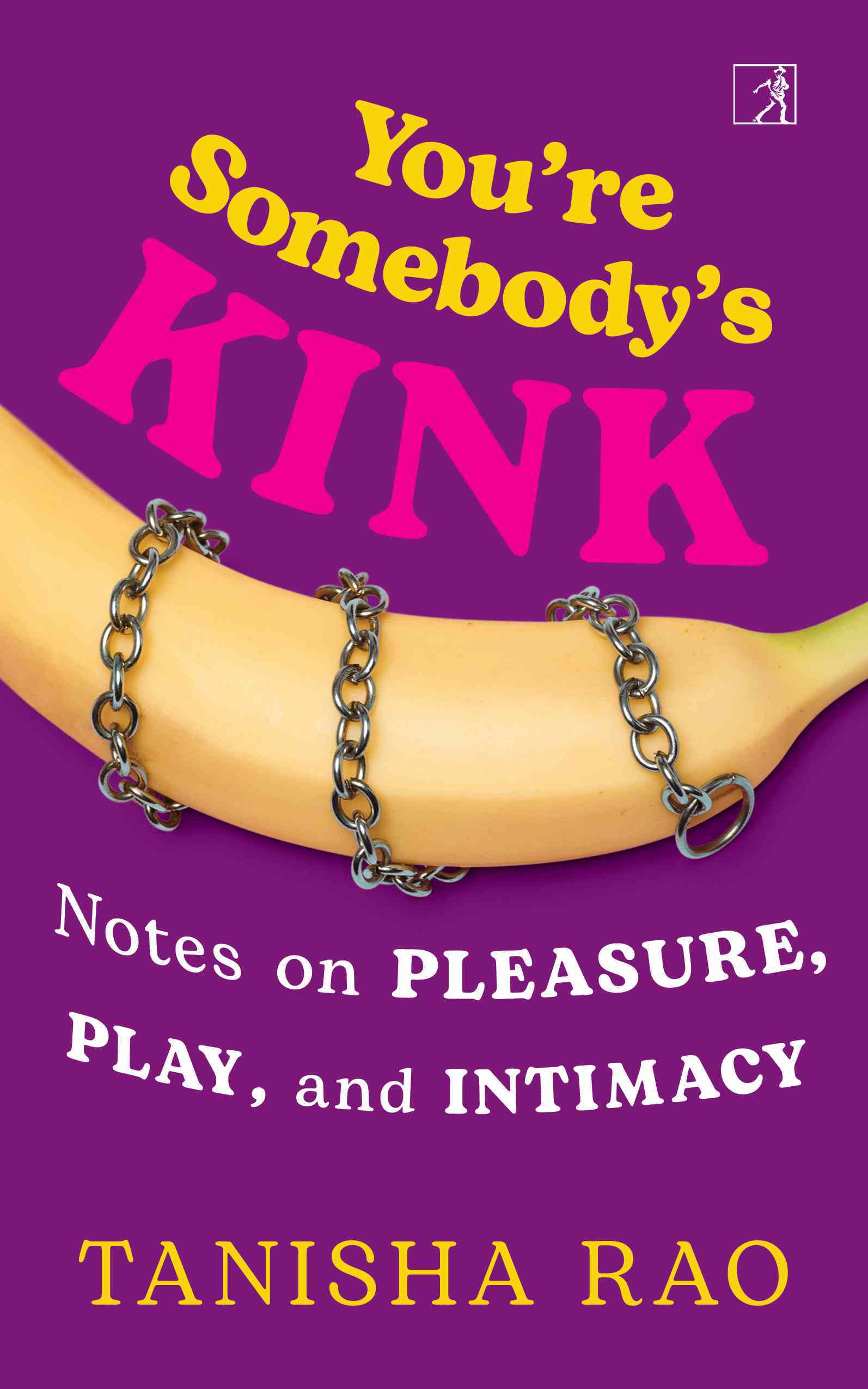
You’re Somebody’s Kink: Notes on Pleasure, Play, and Intimacy, Tanisha Rao, Simon and Schuster India.
