







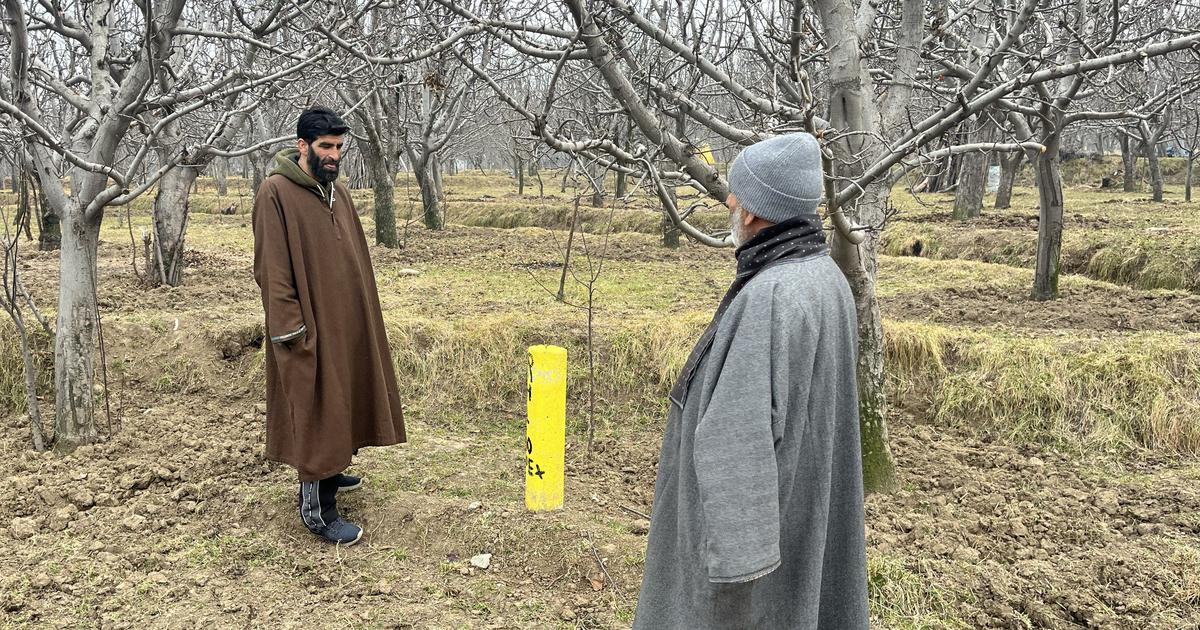
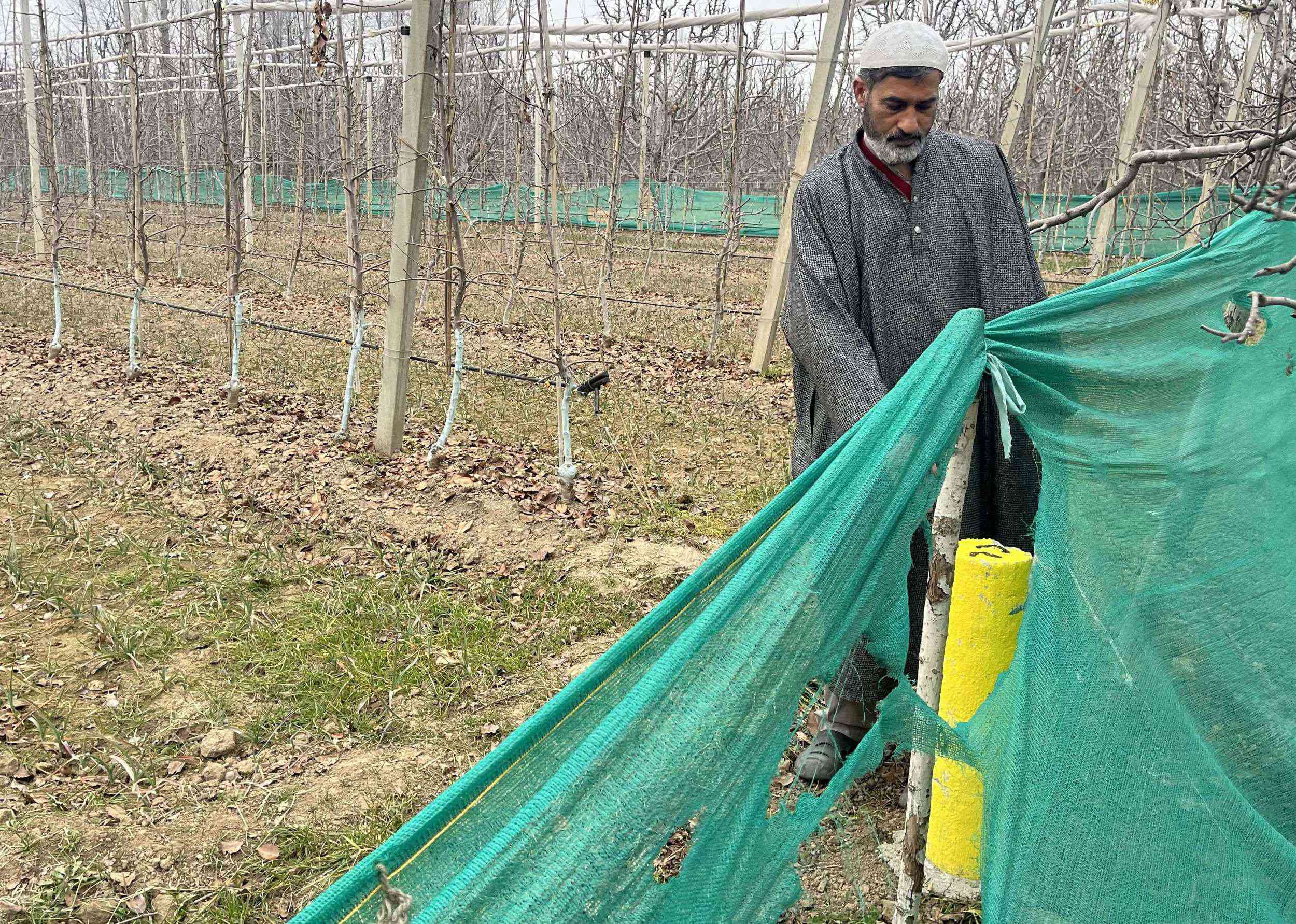
“This is not a survey marker for me – it is like a dagger driven into my heart,” lamented Hafizullah Ganie, an apple farmer in Pulwama district’s Babhara village pointing to a bright yellow concrete pillar indicating the route a planned railway line will take through South Kashmir.
When the 27.6-km Awantipora-Shopian railway line is built, the project will consume Ganie’s half-acre orchard.
Similar survey pillars were installed in December in orchards in Babhara, Tikken, Keegam, Kunso and other villages in Pulwama and Shopian districts.
In December 2023, Railway Minister Ashwini Vaishnaw told Parliament that the final location survey has been sanctioned for this project.
The construction, villagers claim, will swallow hundreds of acres of orchard land and between half a million and 700,000 trees. The district authorities say they have not yet begun to estimate how much land will be required for the project and how many trees will be cut.
But since the markers were installed, apple farmers in several affected villages have held peaceful protests. They say that the railway line imperils the prosperous lives they have built since they shifted from paddy cultivation to apple farming around 25 years ago.
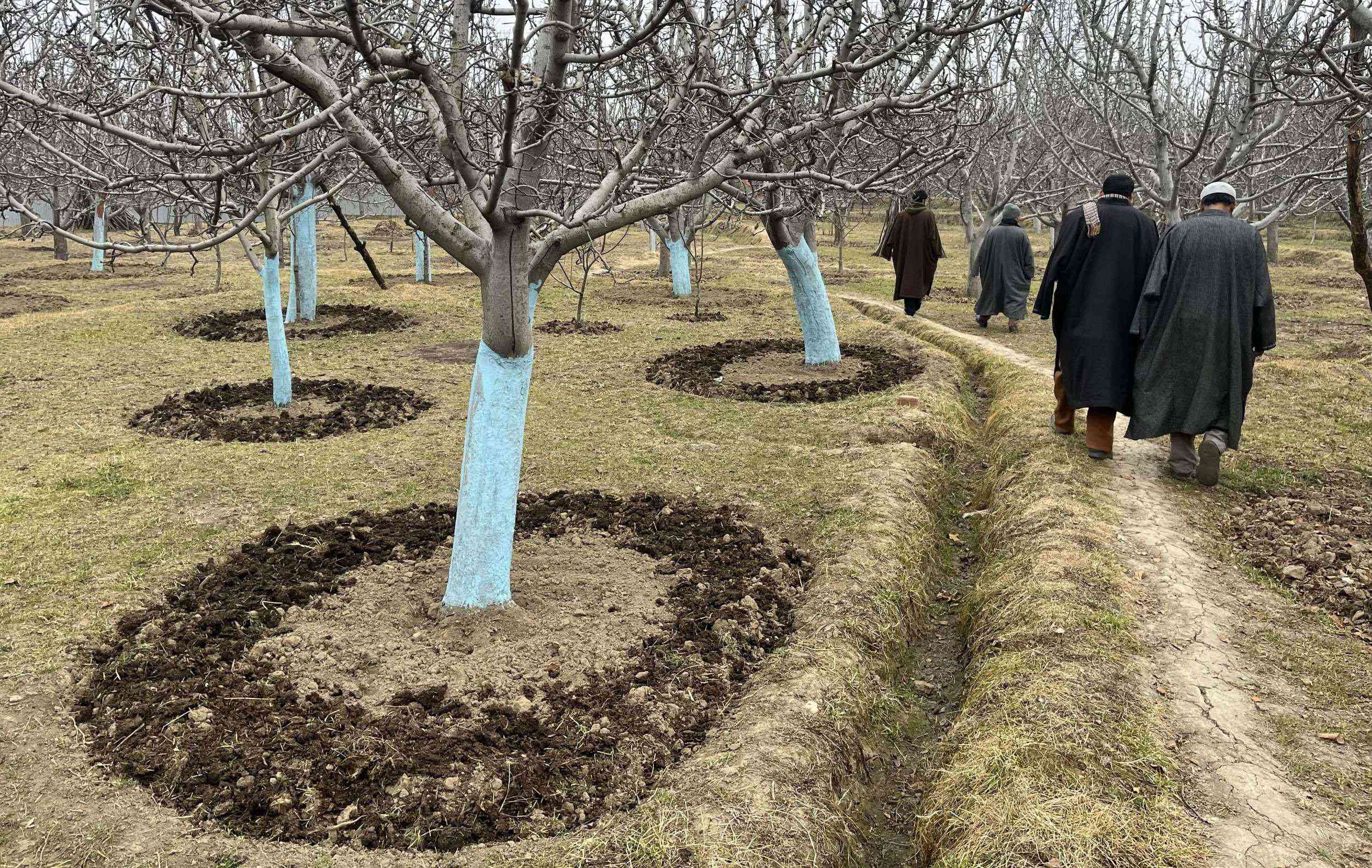
Since the 1970s, apple farming has lifted incomes in Kashmir, reshaping aspirations and making horticulture the backbone of the Valley’s economy. The industry directly or indirectly provides a living for 3.3 million people.
The decision to change what was grown on their land was born not just of the desire to produce a more lucrative commodity – it was the result of growing water scarcity.
Traditionally, paddy cultivation in this area would be irrigated by water from snow-fed streams, said 58-year-old Abdul Hamid, a farmer in Babhara village. But now, he said, “snow has almost vanished… and so has the water”.
Ganie still remembers how he and other farmers from Babhara were beaten up by farmers of a nearby village in 2001 when they attempted to divert a stream there to provide water to their farms.
“That day many of us decided to convert our paddy land into orchards as apple trees and other fruit trees are not reliant on irrigation,” Ganie said. It took him a year to move from paddy to growing apples. Many of his neighbours followed suit.
Not only did this solve their water problem, it also turned around their fortunes because the earnings from apple farming are far higher than paddy farming, he said.
Ganie said it is hard to believe how the snow and glaciers that fed Kashmir’s streams have diminished over the past few decades. “When I was a young boy, Pir Ki Gali [a mountain pass] had snow even in July and August,” he said. “Today, there is none even in April.”
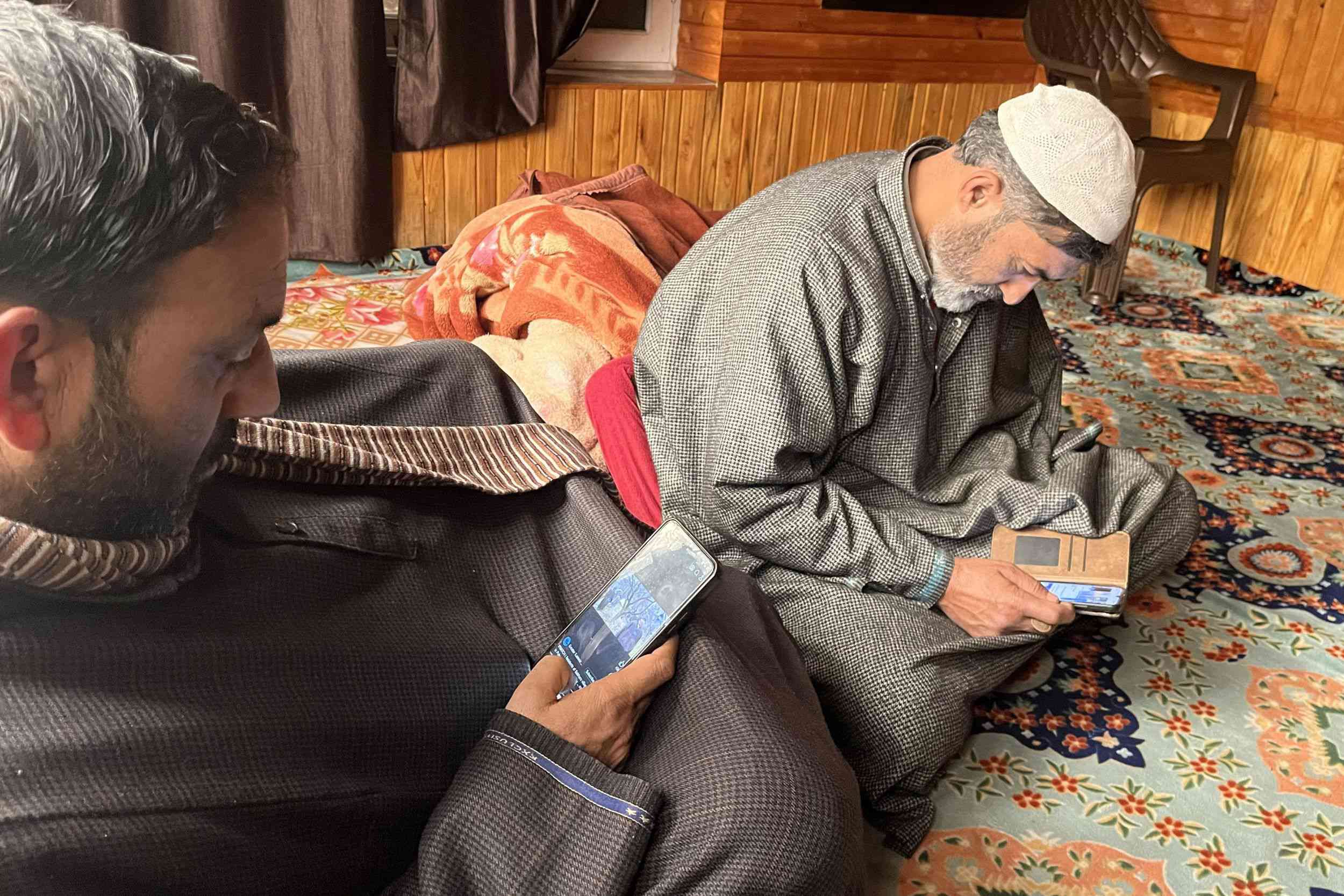
Over the past 60 years, glaciers in the Kashmir and Ladakh Himalayan regions have reduced by 25% to 30%, said Irfan Rashid, an assistant professor at the earth sciences department of University of Kashmir who has studied the phenomenon.
Farhat Shaheen, an agricultural economist at Sher-e-Kashmir University of Agricultural Sciences and Technology who has done extensive research on the impacts of climate change on agriculture, said that the decisions of farmers in recent years in some water-stressed villages of Kashmir have turned out not just to be economically advantageous for farmers – they were climate-smart too.
“The water footprint of apple is very low compared to paddy,” Shaheen said. While paddy needs irrigation, apple orchards are largely rain-fed. He added that horticulture also has a significantly smaller carbon footprint. Apple trees, he noted, help sequester carbon. Paddy fields, on the other hand, are a source of methane emissions.
From a climate lens, Shaheen observed that apples are well suited to Kashmir’s conditions, requiring only a few showers during the growing season and minimal irrigation in dry spells.
The effects of climate change have been especially intense in the region. After analysing the recession patterns of nine glaciers in the Kashmir Himalaya over 28 years from 1992 and 2020 with the help of satellite images and field measurements, Rashid of the University of Kashmir and his co-researchers found that glaciers here are melting faster than in other regions across the Himalayan arc.
Farmers have sensed such changes way earlier. Farmers in Babhara, Drubgam and other villages in Pulwama said that shifting from paddy cultivation to apple cultivation wasn’t just a way to seek better returns – in the face of water shortages, it was a survival strategy.
Adjusting to climate change will not be cheap. A new regional analysis report by the International Centre for Integrated Mountain Development has found a $12.05 trillion gap in amount of money the Hindu Kush Himalaya will require to address the region’s adaptation and mitigation needs between 2020 to 2050
The report notes that global climate finance flows, which reached approximately $1.3 trillion annually in 2021-’22, are predominantly directed toward mitigation in developed and larger emerging economies. The Hindu Kush Himayala region received significantly lower shares.
Despite this, resilient farmers in various Himalayan villages have already found their own solutions to climate-driven problems – such as switching crops.
Paddy cultivation, said the agricultural economist Shaheen, is increasingly unviable from a farmer’s perspective though it is crucial for food security in a region where rice is a staple. “It does not even recover the costs farmers incur every season,” he said.
In contrast, horticulture offers quicker and higher returns. High-density apple plantations, for instance, begin bearing fruit from the second year, with production peaking by the sixth year.
Still, apple production isn't without problems. From an environmental perspective, Shaheen acknowledged that pesticide use in horticulture remains a concern. “But it can be taken care of by bio-pesticides in due course,” he said.
He said that horticulture has been a critical economic lifeline in Kashmir, particularly during years of conflict and economic uncertainty.
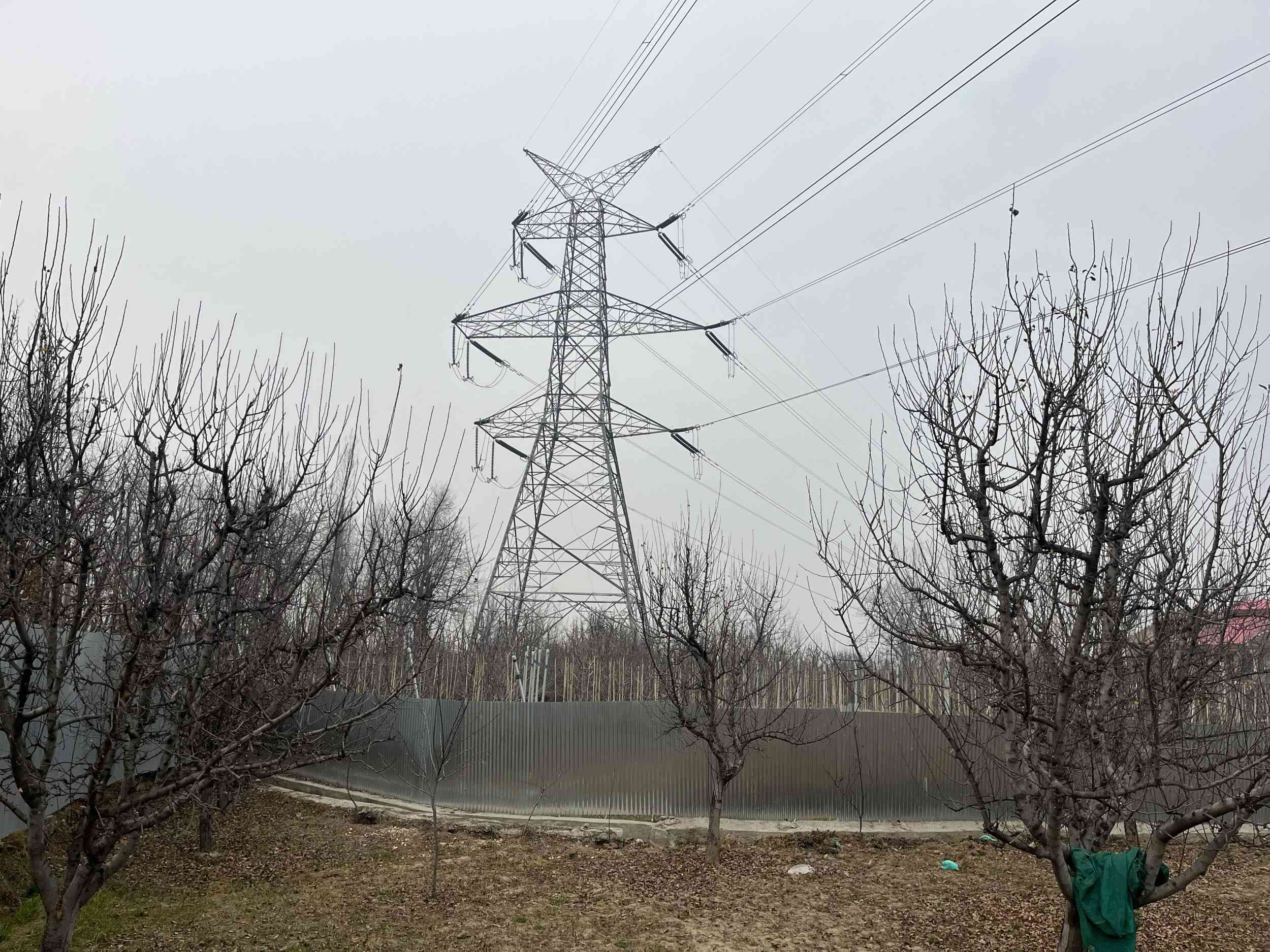
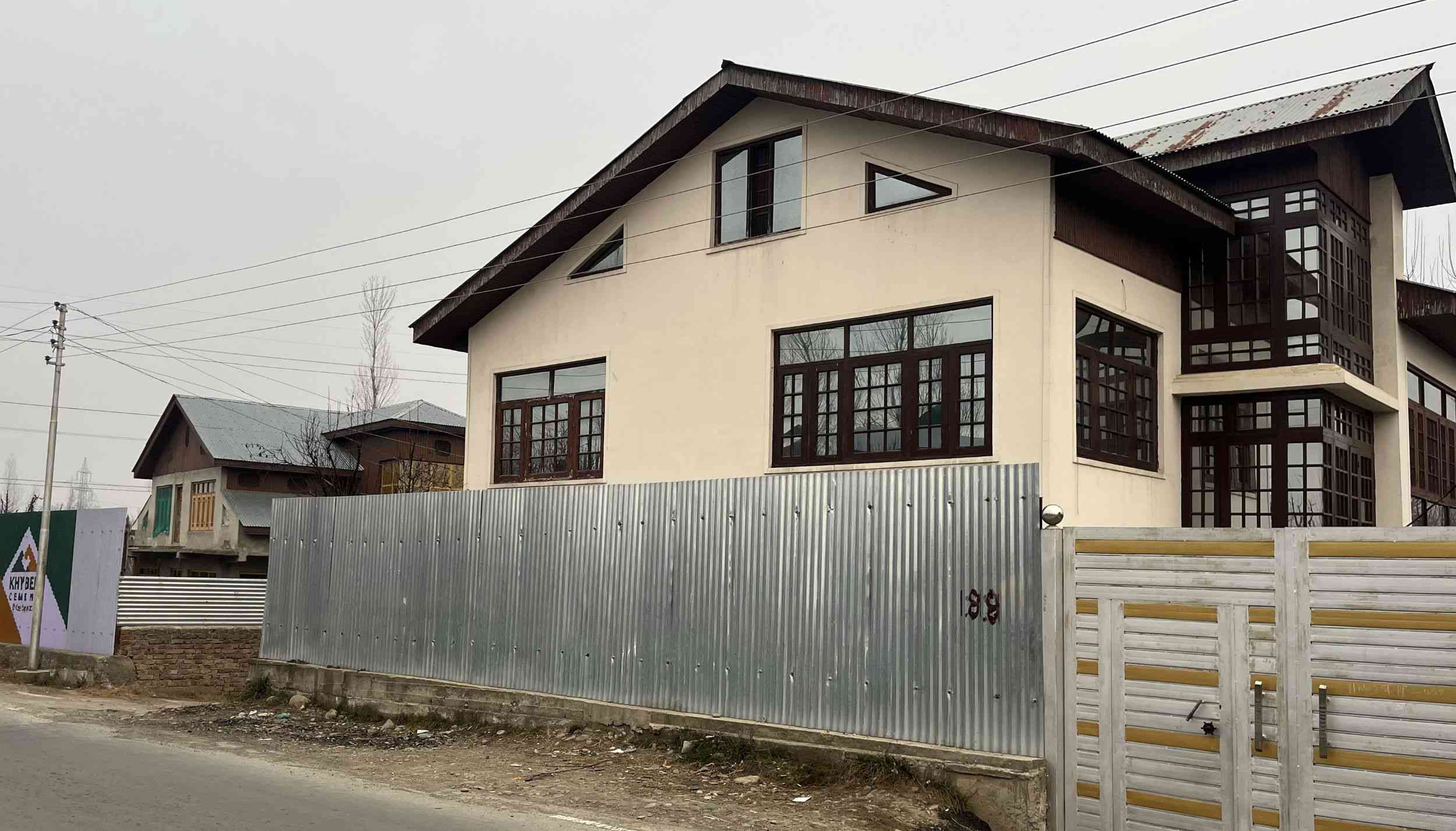
The prosperity apple farming has brought is written into the landscape. In most villages in South Kashmir, beautiful houses, most of them built in recent years, stand amidst rolling orchards.
In this region, homes and orchards stand in close proximity. They are sometimes separated only by a narrow street because apple farmers do not want orchard land eaten into by broader roads.
Ganie has not yet told his 78-year-old father how much of the family’s land will be lost to the rail project. “That would simply crush him,” he said. “Land is all he has known in his life.”
In Babhara, farmer Altaf Ahmad pointed to the stylish houses around the village surrounded by orchards, noting that these signs of prosperity would have been unimaginable 10 or 15 years ago.
“Thanks to our incomes from our orchards, every household is now prosperous enough to construct a house and afford whatever it takes to live a good life,” said Ahmad.
But with the rail project, “all this hard-earned success is at stake now”, he complained.
Ahmad hastened to add that the residents do not oppose the idea of development. Many years ago, he said, the people of South Kashmir gave land for the railway project that connected the region to the rest of the country.
But they could not see the reason for the Awantipura-Shopian line, he said. “We are already connected through a network of roads,” Ahmad said. “For god’s sake, a small distance of around 20 km doesn’t need a railway connection.”
Another villager said that the line “would achieve nothing except slicing our land and our future”.
Farmer groups in Pulwama and some Kashmiri political leaders have emphasised that such projects require a Social Impact Assessment and formal consultations with affected families. The farmers claimed that the surveyors installed the project's boundary markers without informing residents, “breaching procedures” meant to safeguard landowners’ rights.
Shahbaz Ahmad Bodha, Pulwama district’s Assistant Commissioner Revenue, said that his office has not yet received communication to carry out a complete estimation of land and trees involved.
“We will carry out the assessment as and when we get specific directions ... and the compensation will be provided to those whose land gets involved as per the Fair Compensation Act,” Bodha said. He added that protesting farmers had not approached their office directly.
Himanshu Shekhar Upadhyay, Chief Public Relations Officer of Northern Indian Railway, said that he had not heard about “any such protests” against the project.
“I will get the information regarding your questions and get back to you,” he said. “But, as of now, I will only say that Railways is for people. People are not for the railways...so whatever is in the interest of people, Railways will do that after taking the people in confidence.”
When contacted several times later for further information, he did not pick up the phone nor answer the email sent to him. This story will be updated if he responds.
Athar Parvaiz is a resident fellow at the Climate Change Media Hub, Asian College of Journalism.
