








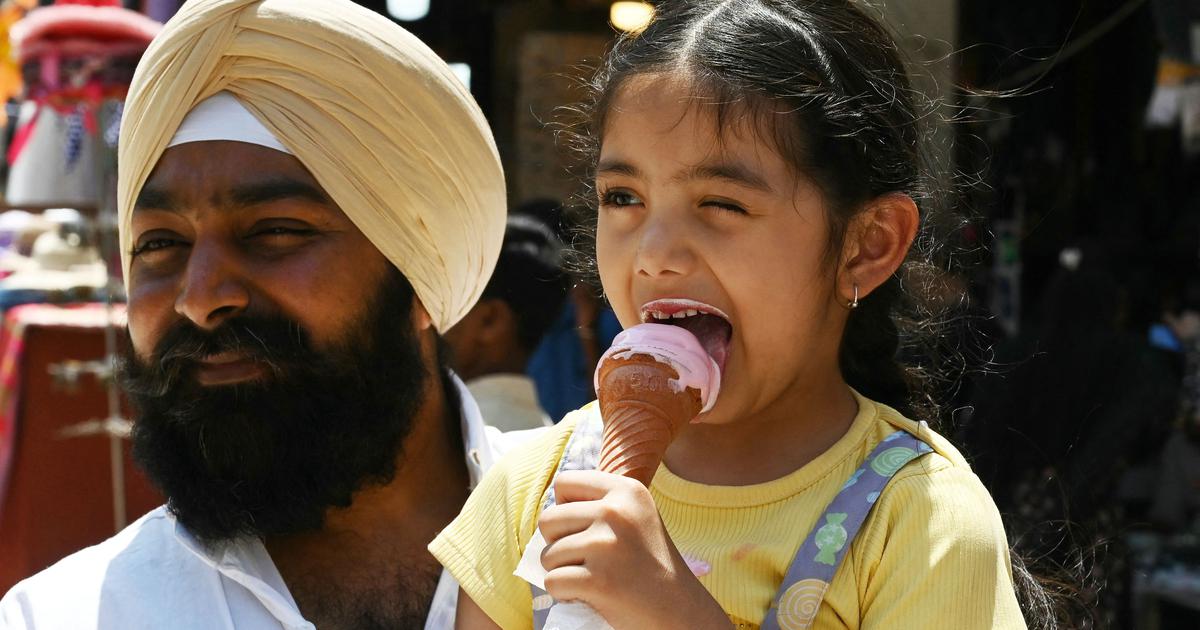
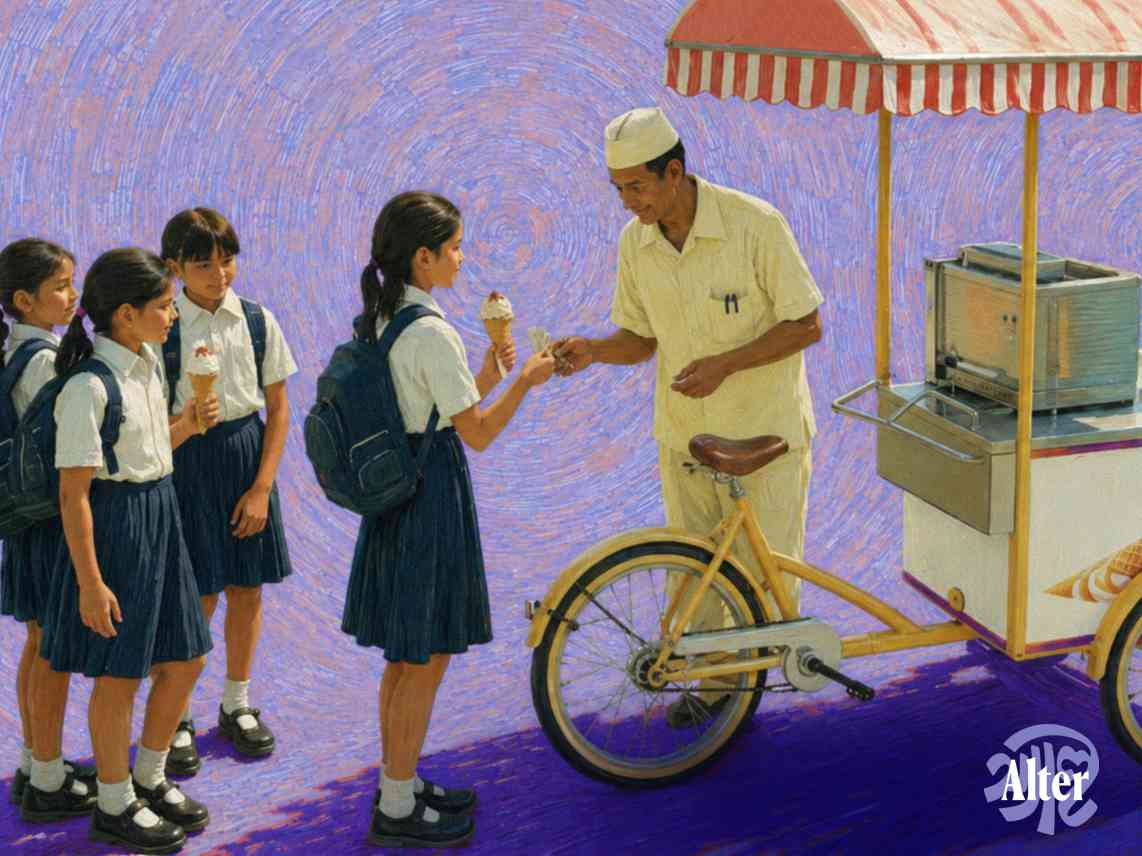
In middle school, I decided to spend my life’s net worth in saved-up coins. The plan pretty much carried itself out when a thallu vandi labelled “Arun” in bright red letters began showing up at my school gate. For many months, I bought ice cream from this cart after school almost every day, often enough to even have an open tab with the Arun anna.
It always went the same way. I hand him a combination of coins totaling Rs 10, a vanilla cup peels open and, by the third spoonful, the surface catches a sheen as the sun takes over. By the sixth, a rivulet escapes the rim, and then there is no going back.
There is something really inconvenient about how quickly ice cream melts in the Indian summer. Not because melting is surprising. Of course it melts. The disappointment is how little time it takes to give up. The product sold today feels like it was never designed for the place it lives in.
Indian summers are not gentle, and ice cream here moves through heat, only briefly interrupted by refrigeration. Consider the journey of an ice cream tub. It leaves the factory in a refrigerated truck to reach the distributor, from where it goes to a petti kada freezer or a street vendor’s cart, eventually to reach the customer’s home on a bike ride.
Each step offers an opportunity for heat to creep in. Repeated cycles degrade its quality even if the product remains frozen.
If we take India thermodynamically seriously, what could ice cream look like?
To answer that, we have to start with what ice cream actually is.
Ice cream as a material
As a lover of ice cream but a hater of its melted form, I would try freezing the melted portion of my bowl, hoping to reconstruct what it once was. It never worked and always resulted in either a hard block of ice or an even weirder soup. This is because, counter to its name, ice cream isn’t just frozen cream. It’s a multi-phase material held together just long enough. The texture depends on the size and arrangement of these phases.
The first thing holding ice cream together is ice itself, which shares the same lattice structure as regular ice called Ice I. When ice cream melts and refreezes, water molecules deposit onto existing crystals. You might have experienced this as a grainy tasting ice cream. Second, a concentrated sugar solution stays liquid even below zero, without which the ice cream would freeze into a solid block.
The third phase is the least obvious one: air. Churning folds air into the mixture and is called overrun, which gives ice cream its lightness. Sometimes, nearly half of what you're eating is nothing but air. The air improves mouthfeel and cuts cost per unit volume, but also increases surface area and structural fragility. Finally, fat from milk or cream partially crystallises, which forms a network around air bubbles that keeps them from collapsing and gives the ice cream body.
It is impressive that we figured out this physical structure long before we had microscopes to see ice crystals or crystallography to study their growth. Remove any one of these constraints, and you do not get ice cream.
How the world does it
Long before refrigeration, the logistics of cold were already a prestige problem. The Achaemenid Persians were making dessert chilled with snow around 400 BC. They stored ice year-round in cone-shaped desert structures engineered to beat the heat called yakhchals. The sharbat tradition grew from this and traveled the Silk Road eastward and southward for centuries.
By the 16th century, it had reached the Mughal court, where the court dispatched riders to carry ice back to the capital for fruit sorbets. The sharbat reached Europe – in part through Muslim Sicily, where sugar culture took root and early frozen drink traditions first arrived on the continent – and continued travelling west.
Different regions began making it their own as ice cream spread globally. It’s particularly interesting how heat influenced new forms of ice cream in equatorial countries.
Turkish dondurma is the eccentric aunt of ice creams. Made with salep (ground orchid tuber) and mastic (a tree resin) that gives it a chewy, elastic texture that lets vendors stretch it like taffy. It can be cut with a knife and fork, resists melting and is often hung on meat hooks to prove this point.
The classic Indian kulfi originated in 16th-century Delhi during the Mughal era, and it is made by simmering milk until it's thick and caramelised, and frozen without any churning at all. Without any overrun or foam, it has almost nothing in common (structurally) with a scoop of Häagen-Dazs and stays stable longer.
Some newer Indian brands are closely competing with the dondurma in the eccentric ice cream game. Hocco Ice Cream dropped a barfi-flavored ice cream with the snack industry mogul Haldiram’s and also a modak edition timed with Ganesh Chaturthi. These come with a denser composition, making them more stable.
India’s ice cream market generates roughly Rs 30,000 crore annually, with projections pointing to Rs 45,000 crore within three years, exceeding the entire GDP of countries like Fiji or Eswatini.
Cold-chain infrastructure
India's cold chain is built on small logistics operators with, until recently, almost no real-time visibility into temperature across the journey from factory to shelf. According to Varun Sheth of NOTO, distributors now run their own Internet of Things dashboards, and some brands place independent data loggers inside their shipments.
A number of specific design choices matter for the ice cream that ends up in your hand. For example, many retail freezers in India are front-opening. But Seth pointed out that a chest freezer with its lid lifted toward the face loses far less cold air than one with a door that swings open horizontally, because cold air sinks rather than spills out.
Similarly, in warehouse design, if ice cream goes directly from -20°C storage to ambient conditions, the temperature abuse has already begun, and a refrigerated truck cannot undo it. Roli Shrivatsava, Hocco’s VP, seemed to think of packaging as a part of the products. They created more robust blister packaging for cones and strengthened laminated seals for their cassata.
Postponing melting (or freezing, sometimes)
NOTO ice cream is built around high-protein, low-sugar formulations. Their earliest formulations had extremely low fat levels, making them more sensitive to temperature shocks. The fix was to increase protein levels and prebiotic fibers. Protein improves water binding and structural stability, partially compensating for reduced fat. Fibre adds body and mouthfeel that helps close the textural gap.
Combined with a carefully designed stabiliser system, the product gets close to traditional ice cream texture despite lower sugar and fat.
An elegant solution to ice cream's cold chain problem might be to stop making ice cream altogether. At least in the traditional sense. And instead, to postpone freezing until the very last possible moment.
Soft serve – or softies as they're colloquially known across India – are an entirely distinct product category from ice creams. Manufacturers heat-treat the mix rather than freeze it, which gives it a shelf life of up to nine months at ambient temperatures. The only point of transformation is the soft-serve machine at the outlet, which freezes the product at the moment of dispensing. The product doesn't exist as ice cream until the customer orders it.
Arnav Bajaj, the Director of Amrit Food, says these commercial machines could cost anything between Rs 1.5 lakh at the low end and more than Rs 12 lakh for higher-end units. The upfront cost helps explain why the format remains concentrated in quick service restaurants despite its logistical appeal.
“If you go to the Thikse Monastery in Ladakh, you'll actually find a soft serve machine there on the first floor,” Arnav explained, clearly pleased. “They can store the TetraPak at ambient temperature. Now whenever you want, if there's electricity switched on, turn on the machine, sell ice cream, get it done with.”
The economic drag from melty ice cream may be less dramatic than it sounds. One founder I spoke with estimated their heat-related inventory loss at 2% to 3% on the high side and shared that most of these partially thawed get sold anyway, rather than discarded.
The supply chain problem is going to improve over time, even as temperatures rise due to climate change, eventually paving the way for better cold chain logistics. What is not on a trajectory of getting better is the experience of eating an ice cream bar on a 42°C afternoon. That is a different kind of failure that happens in the hand. One that hardly holds it together long enough to eat.
What ice cream could be
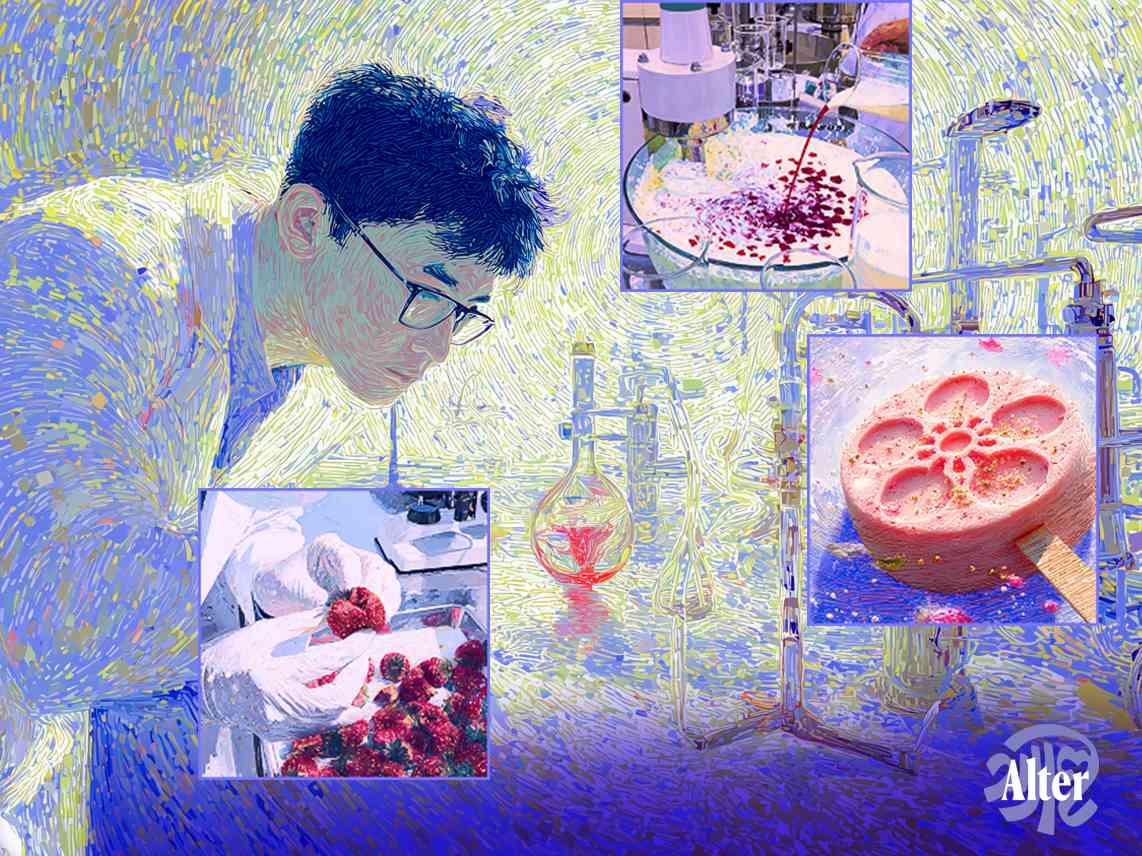
Heat-stable ice cream is not just a future possibility. Several versions already exist, ranging from reformulated mass-market ice cream engineered in different countries to small-batch premium products in labs.
Strawberries and polyphenols
An answer to non-melting ice cream already exists, and was commercially sold in Japan in six flavours. It arrived by accident when scientists at the Biotherapy Development Research Center in Kanazawa, Japan, had asked a local pastry chef to create a dessert using polyphenols extracted from earthquake-misshapen strawberries that couldn't be sold as fresh fruit. They realised that strawberry polyphenols work as an emulsifier, preventing the oil and water phases of ice cream from separating, helping the frozen product to retain its shape.
According to the maker, the ice cream held its form for about three hours at 40°C, while milder commercial batches tested by journalists confirmed it resists melting though it still softens over time.
Bacterial raincoats
A decade ago, a separate line of research from the Universities of Edinburgh and Dundee identified another natural protein with heat-resistant potential. The protein, BslA, is produced by Bacillus subtilis and works by adhering to fat droplets and air bubbles, making them more stable in the mixture.
The researchers likened BslA to a “bacterial raincoat”. The protein already has a foothold in the food chain. Bacillus subtilis is used to make fermented staples like natto and meju, giving it a head start on food safety regulations.
Antifreeze proteins
This class of intervention involves antifreeze proteins which are produced by organisms that have evolved to survive sub-zero environments. Think cold water fish, winter wheat, certain insects, and bacteria. They adsorb directly onto the surfaces of growing ice crystals, halting further growth – while also preventing recrystallisation – even at low concentrations.
Unilever commercialised this by expressing a type III ISP gene from ocean pout in genetically modified baker's yeast, and the purified protein has been used in low-fat ice cream lines.
Unilever has the most commercially serious work happening right now. In November 2023, it granted a free, non-exclusive licence to 12 of its reformulation patents. I found no Indian startup or manufacturer that has publicly committed to heat-stable reformulation as a product strategy. The first Indian company to do it stands to define the category.
The category is already moving upmarket. The government’s India Brand Equity Foundation describes an Indian ice cream market that now runs from affordable impulse buys to premium artisanal tubs. Hindustan Unilever’s own presentation shows how clearly the category has already split into mass, popular, premium, and super-premium price bands. An ice cream that holds its shape for a few extra minutes but costs a bit more can easily be classified as a premium product.
The sixth spoonful of my Rs 10 cup after school did not have to end in surrender. Eating an ice cream doesn’t have to mean risking a sticky mess for millions in India every day. The answer to India's melt problem has clues in a monastery, a Turkish street corner, a Japanese lab and a Mughal kitchen. Unilever gave 12 reformulation patents away for free.
Someone just needs to make it a reality at every thallu vandi now.
Chandhana Sathishkumar is a Robinson Fellow at the University of North Carolina, Chapel Hill, studying chemistry. Her X handle is @chandhana.
A longer version of this piece is published in Alter Magazine, a monthly journal that features new literary writing on science, technology and progress from South Asia.
