





A Hindu marriage is considered a sacrament. Ironically, however, an arranged Hindu marriage is often preceded by most business-like negotiations, the marriage being regarded as finalised only when the two parties, the bride’s family and the groom’s, reach a satisfactory agreement. In all matters the groom’s family has the upper hand; the bride’s family has but to concur with their wishes. This is how it was and, in many cases, still how it is.
By the standards of arranged marriages of the time, my parents’ wedding, which took place nearly 90 years back, has to be looked at as an oddity. In spite of having heard the story of their marriage and of having read about it in the book my mother wrote on her life with her husband, for me, the mystery still remains: why did her family, a very well-to-do family, get her married to a man who had nothing but the salary he earned as a lecturer in a government college? Equally damning should have been the fact that he didn’t seem to have a family; he came for the wedding with just a few friends. That he had cut himself off from his family because he could not live as they did, a life strictly contained within the rigid rules of caste, would not explain or condone his behaviour; in fact, it would be considered a greater fault. Even more strange was the fact that the groom did not ask for a dowry – this, when he could have made extravagant demands because the bride’s family was a fairly wealthy one. Landowners, my grandfather and his three brothers were also successful professionals.
This is not all. Even more curious is the question of language. My mother from Pune, knowing only Marathi, and my father, a Kannada man who knew a smattering of Marathi because he had studied in a Pune college, though he was never comfortable with it – how did her family imagine they would communicate? In effect, why did the bride’s family decide to marry her off to a man who was no match for their daughter? Was it because of his England-returned tag? After all, it did mean something in those days. As for the couple, they were clear: the man chose the girl because she was educated. She was a graduate in the days when few girls went to college, perhaps even to school. And the bride was happy with her family’s choice because she was fascinated by the fact that he was a writer. Besides, as she often confessed later, she was also attracted by his unusualness.
How unusual he was she came to know the moment she entered her new home. It was bare, without a stick of furniture! My father’s landlord had given him a table and a chair in the hope that the man would marry his sister. When, instead, he returned from Pune with a bride, the landlord, in a fit of pique, promptly took away the table and chair. My father was writing his first novel then. It was a daily deadline project, with the publisher, a novice like his author and in a hurry to establish himself as a publisher, coming every evening to take away the pages written that day. My father, therefore, could not stop writing. So, he continued to write, sitting on the floor, and using a steel trunk as a table. I imagine the publisher did get his daily quota of material.
News of his daughter’s furniture-less situation must have reached my grandfather, Babasaheb Chandrachud. And there soon came to my parents some pieces of furniture from the prestigious Army and Navy Stores in Bombay. A prosperous lawyer, my grandfather unstintingly bought the best. A very generous-sized bed of mahogany, with bedposts that went up in elegant swirls to a shining mahogany grape-shaped top. A writing table, covered with green baize, almost half the size of a billiards table perhaps, with two chairs that fitted snugly into the kneehole. There was also a dressing table with a beautiful oval mirror and drawers that moved in and out silently and smoothly.
The landlord, if he had seen this stuff, especially the writing table, would have gnashed his teeth in rage. However, by then my father had risen in the hierarchy of teachers in the college and was given a large sprawling bungalow as his residence. Built for British officials, it had a formal garden, surrounded by a wilderness of bushes and rooms for servants to live in. The furniture fitted into the large rooms of the bungalow as if custom-made for the house. We grew up here, in this bungalow, among this furniture. India had at the time just crossed the cruel hump of partition and become independent. The country walked carefully between the trauma of partition and the euphoria of independence. Everything was in a fluid state. The long shadow of a receding British rule still lingered. After all, the influence of a century (two, if one included the East India Company period) of domination could not vanish overnight. The bungalow we lived in, our much-admired furniture, even my father’s clothes … all these carried traces of British influence. Yet my father, who had come back from England admiring the British for their liberalism and appreciating the sturdy independence of the working class, was also a great admirer of Gandhi-ji. I remember the day of Gandhi-ji’s funeral, the large hall in our house packed with shocked students listening in pin-drop silence to Melville de Mellow on the radio, who broke down even as he was describing the scene of the funeral. And I vividly remember my father in his easy chair, a towel thrown over his face to hide his tears.
Our lives too changed after this. My father resigned from his job, on a “matter of principle”, we were told. We had to move out of our beautiful bungalow and live in a doll-house-sized house. None of our grandfather’s gifts could fit into that house; they were sent away, we don’t know where. In two or three years, my father built a house for us (even while he was jobless), a house with rooms large enough to contain my grandfather’s gifts, which came back to us. But this was not to last either. My father got a job in Delhi and my parents rented out the house with all it contained to a friend and moved with my brother to Delhi, while my sister and I were to stay in hostels in Bombay. I imagine that the excitement of living in Bombay, as well as the devouring homesickness we suffered – at least I did – made it possible for us to not look back or regret leaving our home behind. After this, for my parents, it was a peripatetic life of rented houses and rented furniture. I joined them in Bangalore for a few years. Our old life was forgotten.
After marriage, with children and the beginning of my writing career, I was caught up in the busyness of my life and had no time to think of the early days. Of old possessions. Until a childhood friend came to visit me. During our conversation, she told me that her family had bought our hatstand when my father sold the house. At first, I was confused. Hatstand? Did we have a hatstand? Immediately, a picture of it flashed before my eyes. Yes, of course, it had been right there, opposite the front door. One of those period pieces with hooks to hang headgear on and a stand for umbrellas. And then it hit me – if my father had sold the hatstand, he must have sold my grandfather’s gifts as well. I had not thought of them for a long time, or had perhaps imagined them to be somewhere, waiting for us to reclaim them. But no, they were gone. They were no longer ours. A sharp pang of regret pierced me at the idea of the loss. Had my father sold them casually? Or had he suffered a moment’s grief at the loss of what had symbolised his early life, his hopes for his career and the beginning of his family life? But what could he have done with the bed and the table, anyway? There was no room for them in the house my parents ultimately bought and in which they finally settled down. Both of them lived there till the end.
Selling a home your parents had lived in for years, disposing of all that had made up their life for decades, is a melancholy task. And a difficult one. My sister and I put our feelings aside and went through the exercise mechanically. Except for some books I took and my father’s manuscripts and awards, neither of us wanted anything. What, then, were we to do with the rest of the stuff? There was such a lot of it. So I thought then. But about 25 years later, when I had to do this again, selling our house and moving for safety and convenience to an apartment, I was aghast at the amount of stuff my husband and I had accumulated. Things I never knew we owned tumbled out of cupboards and fell from attics. When had I bought all these things and what had I wanted them for? My parents’ collection had been infinitely more modest. I thought then of a character called a Clutter Counselor in Anne Tyler’s wonderful novel, Saint Maybe. This is someone who helps you to get rid of things periodically. A job most people find hard, since they are hindered both by inertia and a reluctance to part with anything. “Do you think you will need these in the next month or so? Or in a week? No? Then out it goes.” That’s how the Clutter Counselor worked. Ruthlessness – that’s what’s needed with objects. A ruthlessness I never had. Which few people have.
My parents would certainly never have needed a Clutter Counselor. They bought only what they needed, there was no accumulated clutter. “Simple living and high thinking” – one of the aphorisms my mother often quoted. It was a habit of hers, making it seem that she believed in and acted according to the maxim she was quoting. Simple living, however, was certainly a part of their lives. It was an austere life they lived. Their needs were minimal. Even clothes, on which we splurge, buying them for more reasons than need, occupied just two shelves in their steel almirah. My mother had given away all her silk saris; only a few cotton saris were left. And my father, who had given up his “western” clothes many years back, had only a few dhotis, kurtas and one Nehru jacket for occasions. He had lost all his “English” clothes when a burglar, unable perhaps to find anything valuable in the house, had taken away the trunkful of clothes that looked expensive. I don’t think my father regretted the loss of those clothes. After the trauma of his jobless days, he was perhaps relieved to be free of that dapper young England-returned man, who had been so popular with his students and had made his girl students’ hearts flutter. (One of his students told me this, the old woman laughing at the memory of her younger romantic self.) In a way, my father remade himself after years of humiliation; he even changed his name. And I thought, if he could give up so many things, especially his name, so much a part of oneself, he was obviously even less attached to objects. Perhaps selling my grandfather’s gifts had been no sacrifice.
Yet the truth is that the objects we own are not mere objects. They are imbued with our experiences, our emotions, our memories. Memory brings back to me an old brown sweater that my father wore in his old age. He had lost much weight in his last years and the sweater hung on his emaciated frame. “The shrinkage of old age”, as Virginia Woolf called it. But she was speaking of the mind, not of the body. And my father’s mind had certainly not shrunk. During a TV interview, responding to a statement of the interviewer, he said, “I am an intelligent, thinking man.” The words were said positively, yet not boastfully. This is me, he was saying. He looked strong and confident as he said the words, no longer a frail old man in a sweater too large for him.
All religions preach against the accumulation of wealth and possessions. The Buddha speaks of desire as the source of grief. The Upanishads say the same thing through stories and conversations. Maitreyi refuses the wealth offered by her philosopher husband Yajnavalkya, and Nachiketas, only a boy but a wise one, rejects Yama’s offer of all that he, Nachiketas, desired. Both Maitreyi and Nachiketas opt for knowledge. And there are Jesus Christ’s dramatic words that a rich man can no more go to heaven than a camel can go through a needle’s eye. All of it is futile advice. We are human. And therefore slaves to our desires. The ruthlessness the Clutter Counselor advocates is way beyond us. How can you despise objects when the spirit of the age is to acquire? When we are constantly assailed by voices telling us to buy, when we have beautiful people and happy families telling us that they are happy and beautiful because they use this, that or another product? When desires, not really our own, are instilled into us by those who want to sell us their merchandise?
Nevertheless, to be fair to ourselves, it is also true that we are often attached to objects beyond their utility, beyond their monetary value. Objects evoke memories; they are associated with a place or a time. The pang of regret that shot through me when I heard that my father had sold my grandfather’s gifts was not because of the objects themselves, or their possible English provenance. Yes, my grandfather’s gifts were elegant; they were unique. But that was not why I regretted that they had been sold. Nor was the regret sentimental, because they came from my grandfather. I had scarcely known him; I had been perhaps four when he died. No, my feelings for the objects were mainly because they were associated with the magical days of my childhood. A time when there were siblings to share and quarrel with, friends to play with, a sprawling house and a compound so large, with so many nooks and corners to hide in, that a game of hide-and-seek could go on for hours. There were caring parents in the background, and a father who was a rock on which we could build our future lives. My grandfather’s gifts encompassed all these things.
Only the dressing table survived all the changes and moves of my parents’ lives. And it is this dressing table, the least treasured of my grandfather’s gifts, which carries within it a story that I, as a storyteller, find fascinating. I learnt when I began writing that the past often creeps into the present, that it is difficult to disentangle the two. To think of the dressing table is to remember the kumkum box that my mother brought from her natal home to her marital one. Called a kumkum peti, this box was an object that most married women, of a certain class, of course, owned. A wooden box, with a hinged top, the front half of which could be propped up to give women a mirror. A very small mirror, in which a woman could see only portions of her face. In any case, a woman required the mirror only for applying the round dot of kumkum in the middle of her forehead, this being the most important thing in her life; it denoted that her husband was alive. In the peti, there was room for a kumkum container (a dry powder then), and one for wax, which provided the foundation for the kumkum, and there was space for a comb and some U-shaped hairpins, to keep the hair knot in order. It was not possible for a woman to have casual, fleeting glimpses of herself in this mirror. Once she had applied her kumkum after her bath, made a straight middle parting in her hair and tied it up, the box had to be put away. No room there for vanity, not even for the most innocent vanity which gives a woman pleasure in seeing her own reflection.
The kumkum box my mother brought to her marital home had been her mother’s. My grandmother died of TB. It seems strange to call her a grandmother; she must have died when she was about 20. My mother once told us that she was not allowed in the room in which her mother was dying, obviously because of the terrible propensity of the disease to infect others. I can imagine the anguish of the woman who could not see her daughter before dying, who knew she was leaving her little daughter motherless. And then, years later, when that daughter got married, her father – my grandfather – sent her a dressing table. Surely it was for her alone? Why would anyone send a male a dressing table? Was he making a statement? Today, when I think of the dressing table, I think with pleasure of a man who sent his daughter the gift of a large mirror, so different from the cramped mirror of the kumkum box. I also think of the cosmetics available today, of the beauty parlours scattered all over cities and towns, to which even schoolgirls and working girls with just a little money go to have their eyebrows tweezed and shaped, to have a manicure and pedicure. I think of the silence in these places, in which the only sounds are the hum and buzz of machines in which young men and women work on women’s hair, their faces, hands, feet and much else. All of them, staff and clients, worshipping the goddess of female beauty.
I often saw my mother looking at herself in the mirror, not admiringly but questioningly. Was she remembering her mother then, a woman whose life ended before it really began? Or her father who later became a champion of women’s education, thinking perhaps of his young dead wife? Or was she asking some questions of herself? I don’t know. All I know is that my sister and I saw ourselves in the mirror as girls, free birds, and then as young women, later as wives and mothers, struggling to do justice to both the home and career. We managed, though it was hard.
My mother’s dressing table is now in my son’s house and my daughter-in-law, a courageous and independent woman, is the one the mirror reflects. The mirror has reflected three generations of women; it has been a mute witness to their lives. And I, the storyteller, think at times that I can see in the mirror shadowy glimpses of the two men who stood by their women – my grandfather and my father. This, I think with pleasure, is a story with a happy ending.
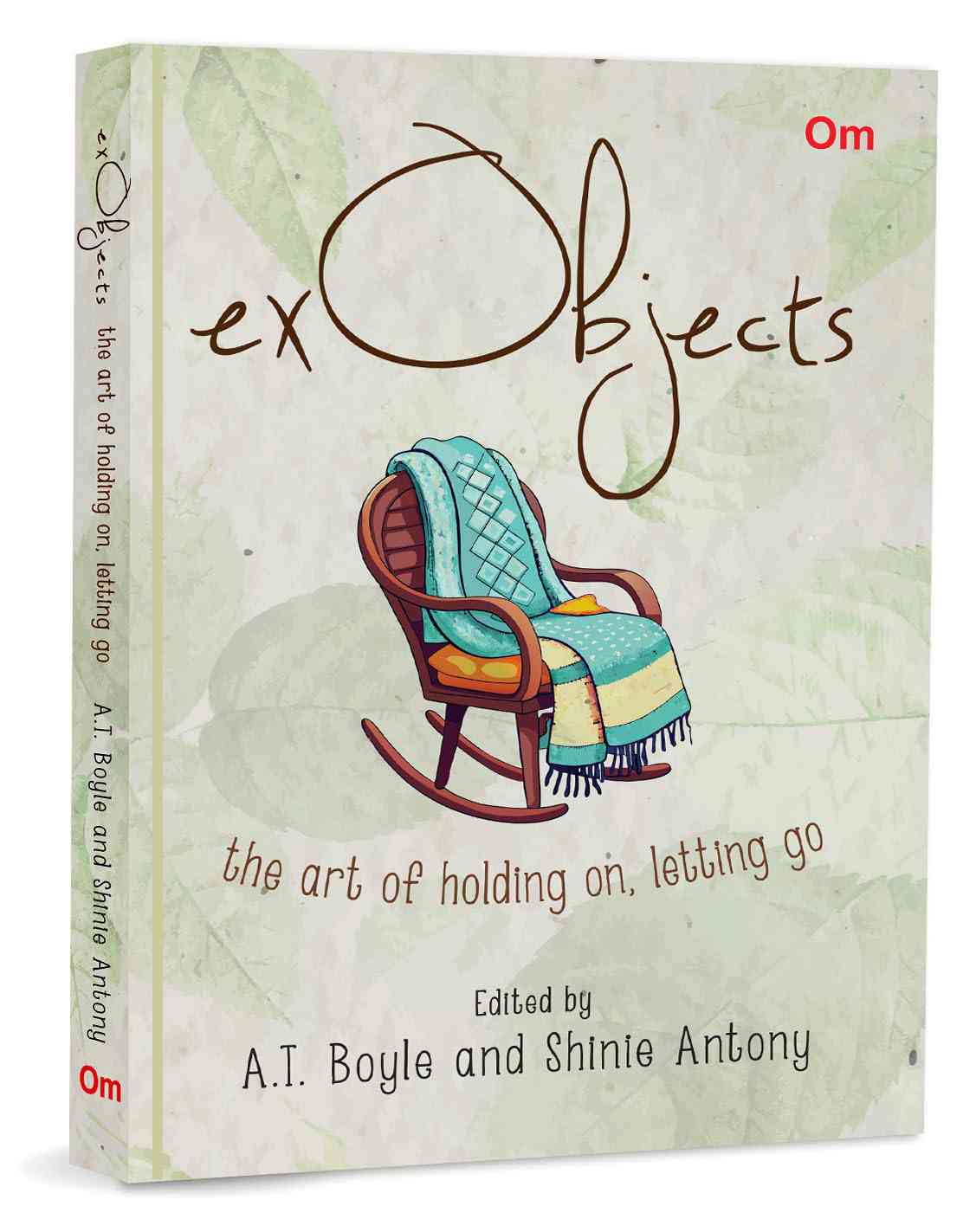
Excerpted with permission from ‘Reflections’ by Shashi Deshpande in ExObjects: The Art of Holding On, Letting Go, edited by AT Boyle and Shinie Antony, Om Books International.
