










There’s a particular species of AI book that has proliferated since November 2022. You know the type: breathless proclamations about disruption, thin on specifics, heavy on buzzwords. Nadim Sadek’s Quiver, Don’t Quake is emphatically not that book.
What distinguishes Sadek’s contribution is that he offers a genuinely useful framework for understanding how the partnership might actually work. I am someone who spends my days building precisely the kind of human-AI collaborative workflows Sadek describes, and can tell you he really has touched that pain point, and taken the abstract and made it actionable and specific.
How to approach technology
The book's central thesis rests on a well-established psychological model: Kahneman’s System 1 (fast, intuitive, feeling-based) and System 2 (slow, analytical, deliberate). Sadek argues that human creativity excels at System 1 work – the spark, the intuition, the lived experience that generates ideas worth pursuing – while AI provides formidable System 2 capabilities: pattern recognition, iteration, structural analysis.
This has profound practical implications for how creative professionals should approach the technology. Rather than fearing replacement or dismissing AI as a sophisticated parlour trick, Sadek suggests we think of it as an “Allied Intelligence” – a creative collaborator that helps us understand and articulate what we're actually trying to make.
I confess a particular appreciation for his concept of “Panthropism” – the recognition that engaging with AI means entering into dialogue with the distilled essence of human knowledge and expression. It's neither anthropomorphism (pretending the machine is human) nor reductive dismissal. It’s something more interesting: acknowledging that when we converse with an LLM, we're accessing a kind of compressed cultural inheritance. The implications for creative work are substantial, though perhaps not in the ways the doomsayers predict.
What earns Quiver, Don’t Quake my genuine respect is Sadek’s willingness to engage seriously with the sceptics. His chapter on “Constructive Contradiction” provides a rigorous and fair-minded tour through the most potent critiques – Emily Bender’s “stochastic parrot” argument, Nick Cave’s eloquent rejection, Timnit Gebru’s concerns about data colonialism, and Gary Marcus’s technical objections. He doesn’t strawman these positions or wave them away with tech-optimist platitudes. He grapples with them, and his arguments are stronger for it.
Sadek is particularly good on the homogenisation risk – the legitimate worry that if everyone uses the same models trained on the same data, we’ll converge on a bland creative mean. His counter-argument is subtle: the responsibility for maintaining diversity, for injecting genuine voice and perspective, for breaking rather than following patterns, remains with the human collaborator. AI can learn conventions. Only humans can meaningfully rebel against them.
Practising what it preaches
The book practices what it preaches: Sadek wrote it in collaboration with nine different AI models, each contributing different strengths to what he calls “the writers’ room.” He’s refreshingly candid about the frustrations – the hallucinations, the maddening limitations, the moment he yelped that “this AI is being such a dick!” This honesty is disarming and instructive. Anyone who has worked extensively with these tools will recognise the experience.
Perhaps most valuably, Quiver, Don’t Quake provides language for something many have intuited but struggled to articulate: that the fear-versus-embrace binary misses the point entirely. The question isn’t whether AI will transform creative work (it already is), or whether it poses risks (it does), but how we choose to integrate it while preserving what makes human creativity irreplaceable.
Publishing, as I’ve observed elsewhere, has a habit of reacting to technological shifts rather than anticipating them. We saw it with digital, with audio, with self-publishing, and we’re seeing it again with AI. Those of us who’ve been working at this intersection for years recognise the symptoms: the oscillation between denial and panic, the slow awakening, the eventual (often reluctant) adaptation.
Sadek’s book arrives at an opportune moment. It offers neither the false comfort of dismissal nor the paralysis of catastrophism. It offers, instead, a framework for thoughtful engagement –for quivering with appropriate excitement rather than quaking with unfounded terror.
For publishing professionals genuinely curious about what productive collaboration with AI might look like, Quiver, Don’t Quake is a serious and useful contribution. It won’t tell you which tools to use or which workflows to adopt, but it will help you think more clearly about the partnership you’re entering.
And that, as any experienced editor knows, is where the real work begins.
Meru Gokhale is a former publisher of the Penguin Press Group in India. She is the CEO of Editrix.
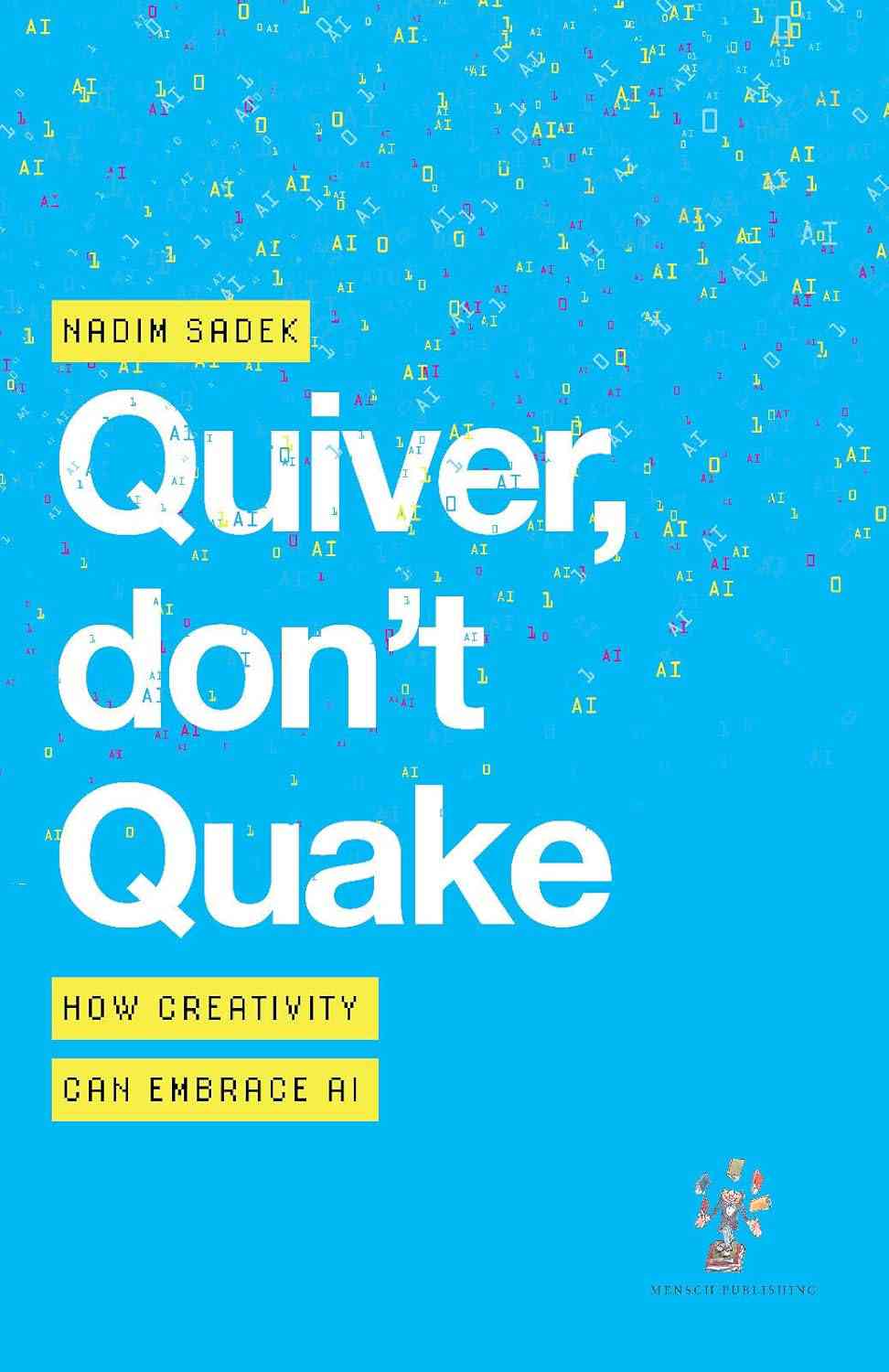
Quiver, Don’t Quake: How Creativity Can Embrace AI, Nadim Sadek, Mensch Publishing.
