





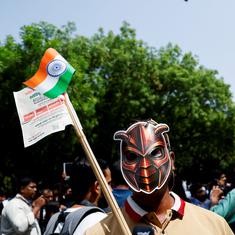
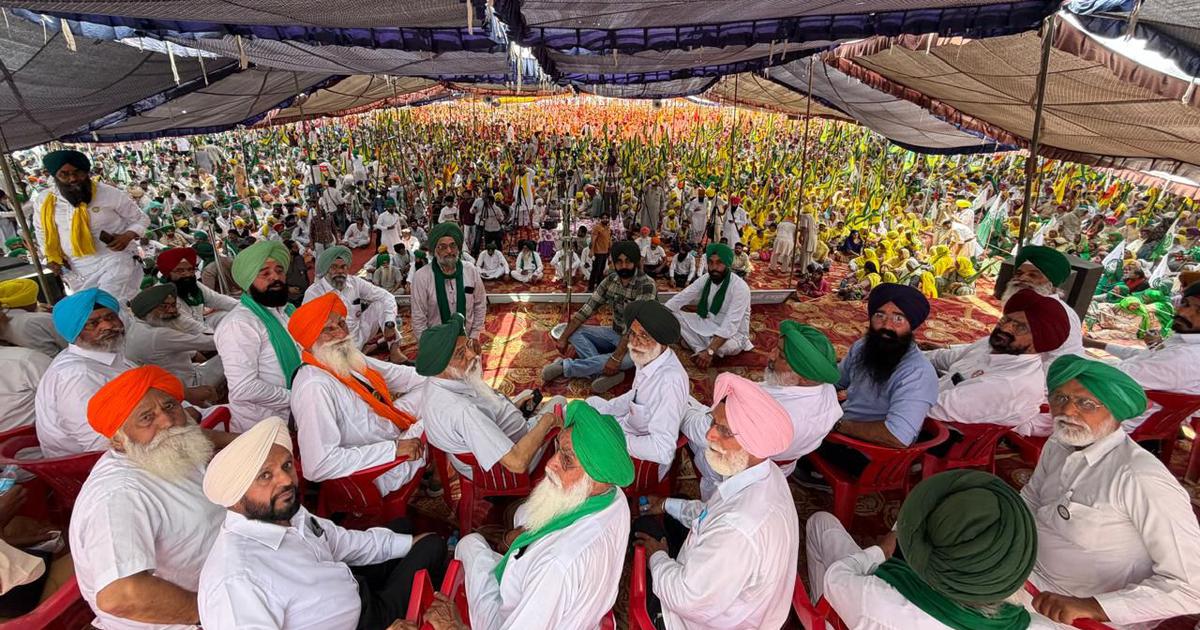
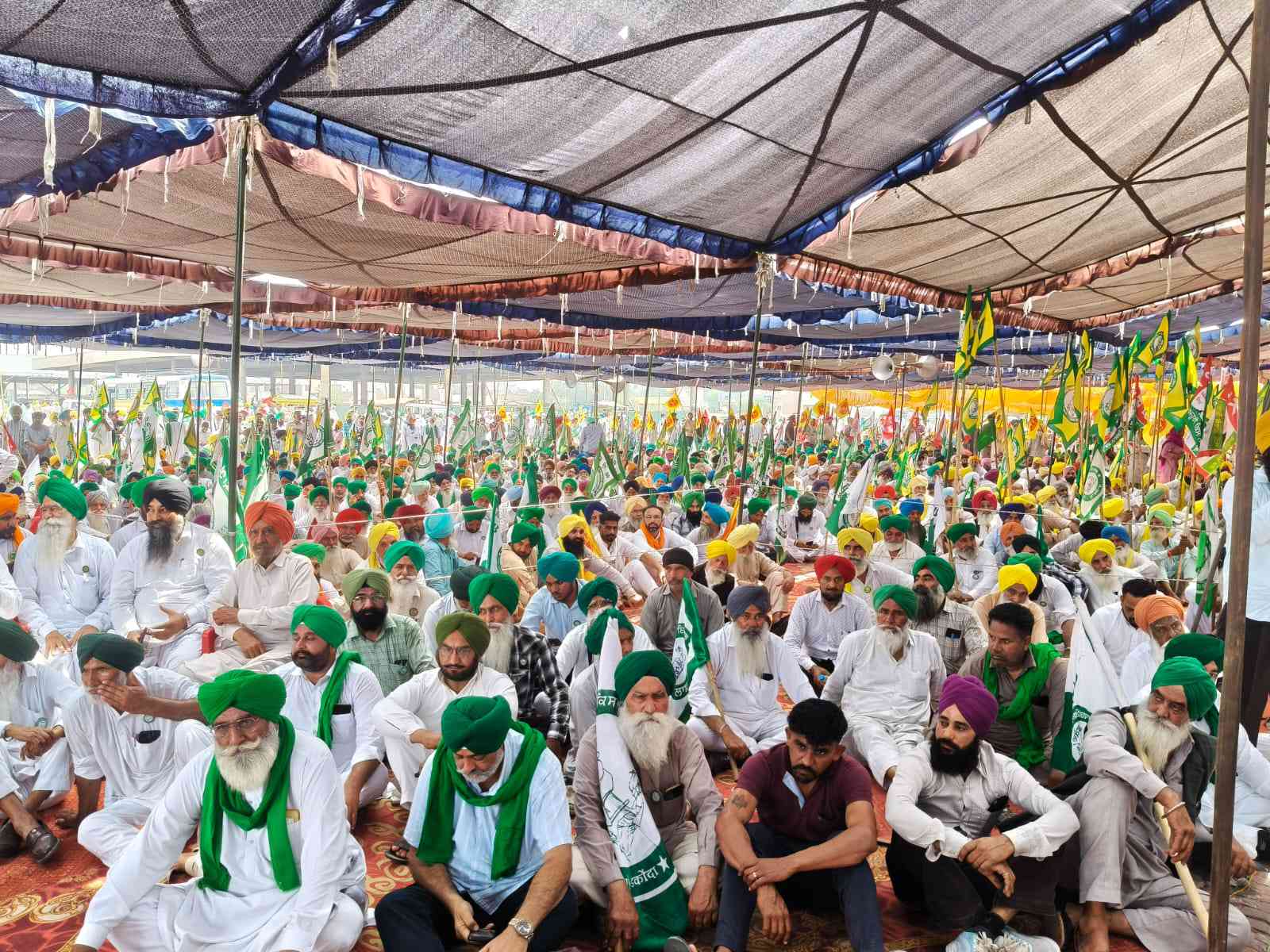
On Tuesday, thousands of farmers from across Punjab gathered in Barnala district to oppose the recent trade deal between India and the United States. They also stood in solidarity with Iran, and took a stand against the Israel-US military aggression.
“Both the US-Israel war on Iran and the trade deal are anti-farmer,” Jagmohan Singh, general secretary of Bharatiya Kisan Union Dakaunda, who attended the protest, told Scroll.
The farmer union is a part of the Samyukt Kisan Morcha, a coalition of different farmers’ organisations that had called for a protest on March 7 against the “war unleashed on Iran by US and Israel … and also against the Indo-US interim agreement framework on free trade.”
The collective, in its statement, also criticised “Prime Minister Modi’s Israel visit just two days before the attack on Iran, ignoring the massacre of 75,000 Palestinians, and its failure to immediately unequivocally condemn the killing of the head of Iran’s leadership”.
Calling the United States the “biggest enemy of world peace”, the Samyukt Kisan Morcha said the “war in the Gulf shall bring new miseries to the world economy and to the people of India.”
The rally passed a resolution against the attack on Iran by US and Israel “and demanded that the central government make proper arrangements for the safe return of Indians stranded in the Middle East and also take a firm stand against the aggressive policy of the US-Israel.”
It is not only farmers. Even the political leadership in Punjab has been among the first to condemn the US-Israel aggression against Iran and the assassination of Iranian Supreme leader Ayatollah Ali Khamenei.
Observers and religious leaders told Scroll that behind this stand was Punjab’s instinct to side with the oppressed, a lesson ingrained in the Sikh religion. “It is an inherent part of the Punjabi psyche that one has to stand with the oppressed irrespective of their affiliation or identity,” said Jasbir Singh, associate professor in the department of history at Punjab University.
Farmers at risk
In February, the United States and India announced an interim agreement on trade, under which New Delhi will eliminate or reduce tariffs on all American industrial goods, including a wide range of food and agricultural products. The agreement also mandated that India purchase $500 billion of US products over the next five years. The deal was agreed on after the Trump administration slashed US tariffs on Indian goods to 18% from 50%, provided India stopped purchasing oil from Russia.
For several farmer groups in Punjab, that crossed a red line.
“Modi had promised that agricultural products won’t be imported but when the details of the interim free trade agreement was made public, it contained agricultural items,” said Jagmohan Singh from the Bharatiya Kisan Union Dakaunda.
Singh argued that by pushing West Asia into a war, both Israel and the US harm the livelihoods of Indian farmers. “A farmer needs petrol as well diesel to run his equipment,” he said. “If the war fuels a shortage and drives up prices, it’s going to badly impact us,” he explained.
The war against Iran also makes the export front fragile, putting Punjab’s paddy farmers at risk. “Forty per cent of Basmati rice is exported by India to the world. The export supplies have been affected because of the uncertainty of shipping routes,” he added.
Raminder Singh, from the Kirit Kisan Union, who attended the Barnala protest said the farmers “demanded that India should condemn the US-Israel attack on Iran”.
He alleged that India has agreed to the trade deal “under pressure from the US” and that it was in farmers’ interests to stand up to Trump. “We called upon the Modi government to intervene and stop this war – and not sign the trade deal.”
Assembly pays tributes
On March 6, the first day of Punjab assembly’s Budget session, Aam Aadmi Party legislator Sukhwinder Kumar Sukhi stood up to talk about the “humanitarian tragedy” unfolding in Iran following the joint attack launched by US and Israel on February 28.
Raising the matter during the obituary references in the house, Sukhi described the targeting of a school in Iran as an “inhuman incident” in which at least 165 school girls were killed. During the initial round of attacks on Iran on February 28, a missile strike by US-Israel targeted a girls’ primary school in Minab area of Iran’s Hormozgan province. Most of the victims were mainly girls aged between 7 and 12.
Sukhi said he condemned the Trump administration for the attack on the school, and the assassination of Iranian Supreme leader Ayatollah Ali Khamenei. He also requested the Assembly Speaker to pay tributes to those killed in the attacks if possible.
The Speaker, Kultar Singh Sandhwan, agreed to Sukhi’s request and urged everyone in the house to stand up and observe a two-minute silence for the departed.
With that, Punjab became the first state in the country that condemned US-Israel’s attack on Iran on the floor of the house.
This is in sharp contrast to how New Delhi has responded to the events unfolding in Iran since February 28. While Prime Minister Narendra Modi rang up different Gulf countries affected by the war, he did not condemn the assassination of Iran’s supreme leader – not even when Shia Muslims from across the country took to streets in protest against his killing.
Despite India and Iran having maintained friendly and cordial relations with each other for decades, Modi’s silence was construed by many as India’s foreign policy tilt towards the United States and Israel.
India’s official response to Khamenei’s assassination came on the sixth day of war, when foreign secretary Vikram Misri met the Iranian ambassador in Delhi. Misri conveyed condolences to the West Asian country by signing the condolence book at the embassy on behalf of the government of India.
Sikh delegation visits
The sentiment against the US appears to be a bipartisan one. On March 9, a delegation of Punjab’s grand old political party Shiromani Akali Dal, paid a visit to the Iranian Embassy in Delhi. Led by the party’s Delhi unit president, Paramjit Singh Sarna, the Sikh delegation conveyed its condolences to the people of Iran on the assassination of its Supreme leader.
VIDEO | Delhi: A Sikh delegation headed by Paramjit Singh Sarna of the Shiromani Akali Dal offers condolences at the Embassy of Iran following the death of Ali Khamenei. pic.twitter.com/U9yEQQknsl
— Press Trust of India (@PTI_News) March 9, 2026
According to Sarna, the delegation emphasised the historical ties, trade and cultural exchanges between India and Iran. “The relations between India and Iran are more than 1,000 years old,” Sarna, who also happens to be a former president of the Delhi Sikh Gurdwara Management Committee, told Scroll. “We discussed how the works of great Iranian philosopher Sheikh Saadi carry the wisdom of Guru Nanak Ji’s teachings or that of Baba Farid.”
Baba Farid was a Punjabi Muslim Sufi saint, whose poetry is included in the Guru Granth Sahib, the holy book of Sikhism.
While offering an ardas or prayer for the departed Iranian Supreme leader, Sarna said he also requested the Iranian ambassador to restrain from attacking its neighboring countries. “We told him that we want this war to end as it threatens our country as well,” said Sarna. “We prayed for their [Iran’s] victory.”
‘On the side of the less powerful’
Observers in Punjab say the fact that the stand taken by political leadership as well as farmer groups is not surprising.
“People of Punjab believe that we have to be on the side of people who are at the receiving end or are being oppressed,” said Jasbir Singh, the Punjab University associate professor. “It doesn’t matter even if that person happens to be your political opponent.”
Behind this philosophy in Punjab, Singh argues, is the role of Sikhism. “Recently, we celebrated the 350th anniversary of Guru Tegh Bahadur’s martyrdom,” said Singh. “He was also killed for standing up for the oppressed.”
In 1675, Guru Tegh Bahadur was executed on the orders of Mughal emperor Aurangzeb for resisting forcible religious conversion. “In the current time, the world dictates that you go along with the powerful,” Singh explained. “But in Punjab, the belief is altogether different.”
