






Maithreyi Karnoor’s ten-story collection, imaginatively titled Gooday Nagar, set in a city by the same name and featuring its big-hearted, good-natured citizens, is a picture of every Indian nagars through its goodays and badays.
In a spin on the Indian prime minister Narendra Modi’s overdue delivery of the promised acche din of wealth and prosperity, the naagriks of Gooday Nagar too await a bountiful future while they play their part as dutiful, patriotic citizens.
Though very much set in contemporary times, during the COVID-19 pandemic years, there is still a nostalgic goodness in the Gooday Nagar citizens and their small-town, old-time ways, which remind the reader of RK Narayan’s Malgudi – although the good people of Malgudi never had to worry about living in a world where everything was cake.
Reality and unreality
Karnoor’s stories range from slice-of-life to post-apocalyptic comedies, encompassing a full range of experiences that a city goes through in its lifetime. Witnessing a deadly pandemic and outbreaks of several wars in the last five years proves just how restless history can be, and even though in our world, only cake is cake, everything else is so shocking that we seem to have made a direct entry in a post post-apocalyptic timeline.
To those who live near Gooday Nagar – in its suburbs or villages – the city is the paragon of urban harmony. Everything that cannot be found anywhere else is sure to be found in Gooday Nagar – higher education, jobs, exciting romance. It is difficult to ascertain just how progressive Gooday Nagar is, how accomplished its citizens are, or really, even how big it is. In the minds of Gooday Nagar admirers, there can be nothing better than a life in this city, which is not just the best for them but an essential contributor to the country’s good health.
In “The Return of the Salesman”, the vacuum cleaner, often an ignored appliance in many a household, acquires a demi-god-like status once its contribution to the nation-building exercise is recognised. A town’s enthusiastic acceptance of the appliance is not simply that; it is a sure-shot step towards a new India where humans exist peaceably with technology, not ever having to worry about small things like keeping a clean house. Precious time can be used to become productive citizens.
“The Bachelor of Artsy Fartsy” is a bittersweet story of a young man, eager to become a playwright, reluctantly accepting responsibility and financial stability instead of an “artsy fartsy” life. High intellectual pursuits are no match for the steady income from a soan papdi enterprise. It is best to be practical about money matters.
“Mapmaker, Mapmaker, Make Me a Map” is among my favourite stories in the collection. A vivacious, intelligent young Rani is suddenly faced with a crisis when she’s diagnosed with vitiligo. She sets out in pursuit of academic excellence, which she believes can be the only armour against her unusual appearance. A chink appears in the armour when Covid hits and schools are shut down – the disruption of her education leaves her helpless against her condition, till a kindly middle-aged woman recognises her dreams and helps her rise again.
My absolute favourite story in the collection – “Ringa Ringa Roses” – is among the most riveting I have read. A reclusive artist breaks off his marriage to his college sweetheart and runs away with his mentee half his age. The wife is not interested in being pitied. Meanwhile, her friendly neighbour Aruna, up-to-date with every goings-on in town, flits from house to house consoling and advising women similarly jilted by lovers and difficult daughters-in-law. As a lovestruck couple prepares for their wedding amid the pandemic, the runaway artist husband, down with illness, breaks his young lover’s heart. A terrific, circular story of love and betrayal.
The really real
The people of Gooday Nagar are the adventurous type too, as the reader will see in “The Man Who Dreamt He Was Gobhi Manchurian.” A young man’s dating app experiments yield fascinating results when he matches with a Dom woman. He is almost convinced himself that he’s a Sub, but his would-be lover is not entirely convinced. In the quest to find his Sub side, the man discovers his talent as an eloquent writer and an imaginative dreamer.
An intergenerational story about three women, “Ladies of Lore” features Thumri singers who double up as mistresses to rich men. The daughter, born out of one such illegitimate relationship, is resentful of her identity. The daughter of the daughter, independent and in need of no man, proves to be the pride of her troubled foremothers.
The story “A Writing Competition” is set entirely in the domestic space, quite possibly during the hellish days of the COVID lockdowns. A couple decides to take up a creative challenge to keep their romance and sanity intact.
In the final story, “Alone At Last”, the world is a one giant cake. Perhaps this is Gooday Nagar in the future – a time when people have forgotten what soan papdi is and the Covid pandemic seems like a glitch in reality. Perhaps a cake-world might be nice to live in, definitely softer and sweeter, but in Karnoor’s story, it acquires the shape of survival fiction, where no one and nothing is to be trusted. And yet, even in this disease-free and sugar-filled future, man worries about dying alone and yearns for companionship.
Gooday Nagar is certainly an interesting mix of fiction; the stories become increasingly strange as the book progresses. One can categorise them mentally as pre-pandemic, pandemic, and post-pandemic stories. The early slice-of-life stories are what I enjoyed the most; the humour is especially noteworthy. The later stories, which lean towards the speculative, sometimes struggled to hold my attention. Despite minor complaints, Gooday Nagar is, without a doubt, one of the more memorable English-language short story collections published in a long time.
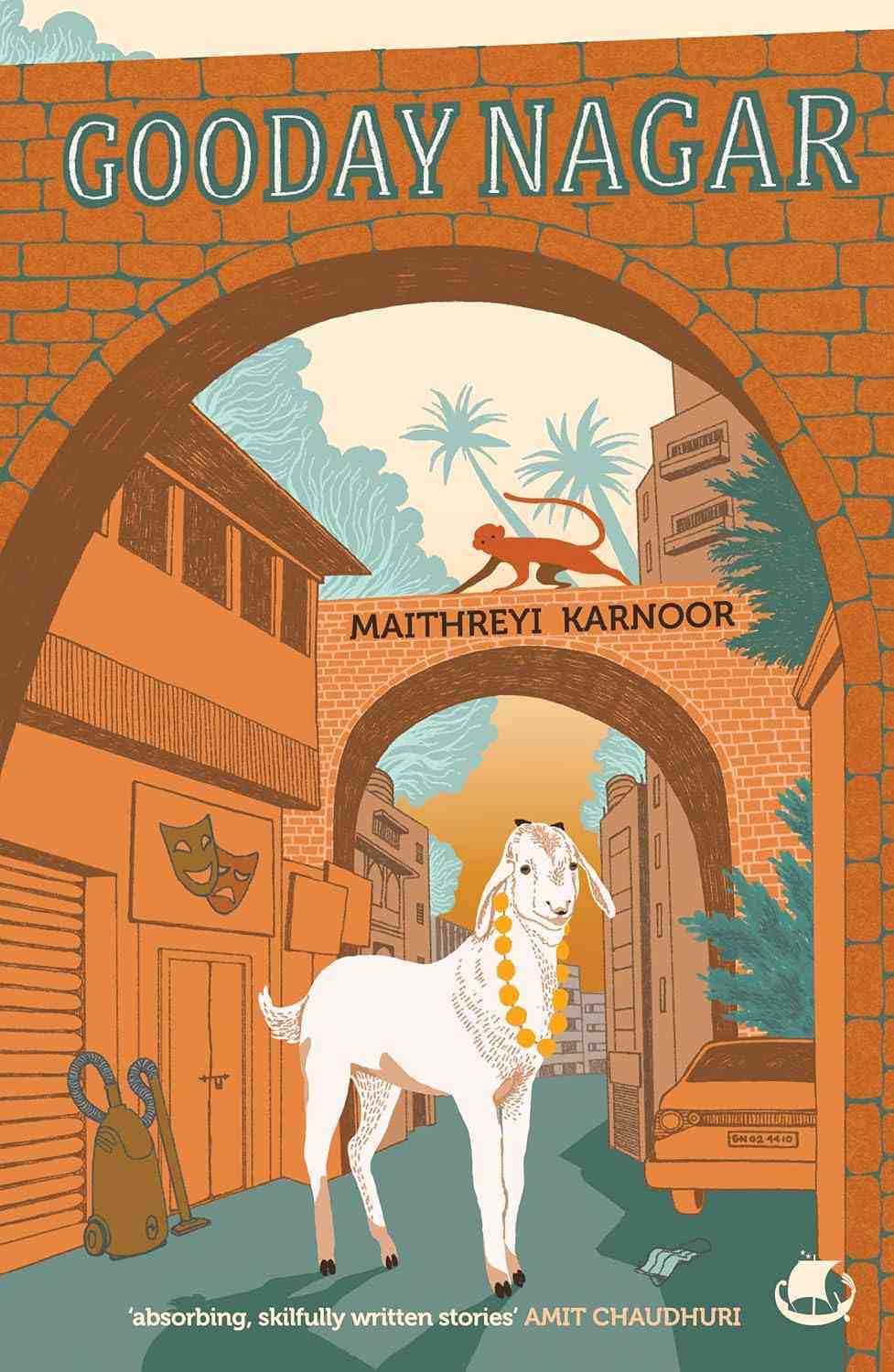
Gooday Nagar, Maithreyi Karnoor, Westland.
