










Voices in the Wind: Folktales, Folklore and Spirit Stories from the Himalaya push against the anchors of geography and time. It is extremely relevant today, when volatile ideologies seem to permeate all hope. The editors Namita Gokhale and Malashri Lal bring together folklore, both popular and obscure, and from languages dominant and extant, into an anthology of folk stories for grown-ups. Most of these tales are previously unrecorded and originate from a myriad of languages, including Dogri, Mizo, Bhadarwahi, Dzongkha, Lepcha, Bhutia, and Limbu, to name a few.
These stories seem to represent all things good and all things bad, while the editors caution against reducing them into a course pack for moral education. Gokhale writes in her introduction, “These are stories for children to know and adults to remember. They arm the young to unblinkingly understand the harsh truths of life, without the sanitised retellings of the Disney universe. And they remind the older generations of the enduring ways of the world.”
Blatant truths
A gory Balti folktale recounts the early origin of the game of Polo in the community. Etee Bahadur narrates the lore in detail: it is said that King Gesar of Ling killed King Baakar at the battle of the Kunlun mountains. The former horrifyingly cut the heads of Baakar’s two children, which is described as “tossed around in his pockets” as he rode down the plains. Gesar threw their heads into the sky, hitting them with a stick so that it would roll ahead alongside his horse. Polo was born. Bahadur emphasises that reciting and playing the Gesar epic was a tradition and part of the polo game in Baltistan.
The candour of folktales, even in the original Grimm’s Fairy Tales, was sanitised in later iterations for commercial value and mass appeal. These tales depict parents who betray their children’s trust, monsters that take the form of men and animals on the prowl, greedy rulers who extort from nature’s gifts, and other injustices that continue to plague our world today. Life’s blatant truths permeate through generations of folkloric wisdom. Stories like these, in all their glorious gore, allow children to understand that the world is indeed a place of malice, evil and envy. They hear of indignity, irrational hatred and extreme violence. At the same time, they also see that good deeds and kindness are generously rewarded. The multiplicities of humankind push children and adults to analyse and evaluate what’s happening around us, and understand the consequences of every action. It so happens that such critical thinking seems to have taken a backseat today.
The Himalayan folktales in the anthology serve as a great leveller between living and non-living beings. A vindictive kite attacks a human, while a crow adopts a human girl. Animals, birds, spirits and other non-human beings serve as guardians, moral arbiters and agents of transformation. Sometimes revered and sometimes dismissed, non-human beings are seen as equal if not above humans. Spirit deities punish intolerance, greed and irreverence to nature.
The lessons
Some of the stories may seem rather absurd. Trees bear fruits of flesh and blood. In the Bhadarwahi tale, “We Should Never Be Greedy”, a saint advises a couple desperate for children to strike a magical tree with a pair of tongs. Each strike would grant them a child. Overcome with greed, the couple strikes the tree thrice despite the saint’s warning. A baby calf, an alligator and a human baby are born. Although distraught at first, the family lives happily, with all three children looking out for each other through the world’s maladies. Mashan Thakur is a popular legend from North Bengal, a spirit that protects the river and its creatures. Sombaru, a fisherman, grew up hearing tales of Mashan Thakur, the guardian of the mid-river, who “allows moderate fishing”. However, he ignores his father’s warnings and hunts continuously for days, only for the villagers to find Sombaru’s bloated body lying on the bank.
Other stories feature intense compassion and sacrifice. “Amo-Dalmo Ju” is a Balti song where a mother ibex lies to her son to save him from a hunter. Already struck by bullets, she assures her son, “Do not worry, dear! Perhaps I ate some poisonous grass, which is making me dizzy. I will be all right soon” As blood oozed from her skull and belly, the young ibex flees from the hunter. The tragic Kashmiri love story, “Himal Te Nagrai”, is a resonant example of the triumph of love. Himal, a beautiful princess, and Nagrai, her serpent lover, yearn to be together, but their parents stand in the way. When they manage to get married, envious wives and vicious curses tear them apart. Even death mocks them when Nagrai is killed by a holy man’s son. Himal leaps into the fires of the pyre, unable to contain her despair. They are finally reborn as birds, chirping songs of love against the test of time and death.
These stories of love, pain, punishment and reward are eternal, living across time in memories. Lal writes in the Afterword, “(the) beauty of such tales lies in the flexibility of its retellings, quite aligned, to the local values where the old threads of the story are woven afresh”. Within these values, the reality of love and death, war and destruction, is the same as romantic fulfilment, triumph of the good and the success of a diligent worker. In many ways, the collection reminds us that we’re not alone on this planet, and that tolerance, caution, kindness and love might just be the way forward in a blue world.
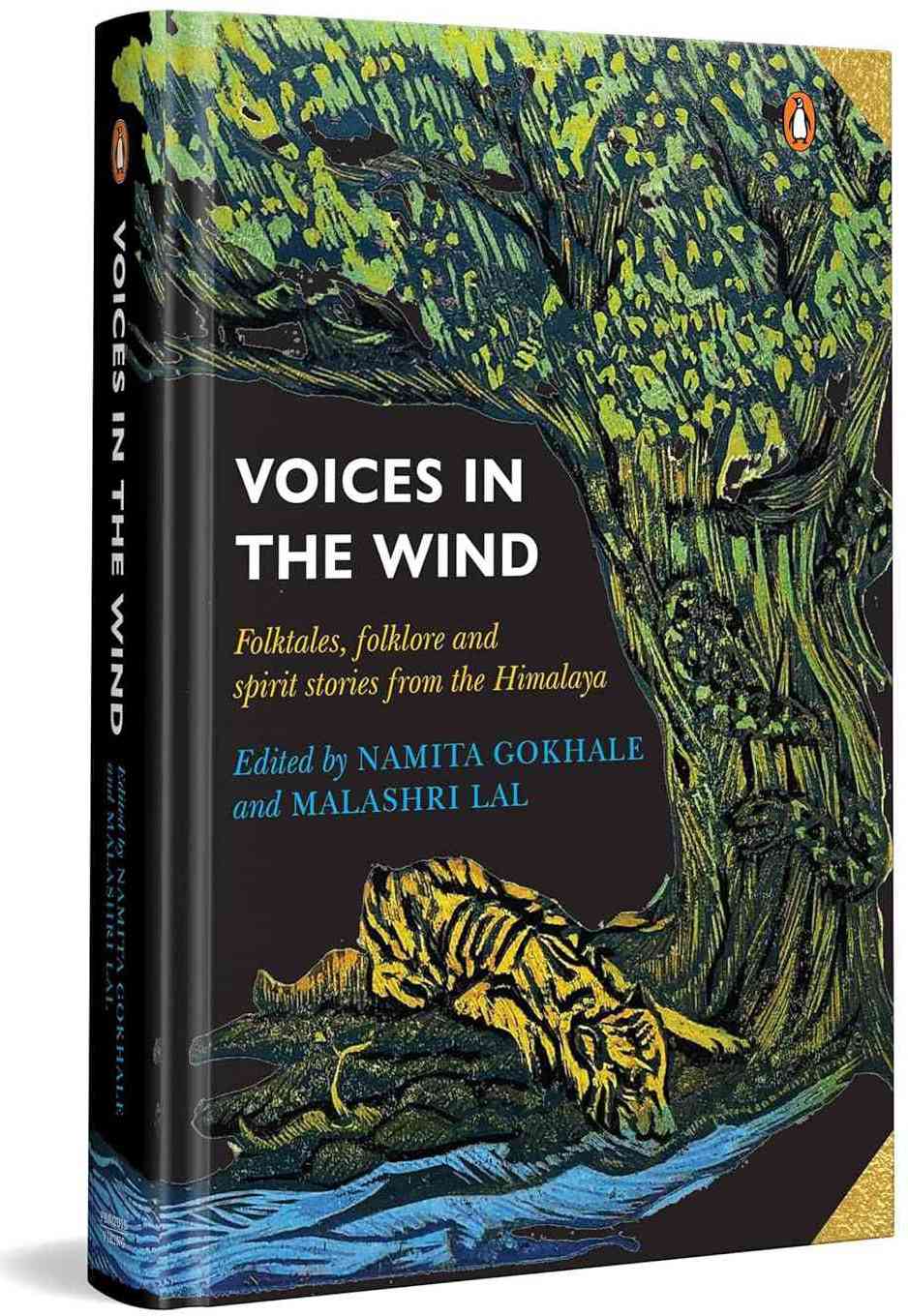
Voices in the Wind: Folktales, Folklore and Spirit Stories from the Himalaya, edited by Namita Gokhale and Malashri Lal, Penguin Random House India.
