









Mute libraries. Rows and rows of witnesses. Tight lipped. Trembling with the desire to unburden. Testify. Accuse. Seek justice.
Only the librarian has fled.
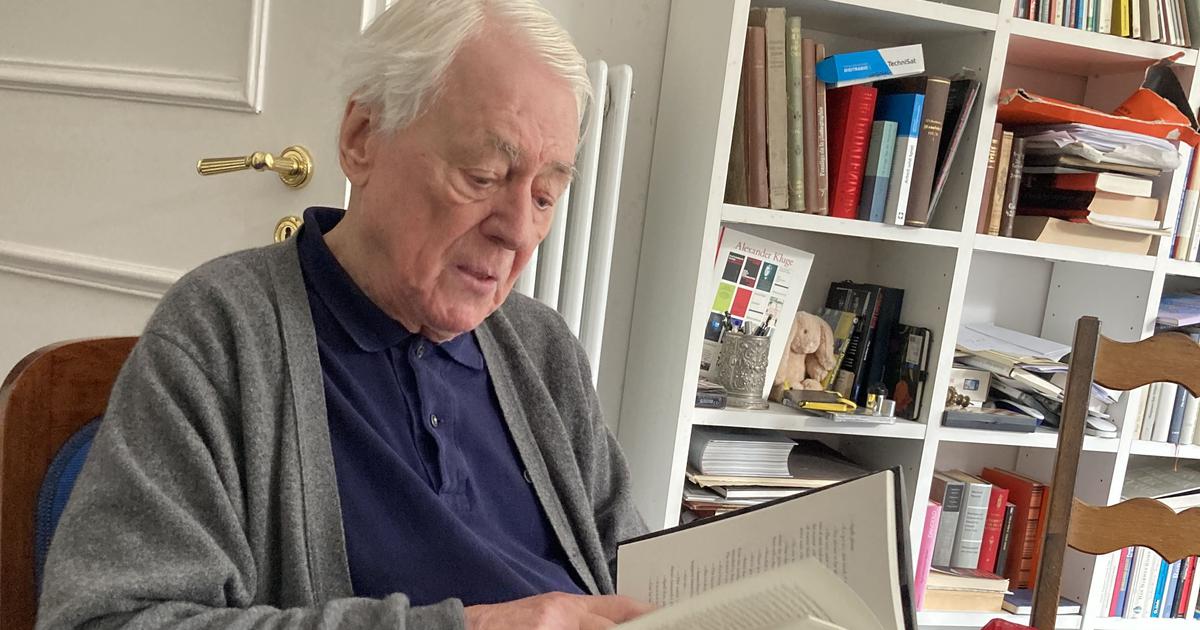
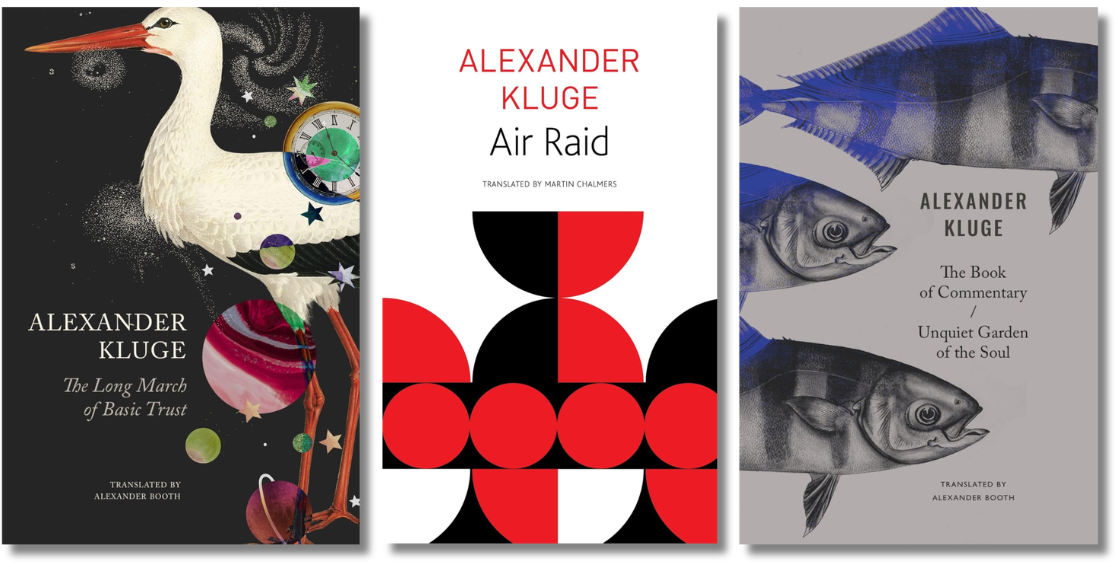
Alexander Kluge was no mere chronicler. He was more a philosophical “interpreter of maladies.” All that is wrong disorderly in our understanding of the past, the present and the future that is unfolding like uneven breath even as we seek to understand it. He made films. He wrote books. He made what he called “expositions” which were a blend of art and video and pieces of installed three-dimensional objects using image and text and there was TV programming. He wrote as one possessed with the knowledge of how to straddle the “simultaneity” of historic events in a style that moved intuitively between the anecdotal and the personal to a narrative made up of theory and allusion and prediction. Everything went from a style that had elements of fiction and observation, therefore, documentary and a certain leaning towards the “essayistic”. All of it with restless but accurate abandon. Each insight a rollercoaster ride that shone a light – his own – on all that needed revealing, exposing, illuminating. So yes, a “witnessing” that moved without limitations across the humanities and sciences with only one purpose in mind: interpret the times. Write relentlessly about both the personal and the larger historical narratives that the war he went through brought about. Be witness. Not one that necessarily or objectively documents but one that reinterprets existing notions of right and wrong and lays bare that which needs to be revealed. And in this our troubled time where all of our “truth ful nesses” have their origin in “un truth”; a world that has embraced all that is “fake”; a time which questions its own unfolding in seeming disbelief; this ability to translate our realities – themselves without anchor – in a manner that cuts to the core, the root of the problem, is as vital as it is exceptional. Alexander Kluge made it impossible for his readers not to actively participate. To act. A writing that inspired activism. He invested a lot in the intellect and the imagination of his readerly beings. And therefore, left his readers and his viewers with the freedom to choose their own interpretations, their own ways of arriving at their own form of resistance. And therefore, of recovering against odds.
Invite the visitor with the dark cloak
the wide brimmed hat
and the staff with a twisted handle
into your home
share your food by the fireplace
drink to his health
and yours
let the night be full
of stories
the life you have lived
these so many years
engage the gentleman
in a wide-ranging conversation
about life and
death almost
as if you had not guessed
the purpose of his visit

Hard. To walk the Munich streets in the same way we did. Together. Over these many years. Keeping pace with your thoughts as you raced ahead with bulky printed manuscripts under each arm. To our lunches at your favourite Italian restaurant around the corner from your home. Not wanting to let you down we kept pace. Sunandini and I. Enjoying every moment. Both the physical and the mental. After all you talked like you wrote in multiple thought-modes. And our conversations. The ones that began elsewhere. Somewhere. Everywhere. Anyplace but this. And didn’t end. Though we revelled in the silences. They. Like our breathing. Had much to talk about. Often our thoughts needing to be heard. In immediate and simultaneous excitement. Uncontrolled. Speaking together. We would smile and say after you. Secretly wanting to be the first one with the fresh idea. Wipe the rain off our glasses. Revealing a shared twinkle. And carrying on in one philosophical direction or another. In one political vein or another. Or simply enjoying the shared literature we were planning to inflict on an unsuspecting English-speaking world. After all we shared the joys of being your publishers.
It will be hard. But soon it will be time. To walk. Yes, will walk “the Munich” again. How can we not? Only this time we will be the ones carrying your thoughts in bulky print outs under our arms.
After one of our visits, I sent Alexander this poem:
Munich Archives?
Photographs sticky
with the juice of rubber bands stacked
like discarded corpses in an 8mm film
about the holocaust
flies
deliberating around decaying sprockets crumbling
under the weight of their own guilt
the graves are
grassflowered over with the innocence of spring
outside
the light
blinded
by its own harshness
lies
in a heap of discarded shadows
If this was one of his screenplays the mise en scéne would be this vivid memory in all the colours of Sunandini’s book covers that adorn our Frankfurt Book Stand. The year would be, say, 2018 when the briskness of Alexander’s pace would surprise us at our stand. Unable to wait for his new book to reach him from Calcutta he would like a good mountain make his way to Mohammed. The book in question this time was his collaboration with Georg Baselitz, World-Changing Rage. And of course, in our excitement we had moved beyond the trade hardback edition and done a limited-edition of 20 bound in handspun indigo which had undergone a Japanese resist-dyeing process called Shibori. A blue lacquered box, also hand crafted. Each set containing a Baselitz print!
Alexander held the box in his hands opened it, took out the Baselitz print; his own handwritten manuscript sheet; the touch and feel of different material; and after a long silence said “you are anti- algorithm. You craft this special edition of our book with no barcode and no price and make the marketplace an outcast. The only way to acquire the book is to find your way to the publisher!’
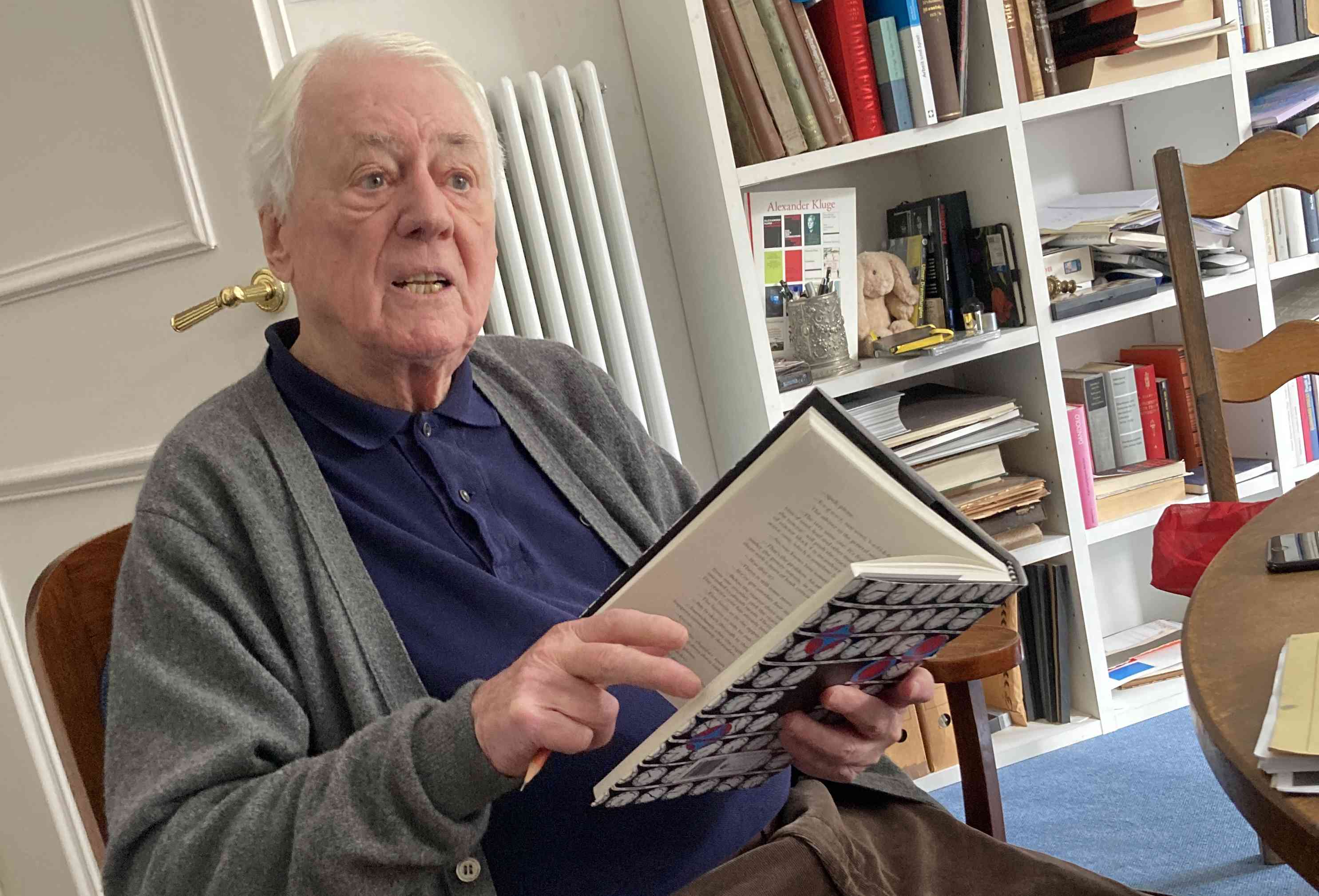
I found this very moving. Having spent most of our lives being against the grain this was a wonderful compliment and recognition of our way of being publishers in a market driven world of books. Thank you dear Alexander for the memories.
Strange
how the air
no longer is
able to whisper
the stories
of our growing up
Here is what I once wrote after he guided us through a Baselitz exhibition in an almost empty Haus da Kunst, Munich. It was about Basleitz that I wrote but it could easily have been about Alexander Kluge.
This man. Bringing alive. The Lucid. Lying dormant inside one. Like an entire Iliad. Or the other one. Odyssey. An ongoing chant inside your head. Interrupting the obvious. And the mundane. Guiding inspiration. Second nature. Fine honed instinct. Intuition by any other name. Or labels. Should you need any. Even as the artist unfolds his curatorial vision. Experiencing memory as it appears. To just appear. Take shape. Make manifest. Like a perceived truth. One we can both believe. And remould. Or sculpt. In a manner that makes it our truth. One we can rely upon. Or shed. Depending on the circumstance of our thinking selves at that moment of appearance. A moment of apparent clarity. Like seeing things through a third eye worn proudly like a good luck charm. Or simply as clairvoyance. Or like Cassandra. Despairing at the vision. The ability to unmask the future. Even as it layered its entire being with make-up. Changing shape and size. A masquerade of deception. Does it matter? I love the concept of devotion. The seeing one. The one who views. For the pleasure of seeing. Or is it viewing? And how different are the two? The view? And that which is seen? Viewed? Sometimes for the pleasure of understanding what lies in the viewing. Often the breathlessness of the view is pleasure enough. Is it not? Being out of breath is not always about having lost the battle. It is also a sign of desire. The rush. The lack. The want. The only way of seeing is through the blindness that faith wears. Often like a mask. The kind that refuses to be ripped off and reveal the truth beneath. Then again does it really matter if it is your truth or someone else’s? The artist. The viewer. The creator and the Creator locked in combat. Dust. Sweat. Grime. Mutual devotees in an endless bout of wrestling.
We lose friends. In so many different ways. Some who take offense and retreat without even an angry word or an explanation; others slip into a fog well before their passing-passings and we lose them well before their bodies give up; Like we did dear Mahasweta Devi; and Mrinal Sen; both had unknowingly stepped back into the shadows well before it was time; others that appear to fool ageing with their ever-fresh minds and lull those of us who revere and yes adore them into a false sense of “grantedness”. We begin to believe that they will be constantly present in our lives. It is this latter category that sits down to a game of wit and chance with Death. At a time of their choosing. And lose.
What would it be? My opening gambit? The move I make to outclass my rival? Wits. Nerves. Concentration. All of the clichés we enact. A mind full of performing the French Defense. Or the Sicilian. The one that calls itself the Modern Dragon Variation. Or the Queen’s gambit. My head full of E4 E6. Common you say? Amateur class? D4 D5. Reeking of domination. Ruling the centre squares. NC3 BP4. Bishop takes on the White Knight. The King in jeopardy. Unable to move. Wrestling. Pinned down. Ah just a logical move you say. E4 Another common move. But what of C5? NF3 D6? G6?
Not easy. To fool your opponent. The old gambit of leaving one of your valuable foot soldiers unprotected. No longer works. Not with the class of the opponent you are up against. Sacrificing one for the sake of another. A deadlier weapon concealed beneath this subterfuge. But no. Always a step head. Mirroring your every move. Anticipating. Blocking. Attacking when you attack. Attacking when you defend.
I sat down to a long game of chess. With my shadow.
And yes, I opened with black.
