







Sunlight spills intrusively into your room, filtered through the curtains that never quite hang right – no matter how many times you’ve tried to fix them. You blame the previous tenants for their reckless drilling. You roll over in bed wondering if the pain in your neck is a new one. Your crumpled bedsheets, evidence of a night spent tossing and turning, wilt stubbornly down the bottom left corner of the bed, revealing a maroon mattress. Overhead, the spider you’ve come to know and love as a brother stands in his dusty web, a silent, supportive observer.
Your peeling wired earphones are still plugged into your phone, a tangled hopeless mess that explains the string of calls and alarms you managed to sleep through. It’s a familiar scene that would be congenial if it were happening to anyone else.
You groggily make your way to the kitchen, deciding that today will be a breakfast of whatever is left in your fridge. Buttered toast and expired cornflakes it is. The toast, made on an inherited frying pan, slips from your hand as you butter it, landing, predictably, butter-side down. With a sigh, you clean up the splotch of crumbs and butter and by the time you’re done, your cereal has already gone soggy. You slice a banana anyway, because what’s cornflakes without a banana? As you accidentally drop one petal of the peel on the floor, you decide the laws of physics have conspired against you this morning.
You set the kettle to boil, debating the merits of tea versus instant coffee, only to be thwarted by the sight of an empty cupboard – no clean cups in sight. With great inventiveness, you pour the hot water into a decorative pot-jug abomination that someone gifted you in 2019. You sit down to eat, deciding that floor toast is perfectly healthy because you picked it up within five seconds. The mushy cereal follows. Finally, you pour too much sandy instant coffee into the pot-jug, swirl it around and carefully carry it back to the kitchen to add more water.
Your toe steps partly on the banana peel that fell minutes ago. You catch yourself without spilling a drop of coffee. It’s a reminder that even the plainest existence can be fraught with chilling hazards. Back in your bedroom, you down the coffee and walk to the bathroom for a brief shower, where you wish for the millionth time that you had a shower curtain – or better yet, a sleek glass case like the ones you see in hotel bathrooms. Your slick tiles are treacherous and the thought of a glass enclosure makes you feel like you’d be living the sheltered high life, if only for a moment.
After your shower, you face the morning’s final challenge: taming your tangled ponytail and gathering your many wires. It’s a laborious twenty minutes, first fighting with your hair and then your earphones, which have somehow become even more knotted and lured in the charger in the meantime. At last, you emerge victorious – though perhaps not triumphant – ready to face the day. Or maybe just ready for a nap.
This is an ordinary lazy morning, possibly on a Sunday. There is nothing notable about it because you’ve lived 700 mornings like this. You suppose millions of people have lived through thousands of days like this around the world. As you settle back into your bed, the morning’s small battles replay in your mind.
A hypothetical arrives. What if the little events of your day weren’t just arbitrary annoyances, but clues to something heavier? Something that has implications for human civilisation? There’s a whole world of complexity, humour and beauty lurking beneath the surface of your routine, waiting to be uncovered.
Unknowingly, in the course of this ordinary morning, you’ve stumbled across at least ten Ig Nobel Prize-winning studies. Each small frustration and triumph – whether it’s gravity acting on buttered toast, the inevitability of tangled wires or the mechanics of slipping on a banana peel – held within it secrets. The studies you accidentally encountered uncover layers of knowledge that had been hidden in plain sight, reshaping our understanding of the world in small but significant ways.
Take those bedsheets, for instance, to the washing machine in your mind. To us, they are large pieces of cloth that protect the mattress from us and us from the elements. To scientists like Lakshminarayanan Mahadevan and Enrique Cerda Villablanca, they’re a goldmine in physics. These individuals make a living dealing with the mysteries of how sheets made of different materials respond to being stretched, pulled and forced out of relaxation. In 2007, this highly technical work won them an Ig Nobel Prize in Physics. These wrinkled, crumpled sheets you wrestle with every day are a classic study in elasticity and plasticity. Big words for a sheet of cloth you sleep on. On the other hand, small words for the site of your wondrous dreams.
Wrinkles in fabric are far from trivial – they’ve been the subject of extensive research in fields like material science and physics. The way sheets wrinkle isn’t just about the fabric itself but about how the material responds to pressure and movement. When you toss and turn, the sheets are subject to forces that stretch and compress the fibres, creating those stubborn wrinkles. This seemingly random, stupid behaviour is under the purview of the principles of elasticity and plasticity, which describe how materials lose shape under stress and how they return to their original shape – or don’t, as the case may be.
As Mahadevan noted in his Ig acceptance speech, “This little problem serves, I think, to teach us how infinitely familiar and yet how far from being understood, our immediate environment is.” You see, the way your sheets wrinkle is more than just a matter of disturbance. It’s about how the material responds in ways that follow the laws of physics, even if those laws seem to have a personal vendetta against you and your morning routine.
The same principles that cause sheets and wet paper to crumple into iconic textures are also at work in much more serious natural phenomena. The formation of wrinkles in human skin, for instance, is driven by similar forces – albeit on a smaller, less noticeable scale until you hit a certain age. As we get older, our skin loses elasticity, leading to those inevitable wrinkles that are essentially permanent crumples in the fabric of our skin. And on an even grander scale, these principles explain how mountains form over millions of years, as the Earth’s crust is subjected to immense pressures that cause it to buckle and fold.
So, the next time you look at those stubborn wrinkles on your bedsheets, think of them as tiny echoes of the forces that shape the planet. And when you’re done with that, remember that the study of wrinkling has practical applications too. Engineers and designers use these principles to develop better materials for everything from clothing to spacecrafts. Understanding how and why materials wrinkle allows them to create fabrics that behave in predictable ways when subjected to stress. The study of wrinkling even connects to the art world, where conservationists use these principles to restore and preserve ancient paintings and sculptures, where cracks and wrinkles can tell the story of a piece’s history.
If you suspected that this interest in wrinkling is a modern curiosity for pointless technological minutiae and an indulgence of modern physicists, given all the important physics needed to run society has already been sorted out, you are mistaken. In fact, ancient Greeks and Romans laid the groundwork for what would become the field of material science.
From wrinkles on our skin, we hop to webs hanging overhead. As you glance at the spider in the corner of your ceiling, you might be tempted to believe that you and your spider are the only occupants of your bedroom. Let’s be honest – your bed is an entire ecosystem. The idea that your bed could be home to more than you think might be unsettling, but it’s true.
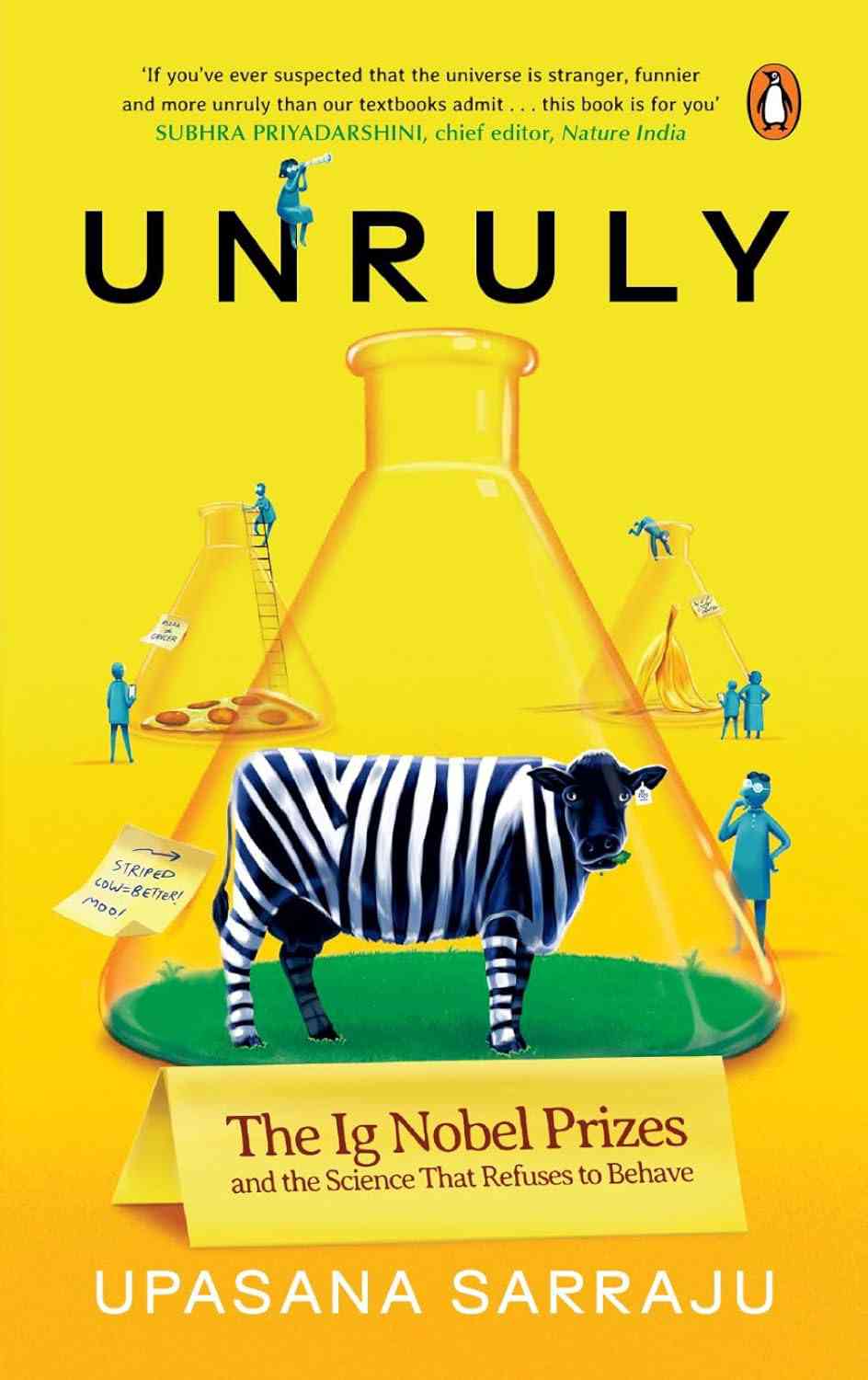
Excerpted with permission from Unruly: The Ig Nobel Prizes and The Science That Refuses to Behave, Upasana Sarraju, Penguin Random House India.
