




During the Emergency of 1975-’77, a few newspapers and magazines tried to get the better of the censors. In the first few days, The Indian Express, most famously had white space on its columns for editorials. The censors got onto that quickly.
The Economic and Political Weekly in Bombay ran an occasional full page of extracts from published newspaper reports. Called “Clippings”, no censor could object. They spoke for themselves, no comment was needed.
Here is one report from the Clippings of December 4, 1975:
“Mr [Sunjay] Gandhi remarked that though Vyasarpadi [in Tamil Nadu] was the worst affected area in the floods, "I see smiling faces here. Much of our troubles would be over if only all of us keep smiling”, he said.” – The Hindustan Times, November 29
That was half a century ago. There is no censorship now in the world’s largest democracy which is also the world’s oldest democracy. There is so much happening, though, that it is hard to keep track and, most important, difficult to remember. A journal or diary on the phone is a useful tool to track what is happening.
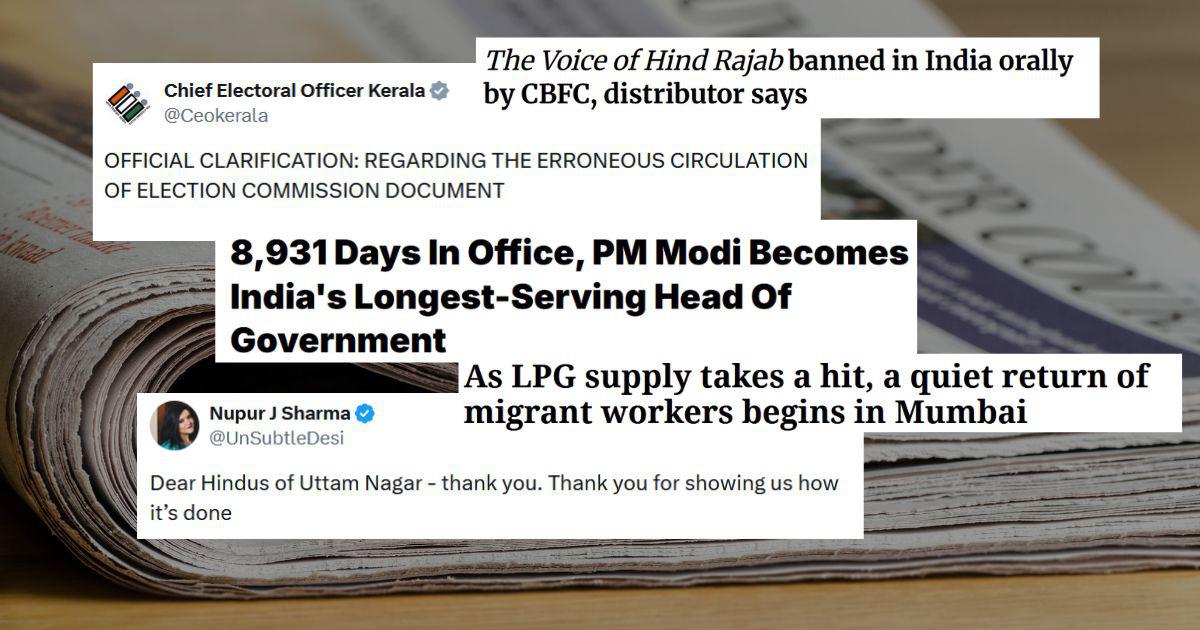
Here is one compilation of news reports and a couple of social media posts from 12 days in March. The headlines are as in the original. The period is arbitrary. A compilation of any period will be just as insightful.
March 19
‘The Voice of Hind Rajab’ Censored in India Amid Fears Theatrical Release ‘Would Break Up the India-Israel Relationship’
The Indian theatrical release of Kaouther Ben Hania’s Oscar-nominated feature “The Voice of Hind Rajab” which was planned for this month, is being blocked by the country’s Central Board of Film Certification (CBFC) for political reasons, according to the film’s local distributor.
[Manoj] Nadawana [the distributor] said he screened “The Voice of Hind Rajab” for the CBFC in February, when he submitted the film for censorship approval, and was planning a March 6 Indian release “because we thought it was a good date ahead of the March 16 Oscars.” Instead, the film has not been cleared for release and he was told by a CBFC member that “if it gets released it would break up the India-Israel relationship,” Nadawana said.
March 20
‘The Voice of Hind Rajab’ banned in India orally by CBFC, distributor says
The Ministry of Information and Broadcasting and the CBFC did not respond to a query by The Hindu. A senior official told The Hindu on Friday that the film has now been referred to a Revising Committee in the CBFC over the last few days, and that it will be reviewed by them now.
Over the last two years, the CBFC has rejected and censored films that have progressive political messaging. Any reference to real life political events and personalities is typically removed. While an emerging crop of right wing cinema has also faced heavy censorship, according to cut lists viewed by The Hindu, their core messages have more or less withstood the process.
March 19
After 8 Years In Jail Under UAPA, Delhi Court Acquits Two Booked For Terror Conspiracy; Flags Serious Gaps In Police Case
A Delhi Court on Thursday acquitted two men in a case registered under the Unlawful Activities (Prevention) Act and the Arms Act, saying that there was a “great deal of doubt” about the recovery of arms and ammunition in the manner as alleged by the Delhi Police's Special Cell.
The judge acquitted Jamsheed Zahoor Paul and Parvaiz Rashid who were charged for the offences under Section 18 (punishment for conspiracy) and 20 (punishment for being member of terrorist gang or organisation) of the Unlawful Activities (Prevention) Act, 1967 and Section 25 (punishment for illegal possession of firearms or ammunition) of the Arms Act, 1959.
March 20
‘Who Will Answer for the Years Lost?’: Families Await Return of Two Kashmiris Jailed in 2018, Acquitted a Day Ago
Rashid was days away from sitting in his final semester exams when everything fell apart. Eight years later, Lone, his father and a retired government employee, struggles to control his emotions at his home in Ganopora village of Shopian.
“The legal battle took away our savings, our peace and somewhere along the way the five years he had poured into his education. It drained us – financially, emotionally, in every way,” Lone who lives alone with his wife in Ganopora said.
Parvaiz, then 24 years old, was pursuing MTech from Shri Venkateshwara University in Gajraula of Uttar Pradesh when a special cell team nabbed him near Red Fort in the national capital along with Jamshed Zahoor Paul, a resident of the adjoining Balpora village in Shopian, on September 7, 2018.
Pramod Singh Kushwah, a deputy commissioner of Delhi police’s special cell had then told the media that four cell phones were recovered from the two “highly radicalised” men which had “videos” linked to militants.
March 19
HC rejects ‘Mohammad Deepak’ plea for protection as ‘abuse of process’, orders financial disclosure
The Uttarakhand High Court on Thursday issued a stern rebuke to Deepak Kumar who gained prominence for defending a Muslim shopkeeper against right-wing activists during a recent communal standoff in Kotdwar.
Justice Rakesh Thapliyal, presiding over a petition filed by Kumar, dismissed his demands for police protection and a departmental inquiry against local officers, labelling the entire legal exercise an “abuse of process”.
Following the incident, a case was registered against Kumar and his associate, Vijay Rawat, on January 28, based on a complaint by one Kamal Prasad, alleging intimidation and misconduct.
During the hearing, Justice Thapliyal expressed deep dissatisfaction with the petitioner's multifaceted prayer. “This is a complete abuse of process. The person who is an accused is praying for protection? Trust them [the police]. You are a suspected accused,” the bench remarked. The court further criticized Kumar’s request for a departmental inquiry against police personnel, terming it a “pressure tactic”.
March 22
Dear Hindus of Uttam Nagar - thank you. Thank you for showing us how it’s done
— Nupur J Sharma (@UnSubtleDesi) March 20, 2026
I wrote about Judicial Corruption and Overreach. And they called my University.
So, [a] few judges, and advocates of the Supreme Court and High Courts, and some law students were unhappy with a piece I wrote on my personal Substack. They found my personal details, found the university I study in, got the contact details of authorities there, picked up their phones and called them to pressure me into silence.
Is any of this making sense? Judges in this country are issuing de-facto “takedown” orders to students through their universities, simply because he criticised them. At least the SC order earlier had the form of a legal proceeding. It was at least happening in public. But this? What exactly is this? What do you even call it? In what version of a functioning democracy is any of this normal?
Criticising a court order for something that is clearly wrong should never be contempt. It is the most basic functions of a free press and an academia. If judges cannot bear to have their orders or their words scrutinised, that is a problem with the judges and the judiciary, not with my criticism. It seems that when some of them have spent their whole career in an institution that is so unaccustomed to criticism, pressure and intimidation is a completely normal response.
March 23
Justice Bhuyan laments lack of space for dissent in ‘Viksit Bharat’
Supreme Court judge Justice Ujjal Bhuyan on Sunday said that incarceration of citizens for dissent, and continuing atrocities against Dalits “cannot be a model of Viksit Bharat”.
“In Viksit Bharat, there should be more space for dissent and debate. Dissent cannot be criminalised,” he said, warning against the growing tendency to invoke criminal law in response to protests, student movements, and even social media expression.
He said the past few years have seen a pattern of “reckless registration” of criminal cases by the State, often in trivial matters. FIRs routinely filed for public demonstrations or online content, pushing individuals into prolonged investigations and incarceration, he said.
He, however, acknowledged that courts have not always acted as an effective check and said, “Many within the judiciary also suffer from the more loyal than the king syndrome. As a result, people continue to languish in jails for months and months together without bail and without facing trial.”
OFFICIAL CLARIFICATION: REGARDING THE ERRONEOUS CIRCULATION OF ELECTION COMMISSION DOCUMENT
It has come to our notice that a letter from the Election Commission, bearing the seal of the Bharatiya Janata Party (BJP), is being circulated across various Malayalam news channels. The Office of the Chief Electoral Officer (CEO) hereby clarifies that this was purely a clerical error, which was identified and rectified immediately.
March 24
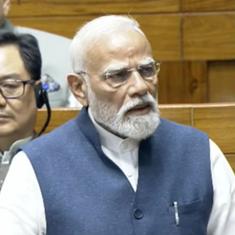
8,931 Days In Office, PM Modi Becomes India’s Longest-Serving Head Of Government
Prime Minister Narendra Modi has achieved a historic milestone in Indian politics by becoming the longest-serving head of an elected government in the country.
With this, PM Modi has surpassed Pawan Kumar Chamling, who held office as Chief Minister of Sikkim for 8,930 days. He has now completed 8,931 days as head of government, combining his tenure as Chief Minister of Gujarat and as Prime Minister, thereby entering his 25th year in a leadership role.”
[Note: Jawaharlal Nehru served as prime minister from August 14, 1947 until his death on May 27, 1964 – a total of 16 years and 286 days: 6,129 days
Indira Gandhi served two separate stints as PM:
First term: January 24, 1966 - March 24, 1977 (4,077 days)
Second term: January 14, 1980 – October 31, 1984, (1,752 days)
Total: 5,829 days
Narendra Modi became prime minister on May 26, 2014.
May 26, 2014 to March 26, 2025: 4018 days
May 26, 2025 to March 24, 2026 = 303 days
Total: 4,321 days]
March 23
New Uttar Pradesh is embracing the power of Artificial Intelligence.
A ₹25,000 Crore MoU with Puch AI will bring AI Parks, large-scale data centre infrastructure, AI Commons, and an AI University to the state. This initiative will strengthen governance, drive innovation, and create future-ready opportunities for our youth.
March 26
As per standard protocols laid by State Government, the MoU signed with Puch AI on 23 Mar 2026 was reviewed.
Necessary details as per SOP were sought from the investor, but they failed to provide them timely. Due diligence showed lack of net worth and credible financial linkages for the project's scale. On directions of the State Government, the MoU is cancelled effective today. No rights or obligations remain. The MoU has been cancelled in the interest of transparency and highest level of probity in governance, which are in the core of Government of Uttar Pradesh.
‘Not a dalaal nation like Pakistan’
The government slammed Pakistan at an all-party meeting on the West Asia crisis on Wednesday, with the Centre hitting out at Islamabad over their reported role as the mediator between the United States and Iran in the ongoing conflict.
Responding sharply to concerns around Pakistan’s reported mediation efforts, external affairs minister S Jaishankar said, “We are not a dalaal (Broker) nation,” news agency PTI reported citing sources.
[Note: India ever ready to play “active role" in peace efforts: PM Modi to Zelenskyy
Ukraine and Russia should sit together without wasting time to find ways to end the ongoing war and that India was on the side of peace since the beginning of the conflict. In his talks with Zelenskyy in Kyiv that took place under the shadow of the raging war, Modi said India is ever ready to play an “active role” in every effort to restore peace in Ukraine and he would even like to contribute personally. The Economic Times, August 26, 2024 ]
‘It’s very humiliating’: Former Calcutta HC judge Sahidullah Munshi to file appeal after name struck off Bengal voters’ list
Former Calcutta High Court judge Sahidullah Munshi said on Thursday that his name has been deleted from the voters’ list following the adjudication process after the controversial Special Intensive Revision (SIR) of electoral rolls in West Bengal.
The former judge expressed surprise at his name being struck off, saying that he had submitted all required documents, including passports. “I do not know how they have adjudicated and how they have deleted. We were kept in the dark.
Former Justice Munshi pointed out that before becoming a judge, he had already submitted documents as part of the appointment process. “Apart from my documents, they conduct an internal enquiry. Only after scrutiny is the name approved by the Collegium. Then the President appoints you, and you take oath on the Constitution,” he said.
March 27
India’s luxury promise hits a wall: not enough malls to shop in
In India’s rapidly growing economy, millions of newly affluent consumers are fuelling demand for bags and accessories from the likes of Louis Vuitton, Chanel and Dior. But getting to a store can be a problem - there aren’t that many of them.
India only has three true luxury malls: two in New Delhi – the Emporio and the Chanakya, owned by real estate developer DLF, and the Jio World Plaza in Mumbai, owned by the Reliance conglomerate.
“We have regular requests from the parent companies – from LVMH Group, from Kering, from Richemont – to give them more space for the brands they want to get into India,” said Saurabh Bharara, head of luxury malls at DLF.
“We have top 15 brands that are ready to enter India, if we give them space tomorrow,” he said, but added there was “zero availability” right now.
March 30
Despite assurance from Centre, MGNREGS workers denied work
For the last 87 days, MGNREGS workers have been protesting at the Muzaffarpur district headquarters in Bihar.
The Union government had assured them that until the Viksit Bharat —Guarantee for Rozgar and Ajeevika Mission (Gramin) (VB-G RAM G) Act, 2025, passed by Parliament in December, is rolled out, the Mahatma Gandhi National Rural Employment Guarantee Scheme (MGNREGS) would continue unchanged. But on the ground, workers say the story is very different.
The protest in Muzaffarpur began on January 2 this year. Nearly 12,000 workers in the district have not received work for the past three to four months – even before the new rural employment law was introduced….
March 29
Oppn attempting to induce ‘artificial fear’, says BJP’s Tarun Chugh on PM Modi’s message to citizens in 'Mann ki Baat'
Tarun Chugh stated that, keeping in mind the ongoing conflict in the Gulf region, the Prime Minister utilised his address to reassure the citizens that there is absolutely no shortage of petrol, diesel, or gas in India. He explained that supplies are continuously arriving via shipments, and therefore, there is no need for the public to harbour any anxiety whatsoever….
March 31
As LPG supply takes a hit, a quiet return of migrant workers begins in Mumbai
It does not show up at construction sites or in factory lanes. There are no visible signs of an outflow, but go to Mumbai’s railway stations, and you will find it.
Vishesh Tyagi, 24, has been working for the last five years at a Mumbai factory that makes plumbing material. He had gone home to Varanasi for a brief break and returned on March 19. Five days later, he was on a train back. He had not been able to find a gas cylinder, could not afford to keep eating out, and saw no point in staying.
The newspaper spoke to migrants at Lokmanya Tilak Terminus (LTT) and Chhatrapati Shivaji Maharaj Terminus (CSMT) over five days. Of the 130 people interviewed, 62 said they were returning home because of the LPG crisis. At LTT, 40 of 70 cited it as their reason for leaving. At CSMT, 22 of 50 said the same.
“For four to five days (Kusum) Gupta tried to arrange a gas cylinder, with no luck. She explored alternatives but hit the same wall. “I don’t have the energy to purchase wood and coal for cooking. It is too tedious a process. I would have preferred kerosene, but that isn’t available as well,” she said. She is leaving until things improve.”
These were just 12 days. Tiring and exhausting as it may be, we could all maintain a clippings file to remind ourselves where we are today and what is happening around us.
