









Through the month of March, major players of India’s fertiliser industry began showing the first signs of an impending crisis.
Early in the month, a Gujarat Narmada Valley Fertilizers & Chemicals Limited plant in Gujarat announced that it was going to cut down on its planned production of neem-coated urea. In mid-March, two plants of National Fertilizers Limited in Punjab’s Namgal and Bhatinda ceased their operations.
These developments occurred after the Gas Authority of India Limited reduced the supply of liquified natural gas by 40% to each of these plants.
The cut in supply was a consequence of the conflict in West Asia, which escalated through March. India’s fertiliser industry depends heavily on liquified natural gas imported from the region as raw material to manufacture fertilisers domestically. Half of these imports come from Qatar alone, where the Ras Laffan liquefied natural gas plant was damaged on March 19.
It is not only the supply of raw materials that has been hit – India also directly imports finished products like urea and diammonium phosphate from Oman, Saudi Arabia and the United Arab Emirates. With the Strait of Hormuz shut since the outbreak of the war, supplies of these raw materials and products have dwindled.
Even as farmers watched the situation with concern, the Indian government sought to assuage their fears. In late March, the government announced that the country had “adequate reserves for fertilisers”.
In another statement, released on March 30, the government said that for the upcoming kharif season, the total available stock of all fertilisers, including urea, diammonium phosphate, potassium chloride and nitrogen-phosphate-potassium, was 18 million tonnes. In the same statement the government estimated that for the upcoming kharif season, the country would require 39 million tonnes of fertiliser – more than double of this available stock. It suggested that it would bridge this gap by building up stocks during April and May, which it described as “lean agricultural periods”.
Scroll spoke to agricultural experts to obtain their assessment of whether the country’s current stocks were likely to be adequate to meet its needs.
These experts offered mixed assessments of the situation. Ramanjaneyulu GV, executive director at the Centre for Sustainable Agriculture, in Secunderabad, noted that farmers would be sowing for the kharif seasons between April and June, and that there would be a high demand from across the country during this period. “There is a short window of sowing,” he said. “That is when all farmers require the fertiliser at the same time.”
Ramanjaneyulu added, “These stocks might be enough for the initial application when the crops are being sowed. But beyond that basal requirement, farmers will require a second and third application as well, and for that, we may not have enough.”
Some experts offered more optimistic assessments, at least for specific fertilisers. Siraj Hussain, former union secretary in the ministry of food processing industries and agriculture, said that he did not expect India to face a shortage of urea, the fertiliser used in the highest amounts in India.
Siraj, who is currently senior visiting fellow at the Indian Council for Research on International Economic Relations, estimated that the demand for the season would be around 18 million tonnes. He noted that in March, the country had a stock of between 5 and 6 million tonnes, and that domestic production in the current war scenario, with reduced liquefied natural gas imports, stands at between 1.6 and 1.8 million tonnes a month. With this domestic supply, as well as the available stock and imports from other countries, meeting the country’s demand “should not be difficult”, Hussain said.
But on the ground, many farmers are anxious about the possibility of a fertiliser shortage. In Maharashtra’s Vidharbha, farmer and activist Vijay Jawandhia said, “The government may say there is enough stock. But if fertiliser manufacturers have stopped or reduced production, it is bound to have an impact in the future. The demand is the same but the supply isn’t.”
Many farmers are frustrated because they feel that the government is not giving them sufficient information about the situation. Tejbir Singh, a farmer from Ambala, on the Haryana-Punjab border, told Scroll that there is a sense of panic amongst some farmers because there has so far been no communication from the government about its plans to make adequate quantities of fertiliser available.
“Neither the government nor the cooperative societies seem to have prepared,” he said. “Many people have bought the fertilisers in bulk in advance, and so in many places it is not available right now.”
Higher demand in kharif
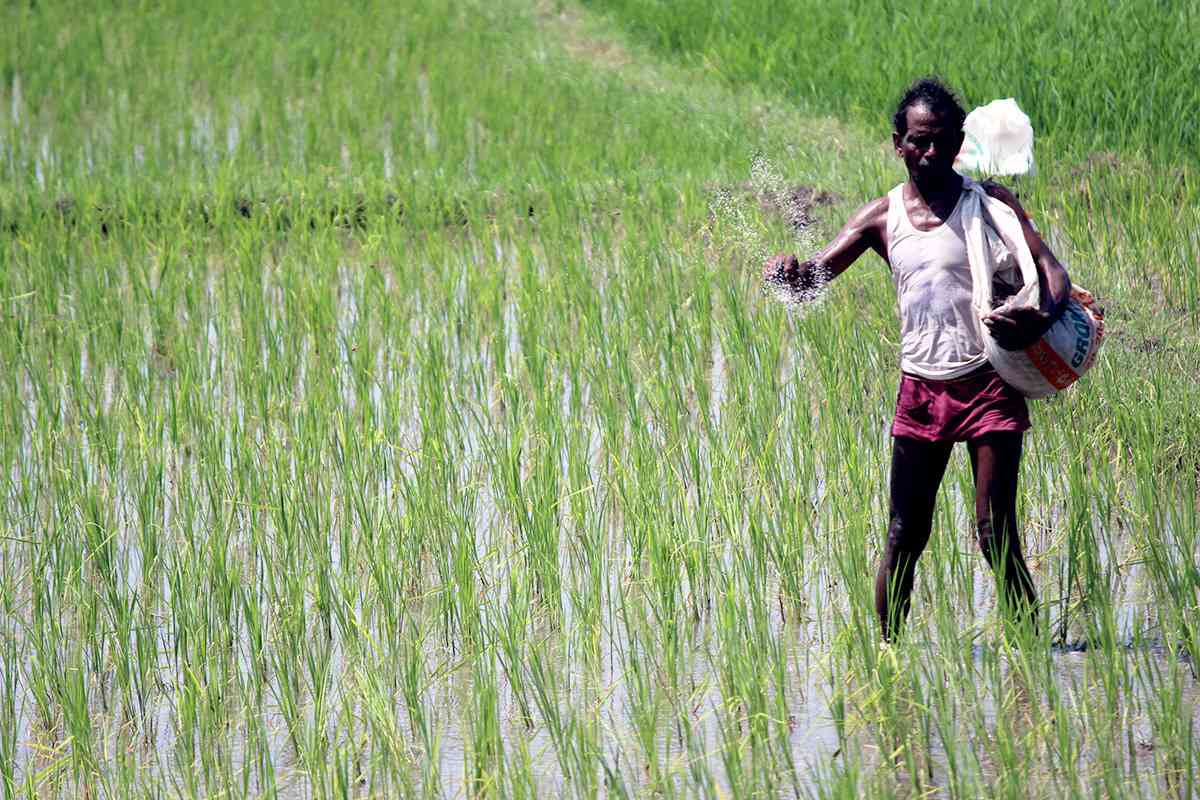
Among the key reasons some farmers and experts are worried is that the kharif season requires more fertiliser than the rabi season.
For instance, in 2023, India consumed a total of 31.2 million tonnes of urea, nitrogen-phosphate-potassium and diammonium phosphate in the kharif season, and 27.2 million tonnes in the rabi season.
One reason for this difference is that more area is cultivated under kharif crops – in 2024, almost 38 million hectares of crops were grown in the kharif season, while 33.6 million hectares were grown in the rabi season.
Another reason is that since kharif coincides with monsoons, fertiliser applied to the soil in the season often gets washed away with rain. Ramanjaneyulu explained that crops end up taking only about 60% of the fertiliser sprayed on them, which reduces their efficacy.
Ambala’s Singh explained that kharif’s paddy crop also needs more fertiliser because “the land is left fallow for a long time, between harvesting in April, and sowing in early June”. Thus, he explained, “There is a need to recharge the soil.” Singh noted that for the complete paddy season, he uses three 45-kg bags of urea per acre.
“The question then is what are the prospects of bridging the gap of supply and demand in the coming two months,” said Sudha Narayanan, senior research fellow at the International Food Policy Research Institute. “The government is diversifying sources of fertiliser imports from Russia, Indonesia, Malaysia, Vietnam, Algeria and Egypt, including talking to China to import finished fertiliser products from. But we do not know if this will materialise, because China is also not exporting right now, since everyone is facing the same constraints domestically.”
To enable the optimal use of available stocks, Ramanjaneyulu suggested that the government should encourage farmers to opt for green manure in the next two months. This, he argued, would reduce the need for the first round of fertiliser use, which is when farmers use the most fertiliser.
“Then, the leftover fertiliser can be used by farmers for top-up application,” he said, referring to the second and third application of the fertiliser, which require smaller amounts than the basal or the first round. He added, “How efficiently can the available stocks be used, that needs to be the strategy right now.”
Food crisis not inevitable
Farmers’ fear of a fertiliser shortage is particularly heightened because they already struggled with the same problem only recently.
In 2025, fertiliser supply to India fell as a result of the Red Sea Crisis – a situation that began in 2023 when Houthi rebels began targeting ships that were passing through the Red Sea. Overall, in 2024-’25, India’s import of urea and diammonium phosphate declined by almost 20% and 18%, respectively, according to the Fertiliser Association of India. Farmers across states complained of an insufficient supply of urea last year.
Some experts believe that some factors may insulate India from a food security crisis even in the event of such a supply crunch. This is because many farmers “use more nitrogen than required, and even the use of phosphate is somewhat skewed”, said Narayanan.
Narayanan referred to a 2025 study of 31,000 fields across Nepal, Bangladesh, and four rice-producing regions of India. It found that 55% of rice farmers were overusing nitrogen fertiliser. It also found that if farmers used 18 kg less of the fertiliser per hectare, they could still obtain the same yield of rice. “This shows that even in a supply constraint, there might not be a yield implication since the returns to increasing fertiliser use have plateaued,” said Narayanan.
She added that the worst-case scenario was that a shortage would have “farmer-welfare implications”, since some may not obtain as much fertiliser as they need, or only obtain it at a higher price. “But we do not have to worry about food security, at least in the short run,” Narayanan said.
Hussain echoed this argument, and noted that in several states like Punjab, Uttar Pradesh and Bihar, “the urea consumption is much higher than recommended levels”. He added that to tackle the problem of a potential shortage, authorities could consider “tweaking with dispatches to various states” so that they did not receive fertiliser in excess of their real need.
Reducing long-term dependency on fertilisers
Experts also suggested that in the long term, India needed to reduce its dependence on fertilisers. The first step towards this, they noted, would be to recognise the factors that created the dependency.
Some analyses have pointed to monocultures as a key such factor that led to excessive fertiliser use. For instance, the journalist Aishwarya Mohanty found in 2025 that among the top ten states that consumed the most fertiliser, six mainly cultivate just five crops on over 90% of land. When farmers grow the same crop year after year, Mohanty found, it absorbs the same nutrients repeatedly, forcing them to depend on fertilisers to make up for the loss of those nutrients. But when farmers plant diverse crops, “the different plants replenish and balance soil nutrients”, Mohanty wrote.
“The problem is not the supply alone, but the extreme dependency on these fertilisers,” Ramanjaneyulu said. “How do we improve soil health? That should be the central strategy.”
He added that such steps would have advantages beyond improving the health of natural resources – for instance, they could help improve the health of the public, which is harmed by exposure to chemicals in fertilisers, either through inhalation if they are sprayed, or through ingestion if they enter groundwater. These steps also reduce the government’s burden of importing fertilisers and providing them at a subsidy to farmers, he added.
Singh, however, pointed out that farmers may not find it easy to shift to alternatives to fertilisers. “Farmers are ready to cultivate without urea,” he said. “But then the market has to make the alternatives available.” He added that the government should strive to provide farmers with seed varieties that had good yields, at a reasonable cost, and also provide them with incentives to switch to alternatives to pesticides.
Narayanan noted that the government “has definitely learnt from the previous crisis”. She noted that it was looking “at diversification of imports, securing long-term stability with other countries, and pushing for new technology at the production end”. But, she added, when it came to making improvements such as using nitrogen fertiliser more efficiently, and thus reducing demand, “we have not made significant effort”.
With additional reporting by Tabassum Barnagarwala.
