






In the early 1970s, a young, charming, restless Jayant Kaikini, freshly enrolled at Baliga College in Kumta, skips his practical exams and boards a bus to his hometown, Gokarna. The reason is neither romantic pursuit nor medical emergency. It is to see Dr Rajkumar in Choori Chikkanna (1969), playing at Kalpana Touring Talkies. He arrives just in time for what might be the film’s final screening there, before the reel travels on to other villages.
But it is raining. No one else is coming. Outside, new posters for the next film are being pasted over Rajkumar’s fading ones. Inside, the muffled voices of the current screening’s climax hang in the air. He waits anxiously, unsure if the show will begin for him at all. At last, Kasim, the industrious caretaker, breaks the news: they cannot run it for one or two viewers. Kaikini returns home crushed and vows to never watch Choori Chikkanna again.
Excessive, perhaps. Yet in that suspended realm between cinema and reality lurks this maigalla cinevyamohi (lazy cinephile). Such telling vignettes fill Touring Talkies (2013), Kaikini’s collection of 60 film-related essays.
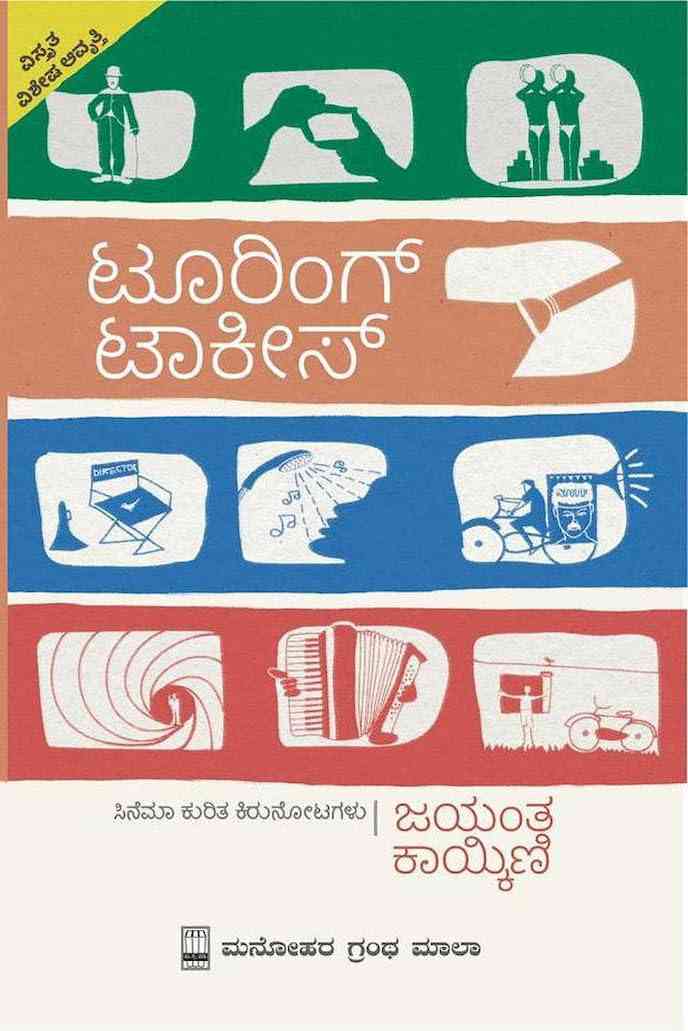
While still in college, Kaikini published his first poetry volume and became the youngest recipient of the Karnataka Sahitya Akademi Award at the time. He would later grow into one of Kannada’s most distinctive literary voices, often seen as among the last figures of the modernist Navya movement. For younger generations, though, he is the beloved lyricist behind several Kannada chartbusters. His short stories, recently translated to English by Tejaswini Niranjana, have found a wider readership. Touring Talkies (Manohara Grantha Mala) is yet another invitation into his genius – a raw record of a sensibility that animates everything else he does.
Originally written through the 1990s and 2000s for the Kannada monthly Rooptara, the essays were later compiled and published by the storied Manohara Granthamala of Dharwad. They range from film reviews and obituaries to deep dives on background score and the texture of watching movies. Kaikini is the sort of cinephile who savours Casino Royale (2006) a second time just to luxuriate over its title card sequence, or absurdly imagines Gabbar Singh escaping from Bengaluru jail, arriving at Basanti’s house, only to be scolded and told to shave.
Cinema is public property
The book’s strongest sections lie in Kaikini’s sensorial descriptions of the communal act of cinema-going (dekhaave). For him, a theatre is a melting pot of lights, sounds, smells, and the divergent lives of its audience. By collectively reacting to a scene, people actively resonate with one another. A cinema hall is thus like a dark garbhagriha (sanctum sanctorum), where we anonymously express our innermost emotions, and in doing so, find ourselves spiritually liberated. As one essay puts it: only when cinema is seen as public property, it truly becomes yours, and also your truth (adu nijavu nimadaaguttade, nimma nijavu aaguttade.)
Unsurprisingly, melodramatic excess (utprekshe), especially in songs, is Kaikini’s favourite preoccupation. Songs in films, he argues, have been a uniquely Indian way of unifying our people across regional divides. In the stunning essay Belakina Runa (In Debt of Light), he analyses Aaj Sajan Mohe Ang Laga Lo from Pyaasa (1957), tracing how a street bhajan and cinematographer VK Murthy’s lighting converge to produce spiritual fervour. Guru Dutt appears saintly, Waheeda Rehman restrained in pain, and the lyrics bridge the infinite space between them, elevating the song entirely.
Of course, excess, when not guided by the director’s overarching humanism, turns stale. Karan Johar’s films are acidly tagged colourful sweets (banna bannada jilebigalu). Sanjay Leela Bhansali’s Saawariya (2007) gets a pass, but even Aishwarya Rai’s long saree cannot conceal the emptiness of Devdas (2002).
Kaikini may critique dabba (bad) arthouse pictures that forgo all aural and visual spark for overt literariness, but he finds much to admire in parallel cinema directors like Shyam Benegal and Girish Kasaravalli. In fact, many reviews simply retell slow-burning world cinema (Iranian, Greek, Chinese), treating them as instructive material. Here, the conspicuous use of abstract terms like essence (saara), dimension (ayama), grammar (vyakarana), and soul (atma) can make the reader feel somewhat distant from the films. Yet vivid metaphors and dry Kannada humour pull us closer to their elusive soul.
That he can move seamlessly from Theo Angelopoulos’s interrogation of borders to Puneeth Rajkumar’s flamboyant avatar in Jackie (2010) – whistle in mouth, tyre in hand, ready to beat up goons – speaks to his remarkable aesthetic curiosity.
Cinephilia is generative
What’s even more striking is how much of Kaikini’s career is a happy by-product of an intensely practised cinephilia. His first foray as screenwriter and lyricist in Chigurida Kanasu (2003) was driven largely by a desire to sit close to Dr Rajkumar. Isn’t that the dream of every fan?
In one tender moment, he gathers courage and reads aloud a short essay on the comfort Rajkumar’s posters have provided to the Kannada diaspora. Patting Kaikini’s hands, the star slyly responds, “How wonderful that my films meant so much to you all. For me, it was just grunt work!”
Another by-product is the cultivation of shared cultural spaces where ideas move freely – a recurring structure in Kaikini’s world. He fondly recalls arranging chairs every weekend at Dadar’s Chhabildas Hall and watching plays by Satyadev Dubey and Badal Sircar. Those evenings shaped his collaborative instincts.
Years later, he carried that spirit into a 2005 ETV interview series on Karnataka’s Jnanapeeta awardees, exploring the human circumstances that shaped their art. Featuring fellow writers along with close aides of the awardees among its guests, the programme became a critical, at times playfully irreverent forum that entered ordinary homes.
The same willingness to critique surfaces in the reviews as well. In one, Kaikini respectfully calls out Govind Nihalani, an icon of parallel cinema, for staging communal violence in Dev (2004) without probing its underlying causes. The film ends with a shallow appeal to harmony that, in his view, only feeds into the very animosity it seeks to resolve.
It is perhaps because of this integrity that one expects a firmer edge when he turns to Kannada cinema. To be sure, the book does not shy away from it. He points out how producers invoke regional pride to push repetitive films with little craft. Reflecting on why the autodriver figure has come to represent a certain insecure, brash masculinity, he flags Auto Shankar (2005) and its “Upendra Syndrome.”
These are valid but flat observations. Auto Shankar is outright sinister. Towards the interval, Upendra threatens to strip the heroine and give her the Bandit Queen treatment. Against such ugliness, a passing nod to misogyny feels insufficient.
The Kannada film industry in recent years, barring minor flourishes, has not witnessed a sustained wave of ambitious cinema. Kaikini had already sensed this precarity. Across several essays in the 2000s, he advocates for structural reform, especially for artists who labour at the margins. Wherever possible, he renders their effort with care. He recalls, for instance, the diligent film journalist Santosh Kumar Gulwadi, whose hard-won scoops once enlivened Kannada magazines and shaped the imagination of aspiring artists.
None of this is incidental. Cinephilia, in deepening our appreciation for collaboration, generates a solidarity few other artistic passions can.
It also refracts culture through participation in ways few formal accounts can. In that sense, Kaikini’s rich commentary in Touring Talkies, if translated, would sit fruitfully alongside Srikar Raghavan’s Rama Bhima Soma (2025) as part of an emerging archive of Karnataka’s modern culture.
At the end of Bogaseyalli Male (2015), a documentary on Kaikini by Nithin MR, friends and collaborators express what they want from him. Some ask for a directorial debut, others a novel. Neither has arrived yet. As a fellow vyamohi, I would greedily want both. But as a fellow maigalla, I wish for more progressive, humanist Kannada cinema that makes his second-show ritual worthy again: swerving through a packed crowd, sinking into a seat, staring at the censor certificate in nervous anticipation.
Also read:
‘The story tells me to stop. Its shape is within it’: Writer Jayant Kaikini
