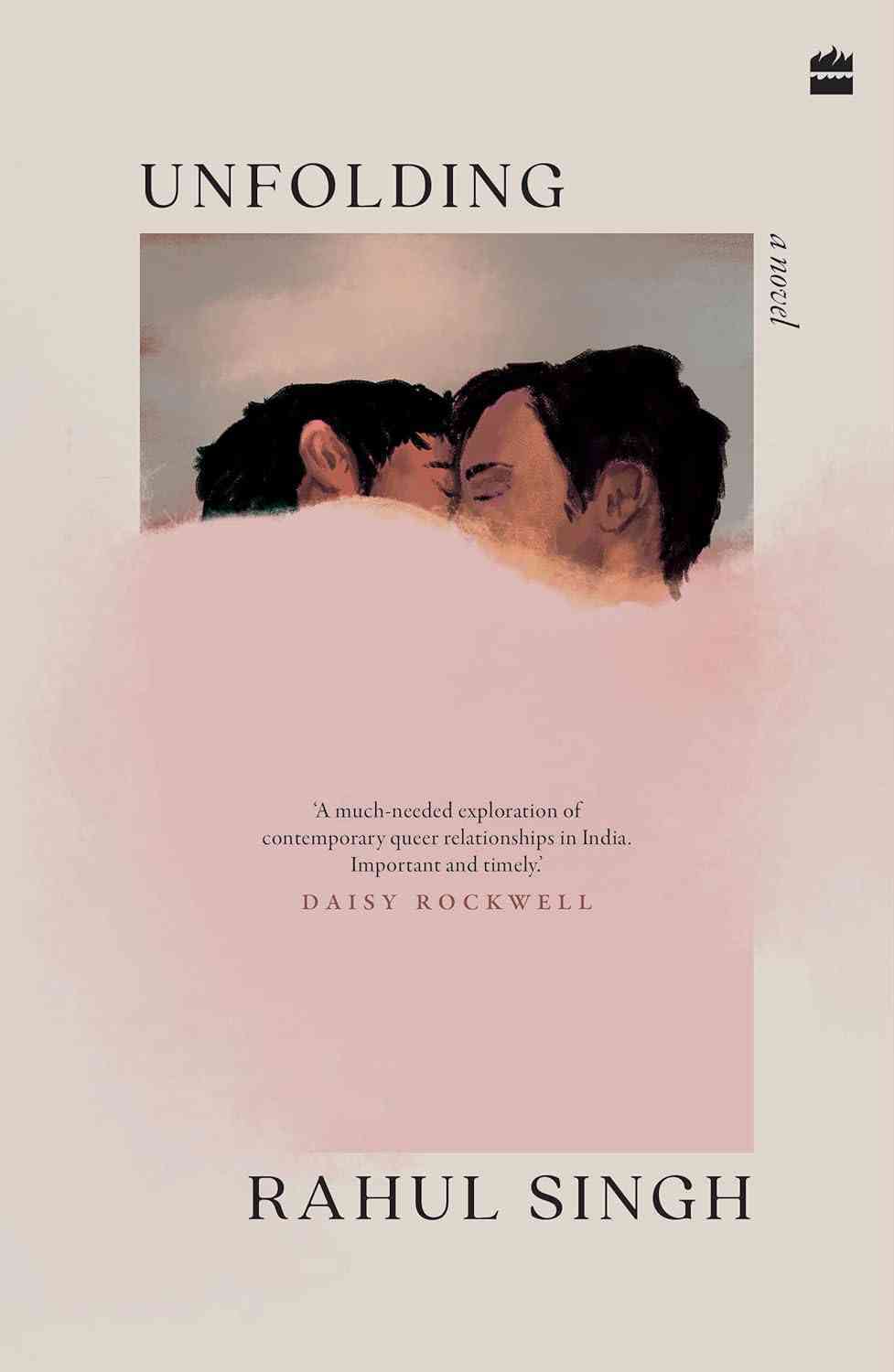


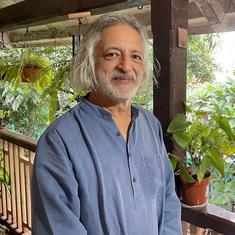

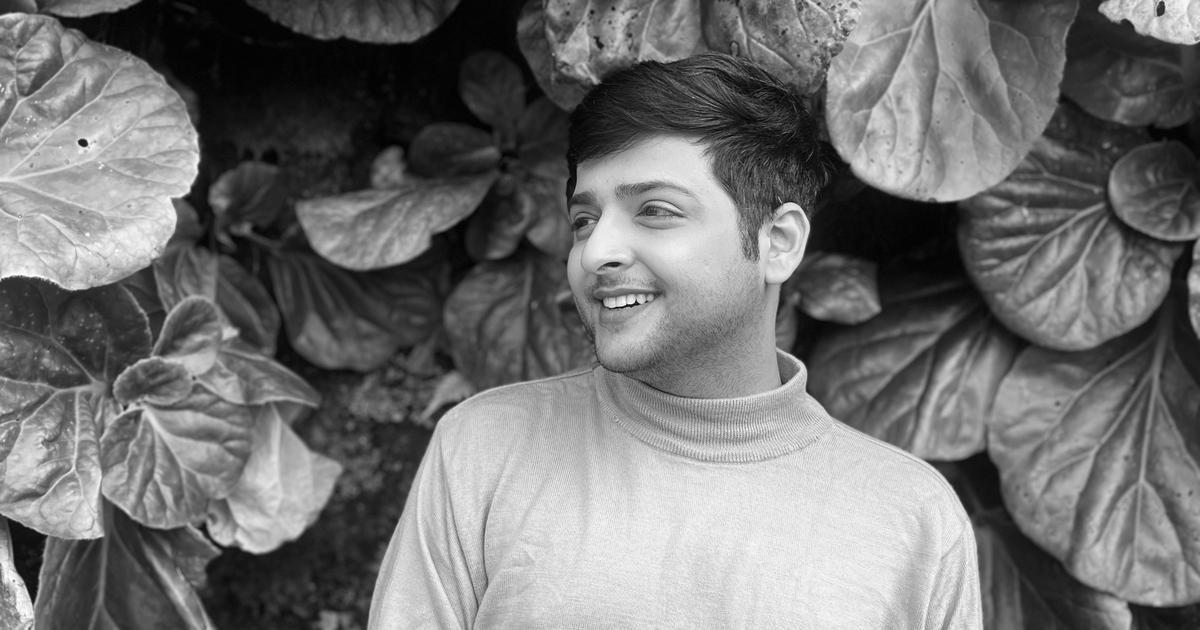
Rahul Singh’s Unfolding may be a debut novel, but the self-assuredness of its prose belies this. Its protagonists are Ralph and Ojas, two men in an on-again, off-again relationship, and how their desires, insecurities, obligations and griefs affect their partnership. The life of the third protagonist, Ralph's household help Zubina, is intertwined with theirs as she watches it develop, sunder and come back together – and how this changes her own ideas of love.
At present, Singh is an Assistant Professor in Sociology at St Xavier’s College (Autonomous), Kolkata. Scroll spoke to him about the book. Excerpts from the conversation:
Tell us about how you came up with the idea of the book. Where did it begin?
I started writing the book in 2020. I don’t think there was any one moment that led to the book. Any fiction with Muslim characters, even queer ones, was mostly very political in nature and talked about the state’s role. I felt that I wanted to read more than that. I also wanted to read more about queer characters than simply their coming out or realising their sexuality. I’m not saying these narratives are not important, but they are already out there. I wanted to read something different, about intimate, domestic spaces in Indian writing in English, so I wanted to write it. I took that Toni Morrison quote very seriously – that if you want to read something that’s not been written, you write it.
Could you tell us more about the characters of Ojas and Ralph being in an open relationship?
There are some people who ask me if they are in an open relationship because of something that happens (to the characters) in Darjeeling, that Ojas was so hung up on it that he wanted to take revenge. I never actually clarified that and it’s for the readers to interpret the text. I don’t think the open relationship is related to either the anger or the jealousy that Ojas experienced. He simply wanted it, wanted to explore. I felt that otherwise it would mean that one is already making a judgment, that an open relationship has to come with something negative, something traumatic. But I don’t think that was the case in the novel at all. It is Ralph who is interpreting – maybe he is hung up on this, maybe there is jealousy, maybe there is anger. But as a writer, I did not take any stance. I opened it to Ralph’s interpretation.
The exposition in the book occurs in reverse – you follow the trail backwards through the thoughts of the characters. It’s not a linear narrative. Why did you choose to create that structure?
I’m glad you asked this question, and I’m glad you noticed it. It’s something I did not do very consciously; it just happened – that was how the novel and the characters were coming to me. I really like reading books with a stream of consciousness narrative, where you keep floating from one moment to another, back and forth. It has a very Proustian quality to it, and at the time that I was writing this book, from 2020 to 2025, I was reading Proust. These are also men and women in their 30s – a lot of life has already happened to them, and I am arriving at a particular juncture where they are living out consequences. How they will currently react to situations really depends on what they have undergone in the past. So, I wanted to give the characters their own histories, and then make the reader understand why they are doing what they’re doing. It also meant that I did not have to create separate chapters, saying, “This is two years later, this is three years later.” And it goes with the title Unfolding, when so much is happening in the present, but also a lot has happened in the past, and the past and present continuously merge in one’s life.
I found it interesting that you chose not to have your other protagonist, Zubina, reconcile with her sister Zeenat at the end. Why did you leave that bit open-ended?
I think if I did that, it would become too filmy, and it would just become a Bollywood script! Given that they have a very complex history, even though at the end Zubina thinks of apologising, I don’t think she would approve of what Zeenat did or the kind of things she got away with. That is also part of Zubina’s character, how she holds on to certain things, and that she’s not so amenable to change, despite being a very curious person. A reconciliation is not how I would imagine Zubina would deal with the issue. I wanted Zubina to still hold on to what she truly believed in.
I found her reflections on love after seeing Ralph and Ojas together very interesting. Instead of being scandalised and judging them, where does Zubina’s desire to feel love like them come from, as a character that’s not used to thinking that way?
When a woman is working for two men, it can present a very awkward gender and class dynamic. But Zubina really likes them as independent men. She really likes Ralph, she really likes Ojas, and she likes talking to them. I think that throughout the novel, what I’ve tried to show is that she still cannot fathom the particular aspect of them together. Deep down, something in her tells her that something is wrong, but till the end, she doesn’t acknowledge it. It ties into how she will hold on to what she believes in. Also, homosexuals live in a world where their ideas of love, belongingness and togetherness generally come from representations of heterosexual ideas. A queer child grows up watching films of a hero and heroine falling in love, and generally, that is how notions of love, even among homosexuals, are built. So, in this novel, I wanted to completely undo that and make it the other way around, how there is a heterosexual woman looking at two men getting intimate and thinking of her own love and intimacy in that way.
Let’s talk a little bit about the intersections in the novel – of gender, class, sexuality, and caste. Would it be correct to say that you wanted to get away from portraying characters that are more visible in the mainstream?
I’m trained in sociology, and I wanted to write a novel set in Kolkata, but without having the Hindu upper caste Bengalis in it. I wanted to completely undo the expectation from a Kolkata novel by having no protagonist who belongs to that kind of social echelon. I was also clear at the outset that my novel’s going to be set in a flat in Tangra (a neighbourhood known for being the home of the Chinese community in Kolkata), where these two men live. Once I had located Ralph, I knew he’d be Christian and Bengali, and then Ojas came about. I also knew that there had to be a woman who had to come and work here. If we look at the map of Kolkata, opposite Tangra is the neighbourhood Topsia, inhabited largely by the Muslim population. So that is how Zubina came into being, because I was imagining the novel within a particular spatial location. I did not want to write about, oh, she’s Muslim, so she’s suffering. Oh, he’s Christian, so he’s marginalised. They are gay, so they are marginalised. I think with working-class characters, especially those living in slums, there is a huge tendency to write highlighting the crimes in the neighbourhood, and how miserable their lives are. This is also where my training in anthropology and sociology came in use, and that helped me to see her as more than simply a person who’s dealing with poverty. And I think it is this I wanted to investigate, and in doing this, their identities came into being.
I found that Kolkata and its many lives are almost a character in the novel – the way that Park Street is portrayed as a refuge and a place where marginalisation can happen to people who are othered, or Tangra as Ralph’s home, or how Alipore is automatically associated with grief for Ralph. Did these linkages that you make with geography happen organically, or was this something that you set out to do?
It did happen very organically, because while I was doing this, I was also doing research for my master’s degree – visiting neighbourhoods and conducting field work. I was reading so much on Kolkata at the time, about the urban history, about the urban spaces in the city. I just put them in these places, and then I thought, how are they reacting to these spaces? I didn’t have an ending in mind; I just knew how I wanted to start it.
The anxiety that Ralph has about ageing and being alone as a queer person is very relatable. Why was that such a concern for you? Do you think it was a direct result of seeing his mother sicken and pass, or was it just the ideals that we kind of imbibe in our lives, these heteronormative ideas of companionship?
I think for Ralph, it was a combination of both of these. First of all, he was extremely lonely since his mother’s passing, so that had a huge impact on how he was now viewing life. It is also the larger queer experience and the anxiety of loneliness that queer people continuously live with in a largely heterosexual society. So sociologically, statistically, it is proven that gay homosexual men’s relationships are not as long-lasting as, say, other kinds. There is an entire dynamic of power conflict that goes on between two men because of the larger patriarchal setups in which they are born. And I show this throughout the novel, how masculinity is always at loggerheads between the two men. Because such relationships are not institutionalised, Ojas feels that he’ll eventually end up alone. For Ralph, I think it has to do with his inability to have full faith in himself, since he, at the end of the day, is constantly going back and forth to other people and seeking reassurances in one way or another. When he is alone, he’s absolutely miserable; he’s unable to find a footing for himself. This is very particular to Ralph, but also very structural to queer experiences. Although this novel may not be about the struggle with coming out, that doesn’t discount the fact that queer men or women and folks do have particular kinds of struggles in their lives that are structurally mandated.
Ojas is almost a third parent to his younger brother, Sarvesh, and I found it interesting that his younger brother is ready to accept him, but Ojas finds himself unable to open up to him. Why do you think Ojas has this immense amount of anxiety about living his life openly?
Ojas is a very shy character, and he realises that he can’t open up to his family and so tries to live his life beyond that. Many queer men live that way, where they have two very separate lives. One is within the domestic space with the family they want to live with, and then they become completely different once they are outside. Ojas has taken up the role of running the family business, so he knows that he can’t just completely overthrow the life he’s led with his family in order to assert himself, and he also really cares about his family and wants to hold them together. He realises what he can do is just use silence as a mechanism to let the days pass.
And with his brother, I think the relationship has a lot to do with the age gap that they share. Almost a decade – and that does make for certain kinds of gaps and silences in the relationship. The brother is trying to bridge the gap throughout the novel, but Ojas is very resistant. He’s very secure about his other life and doesn’t want the two to mix ever. I think by the end, we do realise that he's sort of ready, and we see the first changes.
We were talking about how there are no neat endings, especially in the case of Ojas and Ralph.
I purposely kept the book in a very open-ended way, because they are not dead, right? I feel a closed ending is when the characters cease to exist. It is just an episode in their life that the novel is trying to capture. I wanted to let the characters reveal to the readers what unfolded in their lives, and what more would eventually unfold in the future. I didn’t want to put neat endings because I didn’t think it was required. Their lives go on.
The book reminded me of this novel called Less by Andrew Sean Greer, and the way that it deals with a long history of relationships, and about on-and-off relationships, and about the emotional complications that come with relationships. Were there any novels that inspired you while writing?
There are some authors and writers who were very important when I was writing this. I really love Anne Tyler. I love the way she is able to create the variety of tensions that exist in a family. I also like her writing style, and I remember telling myself that if I were ever to write, I wish I could write like her. That’s why the introductory quotation in the book is from one of her novels that I’m very fond of.
Secondly, there is Garth Greenwell, and the way in which he portrays intimacy and the various kinds of problems that gay men deal with. I learned a lot from his writing and the way he speaks about how gay men deal with both personal life and the broader structural forces acting on them, and how to also write about intimacy. I was reading Cleanness and What Belongs to You. And then his very recent novel, Small Rain, was just wonderful.
Amit Chaudhari played a very important part, his very granular observations of the everyday life in the city. I read one of his books every year. It is through his works that I also thought about how I could bring alive these very fine details of the city, of the spaces in the city, the everyday lives in the households. I was also reading a lot of Marilynne Robinson, and I think the influence of her novel Gilead about religion and race made me think about how to write Zubina.
And lastly, Joanne Harris’s Chocolat, to write about food, because Ralph is a baker.