






What does it mean to be a storyteller, a memory keeper of a land and its people? What does this mean specifically when you’re mute and everything you’ve ever known is on the cusp of irreversible change?
In Huthuka Sumi’s novel for young readers, Giants, Kato, a mute 12-year-old boy, and his best (and, let’s face it, only) friend Apu live in the mountain village of Ayito-phu in the state of Nagaland. His parents are farmers, and this life with its seasonal routines, hard work, and simple pleasures is the only one he has ever known. He likes the sameness – “It was always like this. He wished it would always be like this” he thinks as he runs down the hill after school and first hears the “pentatonic singing” of his parents as they work in their family field, and then sees, as always, his mother “outlined against the terraced fields, one hand raised to her eyes, another resting on the handle of her hoe”, cautioning this wind-spirit-like son of hers to slow down lest he stumble and fall.
One of his most cherished pleasures of their daily routine is the stories that his beloved mother and grandmother have raised him on and that he pesters them to repeat. His particular favourite is the one about Alhou, the almighty creator, and how, before he created man, he brought forth the shi-kheu to look after the animals in the forest, the aki-ghau to look after the rivers and fishes, and the timi-ala, the giants, to look after the men as they wandered the great forests and jungles.
Stories and storytellers
The stories are Kato’s escape from the shame about his muteness, his “defect”, that he has internalised from when he was just three years old, even though his own family have never made him feel anything but loved. Every time he feels this “smallness taking root”, he fervently wishes that the stories themselves may come to find him one day, that he too may experience what it’s like to be a character in a world far removed from his own, because isn’t that what everyone forever changed by them always wishes for?
One night, Kene the giant, one of the fabled Old Ones, the timi-ala, seeks him out with an urgent request. “I need a storyteller.”
But how can a mute boy possibly become one? Surely there has been a mistake.
“Trust me. There is no one better than you.”
It is the early 1940s. Change isn’t coming so much as it is already here. In the form of the “white man”, their “half pants” and “guns”, their “civilisation”: “It was a strange time, a time when the new hadn’t quite replaced the old, yet the old was no longer itself either.” It is a change the land feels most keenly, aware of all that it heralds. The Old Ones are on their way to the long sleep always destined, but when they finally return in the future, at a time foretold long ago, they will have nothing to return to without their memories.
“We do not wish to be forgotten,” Kene tells Kato. Without stories there would be no memories, and without memories, how will we remain rooted? “The stories, that is how we live. The greatest and smallest of living beings.”
Kato doesn’t realise it then, but over the course of the following year, during the nights when Kene visits to spirit him away and in the stark light of day when “life” goes on in the way it always has (until it heartbreakingly doesn’t), he will be transformed. For that, he must not only overcome his doubts and fears and absorb all the stories that Kene shares with him, but he must also learn what it means to tell the truth, the courage it requires to be a storyteller and shoulder the responsibility of being the bridge across times for his land and his people – just as Kene is bridging an essential gap for him, entrusting him with the tales of the land. A land soon threatened by a war that isn’t theirs but gouges chunks out of their lives regardless (the Battle of Kohima, fought in 1944 between the British and Imperial Japan).
Kato, whose inner life is so vibrant, expressive, and full of potential, stumbles again and again, succumbs to the ugly feelings and secrets he feels too ashamed of sharing, and marinates in doubt and despair. He is afraid of making the unbreakable oath to the land without which he cannot become the storyteller the Old Ones need – it will immediately see the festering secret in his heart, that he’s a coward and a liar to boot. That somehow it was mistaken, and he was never worthy. But, when the time comes, he will learn that to love and be guided by love is to be brave; it is also because of that same love that he must let go even when it shatters his heart. When all is done and the dust disappears where it came from, when it’s time to pick up the pieces of loss and rebuild through the grief, Kato will finally understand that there are many different ways in which to have and wield a voice, if only you can find yours first and embrace it with integrity and conviction. To be a storyteller is to listen and to observe as much as it is to tell a story and be able to speak to do so. There are pathways visible only for a storyteller. And yet, none of this means the answers sought are easy, with crisp corners and smooth borders.
The heartbeat of the land
The Sumi tribe, like the others that make up the Naga people, come from a rich oral storytelling tradition that’s evident here in all of its glory. All Huthuka Sumi has done is commit them to the page; the atmosphere remains that of hearing a story around a fire on a cold, clear, starry night. And though he sprinkles in much of his own fantasy worldbuilding too, he nevertheless pulls from the folklore and myths and beliefs lying deep within the soil of his ancestors – capturing the spirit of where and who he comes from without falling into the trap of the exotic. The narrative is quiet and meandering (sometimes too much so) until it finally erupts into chaos towards the end. In this, it is capably aided by a writing style that fluidly traverses the line between the fantastical and real, navigating past and present and future.
Ayito-phu and its residents, especially Kato (with a special shoutout to Apu), come alive through sensory detail. In a story which espouses the importance of the earth, the land underneath our feet that sustains us, it is apt that the location and its surrounding forests, mountains, and rivers, are their own characters – “the heartbeat of the land”.There is also surprising levity and humour sprinkled in, especially in the first half of the story, which reminds us that yes, this is a middle-grade novel with a protagonist who’s as mischievous and impulsive as any other young imaginative boy of that age. And even though Sumi makes Kato really work (and suffer) for his epiphany, there is hope, that wondrous place where faith is bigger than fear and storytellers can rest
Giants is a story of another time, life, and place, but one with an almost keening modern-day relevance and urgency to preserve our stories, our legacies, our heritage, before they are lost forever.
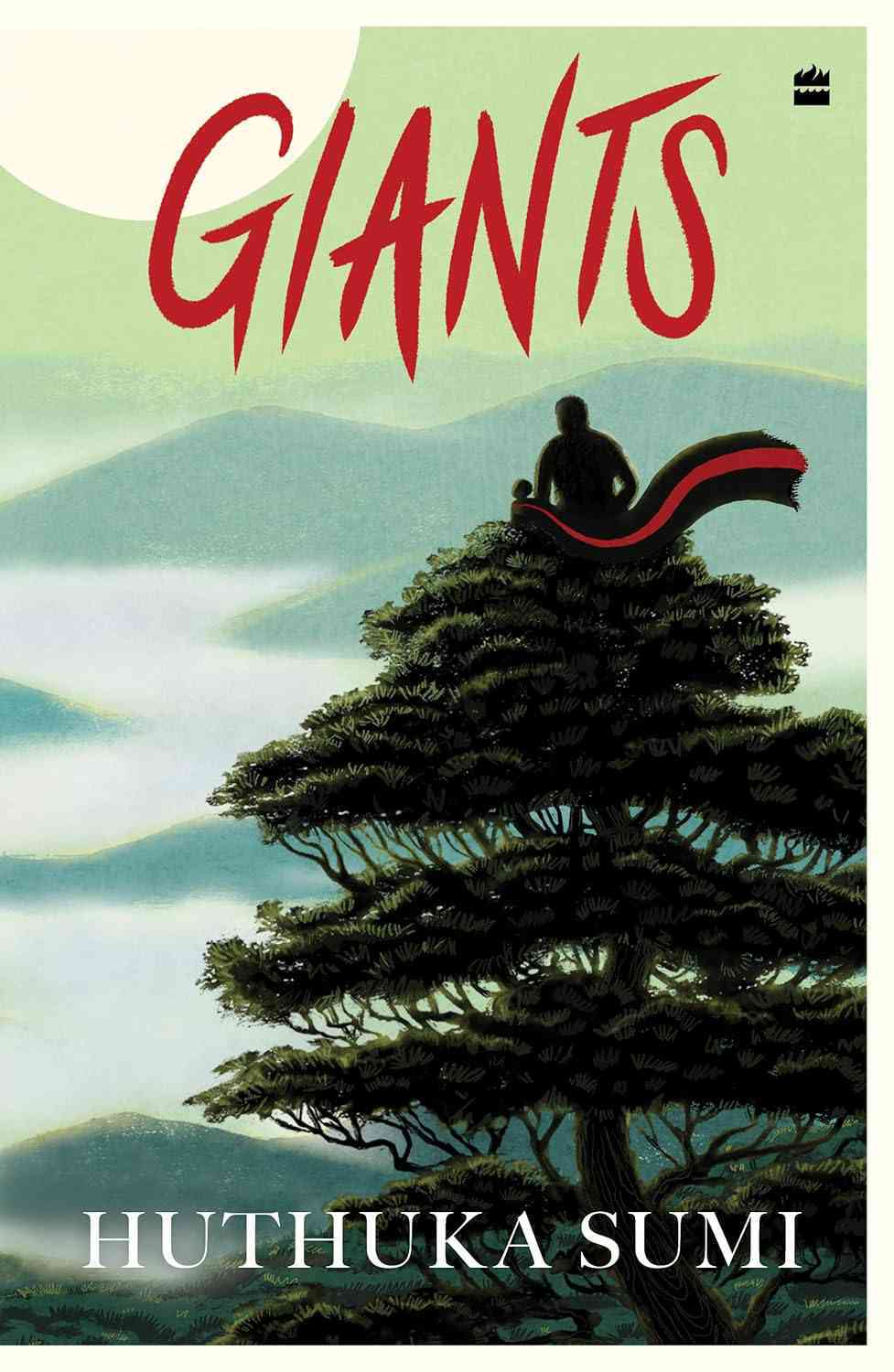
Giants, Huthuka Sumi, illustrated by Canato Jimo, HarperCollins India.
