








For a long while, the dancer faced her back to us.
She was curled into herself, lit by a soft pool of light. A single note from the violin pierced the air and lingered – stretched, almost impossibly, into time. Somewhere, the heartbeat of a tabla. Before her, an image shimmered into form: a planet, an orb, holding earth, fire, water, air, ether – elements that transformed one into the other, slowly fading and coming into being, the sphere glowing and receding into an eclipse of light.
The performance unfolded almost imperceptibly. A hand rose. A gesture gathered itself. What was closed began to open. Fist into fingers. What was seed began, quietly, to unfurl.
This was how A Journey Within opened – and, in many ways, how it continued: not as spectacle or outburst, but as emergence. We were witness to movement that revealed itself only through duration, attention, return, held together by poet and dancer Tishani Doshi, whose practice is shaped by yoga, Butoh, and her long association with the Chandralekha Group in Chennai.
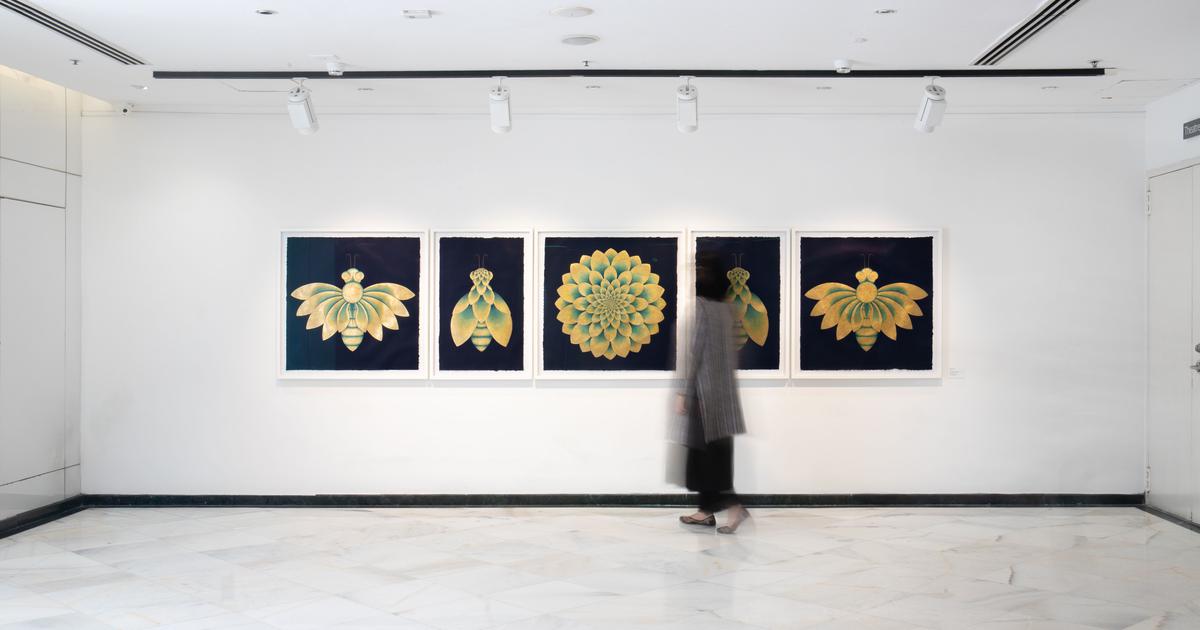
The performance accompanied the opening of Olivia Fraser’s exhibition (also titled A Journey Within) at the British Council, Delhi – and intentionally so. In her welcome speech, Fraser invoked a passage from the 7th-century Vishnudharmottara Purana, in which a king seeking to understand painting is told he must first learn dance; to understand dance, he must learn music; and before music, the art of singing.
What the story proposes is not hierarchy, but interdependence. And it is this interdependence that the performance enacted – where painting, movement, sound, and light did not accompany one another, but arose from a shared, underlying rhythm.
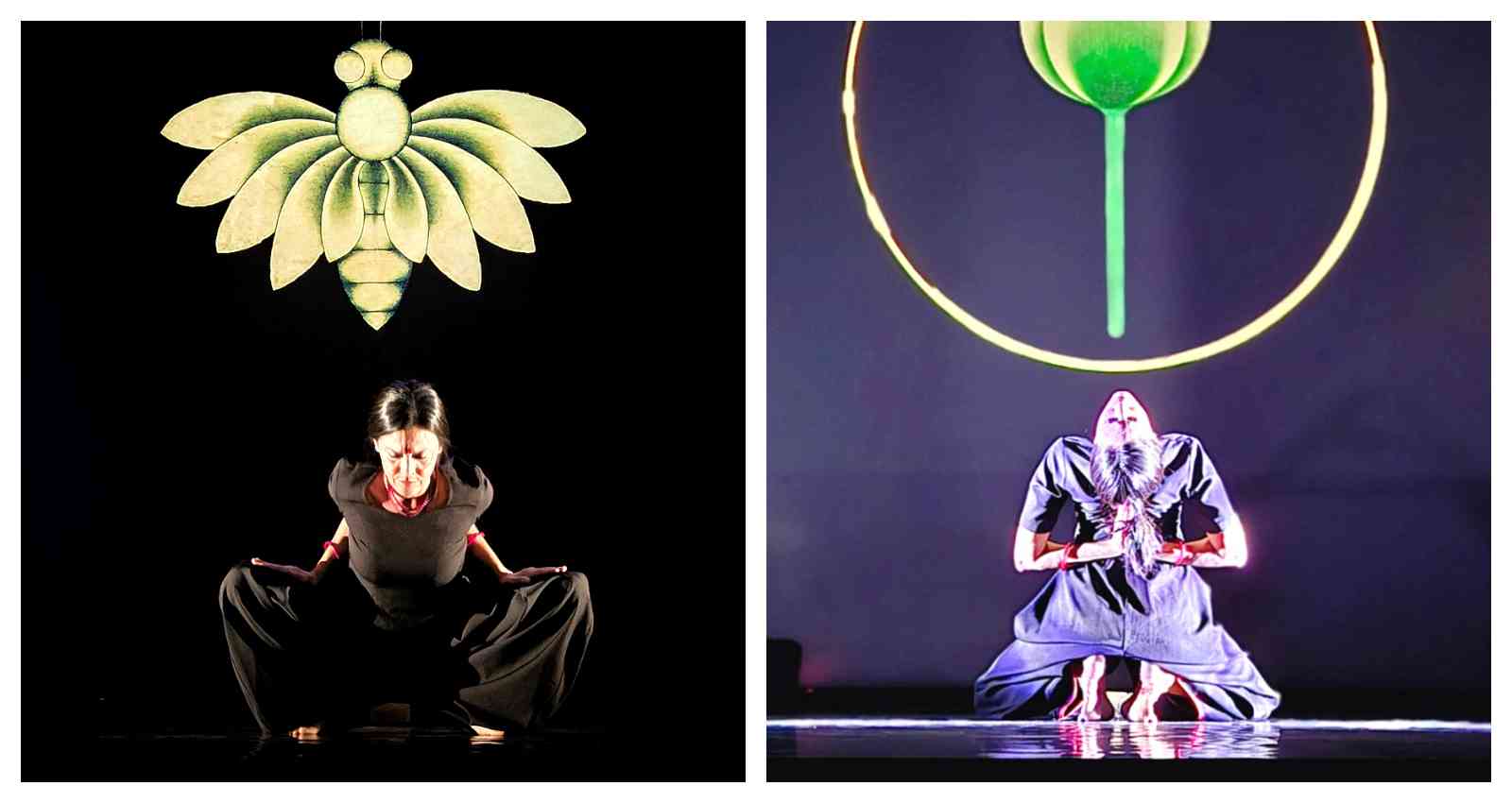
As Doshi reflected, there is in both dance and miniature painting “a lot of play between what is immediately visible and what’s hidden… something you only see when you return and look again.” Her choreography inhabited precisely this threshold.
For the opening stretch, the alaap, she withheld the frontal body entirely, working through back, spine, breath, the slow articulation of limbs. “My movements are very slow… there is no heaviness of narrative – just one body on stage, unfurling.” That unfurling became the central metaphor of the evening.
Stillness as movement
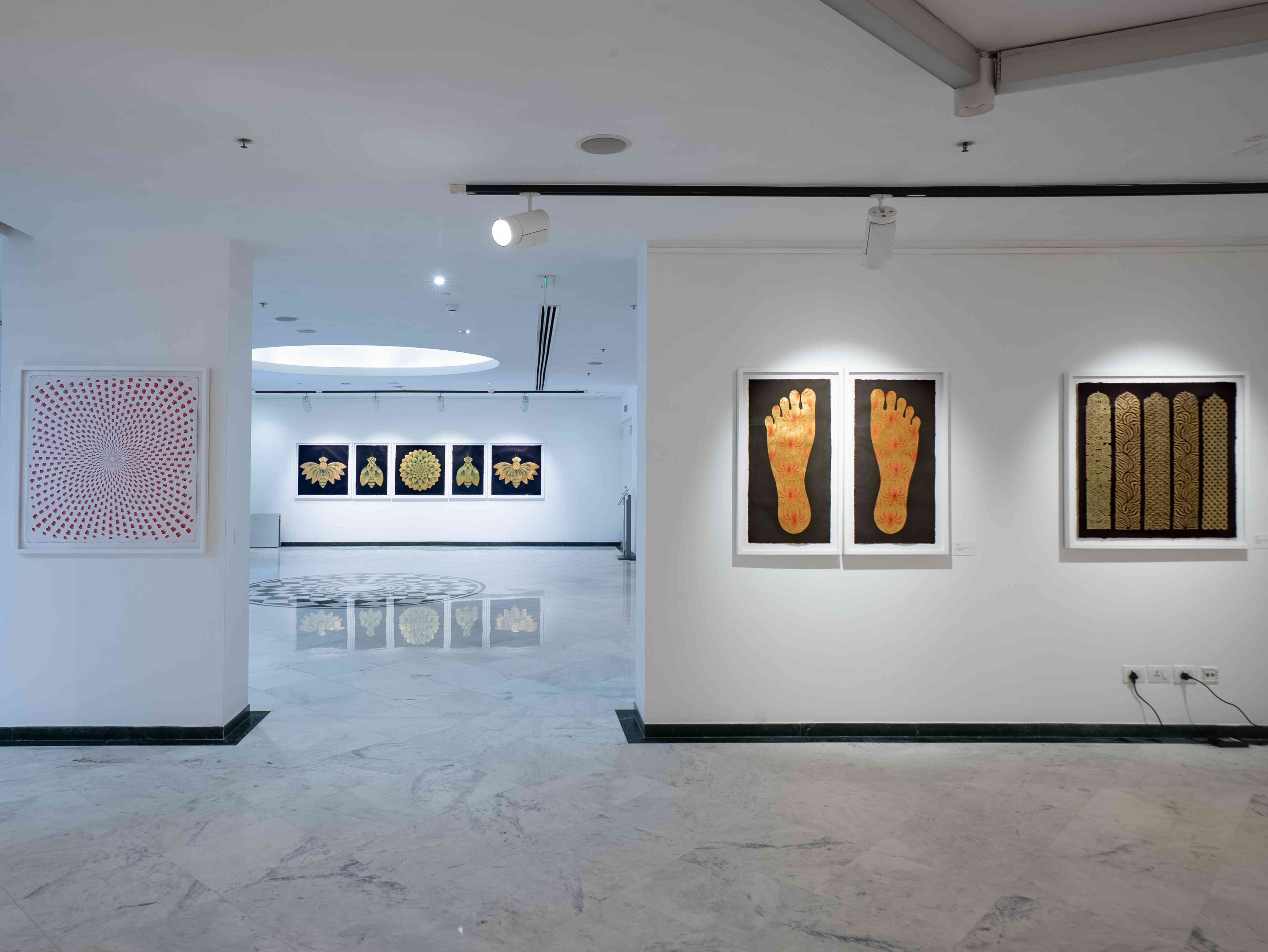
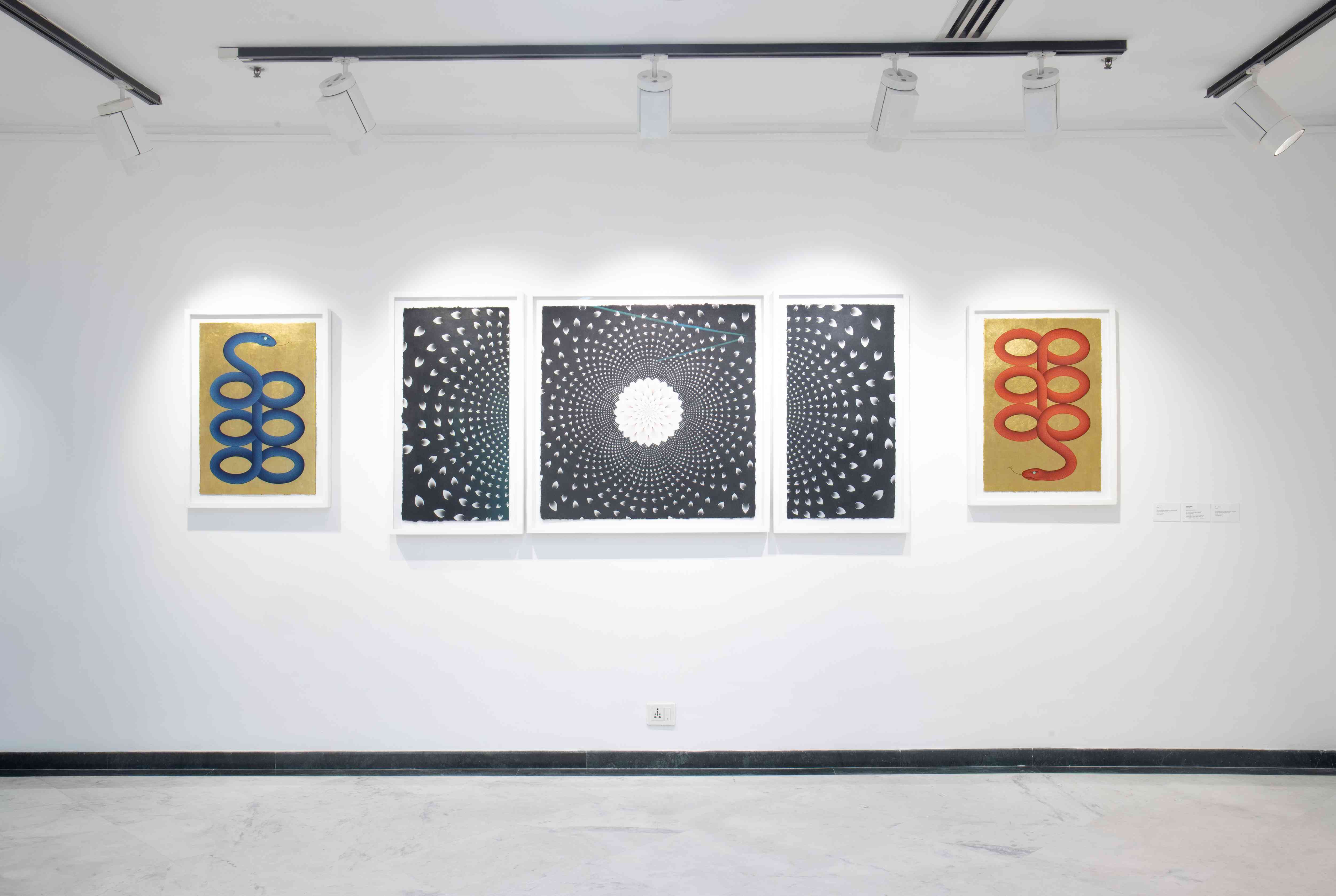
To encounter Fraser’s work is to first encounter stillness – meticulous, luminous, deeply held. Rooted in the traditions of Indian miniature painting, her works are built through repetition, geometry, and the patient labour of gesture. A serpent coils endlessly across gold ground; a lotus radiates outward in perfect symmetry; fields of repeating forms – petal, scale, leaf, seed – seem at once fixed and vibrating. These are not static images but, as Fraser describes them, “an inner metaphysical world of pulse, rhythm, breath.”
To stand before them is to experience a subtle destabilisation of time. Your eye moves; the pattern shifts; something almost imperceptible flickers into motion. “If you look at them long enough,” noted Samuel Sawian, visual designer for the performance, “they seem to come alive, breathing gently.”
The movement of paintings
It is this latent movement that the performance drew out. Sawian’s projections did not animate the paintings in any conventional sense – instead they extended them, allowing forms to dissolve, reconstitute and migrate across the surface of time. “The stillness remained central, even as the images subtly changed,” he explained.
Projected large against a black backdrop, the images were planetary: orbs suspended in darkness, evolving. A lotus became a bee became a mandala of bees. Patterns transformed so gradually that, as Fraser put it, “you weren’t quite sure when the change happened.” This was not animation in the sense of imbuing something with life, but coaxing out “something already present within them,” Sawian reflected. “A kind of life waiting to emerge.”
Time made visible
If visual projection allowed the paintings to enter time, lighting shaped how that time was experienced. Lighting designer Deepa D. approached her work not as illumination, but as rhythm – drawing from the slow, meditative structure of dhrupad. She described her process as “playing out a vilambit bandish through the lights,” shaping the performance through duration rather than emphasis.
Her solution was radical in its restraint: isolate single elements from the paintings, allow them to surface bit by bit, let transitions occur so gradually they evade perception. “I did not, at any point, want people to notice that the lights were changing,” she explained. Some of these transitions lasted up to two minutes.
The effect accumulated slowly. Colour transmuted, intensities rose and fell, but always beneath the threshold of our awareness. The space contracted, becoming intimate, almost interior. Light worked not simply to direct attention but to carefully condition it. It taught our eye how to hold a gaze.
Time made rhythmic
If light shapes time, sound inhabits it from the inside.
For Jason Singh, “each component needed to breathe alongside the others” — and so he built not a fixed score but “subtle soundscape textures that could evolve in real time.” As a beatboxer, his own breath entered the work too, sculpting air into wind, leaves, and birdcall, blurring the boundary between human and more-than-human.
This sensibility extends beyond the stage into the exhibition itself, where a continuous sonic field hums through the gallery. At its core is the biosonification of a banyan tree from the garden of Olivia and William Dalrymple’s home on the outskirts of Delhi: its internal electrical signals translated into sound, “a kind of sonic expression of its inner activity”. The result is something living, constantly shifting, quietly communicating.
The note that opens the world
On stage, the performance was held together by a thread of constant return. Violinist Sharat Chandra Srivastava began with a single sustained note: sa. “One note… and that note will define the whole show.” It was less an opening than an attunement – and from it, everything else oriented itself.
Around this note, the performance gathered its pulse. Tabla player Gyan Singh grounded the work in taal and laya – the cyclical structures and tempos that, as he described, “hold the pieces… together”, giving the work its pulse and direction. If Singh created atmosphere, Gyan anchored: heartbeat and cycle, breath and return.
Yet this grounding was never rigid. Improvisation remained central. Gyan Singh spoke of responding continuously – taking cues from the dancer’s bhaav, from shifts in the music, from the shared unfolding of the piece, sometimes offering a rhythmic phrase, sometimes withholding it. Silence, too, becomes part of the language – “restraint,” as he noted, was as crucial as sound.
For Srivastava, too, the process was one of deep listening: “The whole show is about observing… absorbing first, then responding.”
His playing shifted continually in relation – to the dancer, to the projections, to the evolving sonic field. “Each line has a meaning… depending on the movement and what I see.”
Improvisation here was not flourish, but relation. A gesture extended, and the music followed. A phrase repeated, and the rhythm gathered it.
“It was a give and take,” Srivastava added, “all of us together as one.”
The effect was quietly riveting. Sound did not drive the performance forward so much as hold it in a state of constant becoming – anchoring the unfolding even as it remained fluid, responsive, alive.
The Body: Metamorphosis
At the centre of it all, of course, the body – slow, deliberate, transforming.
Doshi’s movement was pared down to its most essential impulses, drawing from yoga’s inward attention to breath and alignment, and from butoh’s radical reimagining of the body as mutable, porous, and continually becoming. What materialised was metamorphosis. The body moved through seed, plant, insect, mandala – less through representation, more through resonance.
There were moments when everything aligned: a projected lotus bloomed just as her hands formed its echo. The audience gasped. Time seemed to stretch, soften. “We didn’t plan this,” Sawian recalled. “We created space for it, and it arrived.”
A shared field
What distinguished A Journey Within was not simply its interdisciplinarity, but the way it dissolved hierarchy. This was not painting accompanied by dance, or music supporting image. It was, as Singh described it, “a sense of interconnectedness – between disciplines, between people, and between the natural and human worlds.”
For Fraser, the collaboration has altered her own sense of her practice. To see her paintings translated into movement, sound, and light, she said, “made me alert to things I was only dimly aware of before: to hear trees breathing, to feel the rhythms and patterns of the music, and to watch the slow dance movements unfurl… was a revelation.”
The result was not simply collaboration, but transformation — an expansion of consciousness that moved both outward and inward at once. The journey within, it turns out, is not solitary. It is relational.
Toward the inner
What lingered, finally, was not any single image or gesture, but a shift in awareness. Of attention deepening. Of boundaries between inner and outer worlds quietly giving way. Fraser speaks of her work as an attempt “to slow down the viewer and bring them… on this journey within.”
The performance – and the exhibition that surrounds it – realised that ambition with rare clarity. Not by directing us inward, but by altering our conditions of perception. So that, at some point – quietly, almost imperceptibly – we found we were already there.
Janice Pariat is a poet and writer.
A Journey Within runs at the British Council, Delhi, until April 25.
