







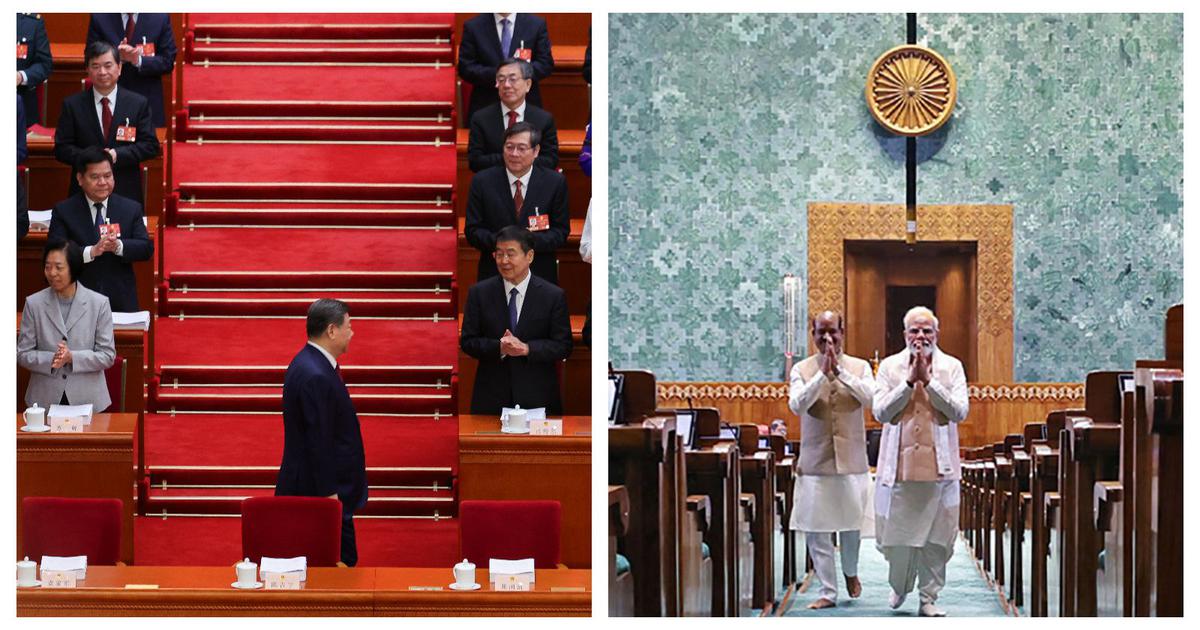
The Bharatiya Janata Party-led government’s decision to summon a special session of Parliament on Thursday to discuss bills to expand the size of Lok Sabha has ignited a debate that goes beyond mere seat arithmetic.
The increase in the number of seats is being framed as a constitutional necessity to ensure better representation for the growing number of voters. In effect, the move appears to be the latest brick in a structural wall being built to imprison Indian democracy.
We are witnessing a transition where the machinery of governance increasingly reflects the political management of the People’s Republic of China, moving away from the deliberative friction of Western democratic models – most notably the high-scrutiny system of the United States.
Perils of a mammoth parliament
The push for delimitation – redrawing the boundaries of electoral constituencies – threatens to create a mammoth Parliament of over 800 seats in Lok Sabha.
It would seem to mirror the model embodied in China’s National People’s Congress. When the nearly 3,000 deputies of the National People’s Congress meet in Beijing every year, all they do is provide a veneer of democratic legitimacy to decisions already finalised by the Party’s central leadership.
A legislature of such gargantuan proportions is inherently unwieldy. When hundreds of members are squeezed into a session, meaningful deliberation vanishes. Individual scrutiny of bills becomes impossible, and the executive’s grip tightens: the floor becomes a site of acclamation rather than accountability.
By expanding the House while simultaneously weakening its oversight committees, the state ensures that Parliament remains ornamental – architecturally grand but democratically hollow.
This stands in contrast to the United States Congress. Despite the population of the US tripling over the last century, the number of members of the House of Representatives has been capped at 435 since 1911. The American model is predicated on the belief that for a representative to be effective, they must have a distinct voice.
In a smaller, capped legislature, an individual member can influence a committee, hold up a partisan bill and command national attention. This “constructive friction” is the engine room of democracy. But by opting for a mammoth Parliament instead, the BJP-led government is choosing to drown individual MPs in a sea of numbers, effectively migrating all real power to a centralised executive office – the Indian version of China’s Politburo.
The meek opposition
Already, the structural dilution of the legislature is accompanied by a chilling transformation of the political landscape: the curated weakening of the opposition. In China, the “United Front” system allows for eight minor parties – but they exist on the condition of absolute subservience to the Communist Party. They are not competitors; they are consultants.
While these parties – such as the China Democratic League – hold seats in the National People’s Congress, they are constitutionally bound to accept the “leading role” of the Chinese Communist Party. Rather than offering adversarial dissent, they help strengthen the facade that the government is representative, while ensuring that legislative outcomes align with strategic goals.
India’s political ecosystem is tilting toward a similar controlled pluralism. Through the aggressive use of the investigative agencies against political rivals, the choking of their political funding and the engineering of defections, the ruling party is hollowing out the opposition. The goal appears to be an India where opposition parties still exist – to maintain the appearance of democracy for the world – but are too fractured and intimidated to pose a real challenge.
Like the minor parties in China’s National People’s Congress, they are being relegated to the role of a “meek opposition”, allowed to speak only within the boundaries set by the ruling party.
The unitary state
The most striking parallel between the two systems lies in the project of cultural homogenisation as a prerequisite for national power. China’s stability is built upon the bedrock of Han-centrism, where the state actively subordinates minority identities – Uighur, Tibetan, or Mongol – to a singular, state-defined “Chineseness”.
India is currently pursuing its own version of internal consolidation through the lens of Hindutva, seeking to redefine “Indianness” through a specific religious and linguistic identity.
By creating the narrative that India is a “civilisational state”, the ruling party has positioned itself as the “vanguard” of a cultural rejuvenation. Much like the Chinese Communist Party is indistinguishable from the Chinese state, the attempt here is to make the ruling ideology indistinguishable from national identity.
Those who dissent are not merely political opponents; they are framed as “anti-national,” echoing the Chinese Communist Party’s rhetoric against “splitists” and “subversives”.
This cultural shift finds its structural anchor in a long-standing war on federalism. Rooted in the ideology of “one nation, one people, one culture”, the ruling party has long viewed India’s diverse state identities as obstacles to a centralised core.
Rashtriya Swayamsevak Sangh chief MS Golwalkar’s 1961 memorandum to the National Integration Council provides the foundational blueprint for this shift, explicitly denouncing federalism as a “fundamental mistake” and advocating for a “One Country, One Legislature, One Executive” model.
Delimitation is the ultimate tool for this Golwalkarian consolidation. By basing representation purely on population, the system effectively penalises the Southern states for their success in controlling their populations.
This stands in stark contrast to the US Senate, which grants every state two seats regardless of size to prevent the “tyranny of the majority”. India, conversely, is mirroring China’s management of its provinces, where local identities are subordinated to a singular interest directed from the centre.
The ultimate justification for this shift is the promise of “authoritarian stability”. The argument is seductive: to compete with the Dragon, India must stop “quarreling” and start “building”. Proponents of this idea suggest that a single-minded focus on development, unencumbered by the “friction” of dissent, is the only path to greatness.
The Argumentative Indian
But India is not China. Our diversity is not a bug to be fixed; it is our primary resilience. China’s stability is brittle, maintained by a staggering security budget and total surveillance. If India swaps its democratic soul – and the effective, deliberative strength of a true legislature – for a Chinese-style “efficient” machine, it risks losing the safety valves that have kept this subcontinent together.
We must remember Amartya Sen’s descriptions of the “Argumentative Indian”. For millennia, India’s strength has been its tradition of public debate, intellectual pluralism and the ability to voice disagreement.
Sen contended that this “argumentative” nature is not a hindrance to development but a prerequisite for justice and social well-being. To swap the Argumentative Indian for the Leaping Dragon is to trade a robust, self-correcting democracy for a fragile, top-heavy monolith.
Development without dissent is not a “New India” – it is a borrowed model that has historically led to the stifling of the human spirit. As the new, massive Parliament prepares to seat its hundreds of members, we must ask: are we building a monument to the vocal, deliberative spirit of our citizens, or a fortress for a one-party state?
The author is the Deputy Law Secretary to the Government of Kerala and author of “The Supreme Codex: A Citizen’s Anxieties and Aspirations on the Indian Constitution”. Views expressed are personal.
