





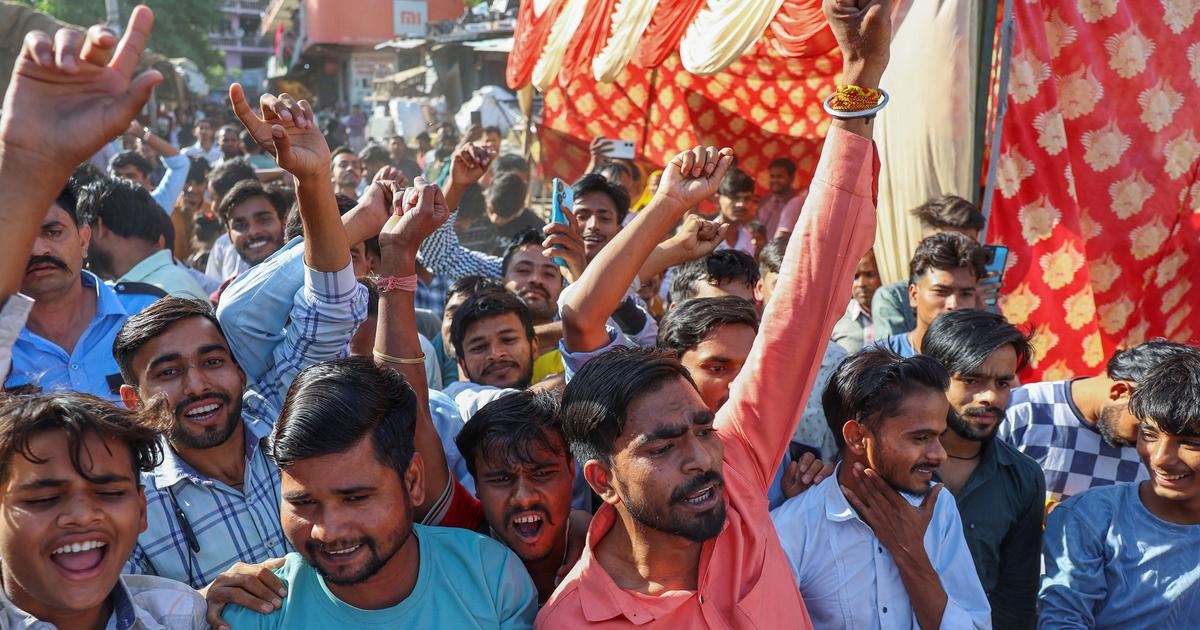
When workers in Noida took to the streets earlier this week, they did more than just focus attention on the unsustainably low wages that many Indian workers are paid. The spontaneous demonstrations across the Uttar Pradesh city also provided the opportunity for the country’s elite to blare out, yet again, their callous – and counterproductive – opinions about working-class Indians.
The fact that 40,000 workers had blockaded roads and torched vehicles to press their demand for a living wage should not have come as a surprise. Experts had been warning about the frustration building in India’s factories for months.
In December, commentator Anand Teltumbde wrote in Scroll about how the four new labour codes passed by the Bharatiya Janata Party government the previous month “legalised the exploitation of workers, formalised their precarity and celebrated their subordination as liberation”.
On April 1, only two weeks before the protests in Noida, trade unions had called a national strike to demand that these new labour codes be repealed. This action, as Nandita Haksar noted, was being organised when “workers are bearing the brunt of the economic fallout from the US-Israel war on Iran”. As a consequence of the conflict, cooking gas has become scarce and prices of essential commodities have started to creep up.
The immediate trigger for the Noida workers to spill out of their factories was the decision of the government of neighbouring Haryana to increase monthly minimum wage by 35%.
The Noida protest forced the Uttar Pradesh government to raise the minimum wage for skilled workers in Noida to Rs 16,868 from Rs 13,940 and for unskilled workers to Rs 13,690 from Rs 11,313. But many workers maintained that this was inadequate to feed, clothe, house and educate their families. They say Rs 20,000 per month is fair.
This entirely reasonable demand so offended the authorities, they set out to teach the protestors a lesson. More than 350 workers were arrested and seven FIRs were registered. The day after the protests, the police carried out flag marches to reiterate why workers should avoid the temptation of aspiring for dignity.
Politicians and the corporate media soon began to provide justifications for why the workers should not be taken seriously. Uttar Pradesh Chief Minister Adityanath speculated that the industrial action was an attempt to revive the Naxalite movement. Representatives of the corporate media parroted the police claim that “handlers operating from Pakistan” had used social media to instigate the protests. One television channel reported that protestors had been communicating through WhatsApp groups, painting their constitutionally guaranteed freedom of association as a seditious conspiracy.
As Nandita Haksar pointed out, the government is enjoined by Article 39 of the Constitution to ensure adequate means of livelihood for all citizens. It may be too much to expect India’s elite to appreciate this directive. After all, they seem to believe that constitutional morality is quaint anachronism. But, if nothing else, self-interest should drive them to support the campaign for fair wages.
Not only are adequately paid workers more productive, their increased spending on goods and services keeps the economy healthy – benefitting their employers. As the German business magnate Robert Bosch is claimed to have said, “I don’t pay good wages because I have a lot of money; I have a lot of money because I pay good wages.”
India’s elite seem to believe that the rising tide of the economy (projected to grow at 6.5% in 2027) will lift all boats. It is essential for them to recognise that millions of Indians do not possess even a rudimentary raft. That is the message emerging from the shopfloors of Noida and beyond.
Here is a summary of last week’s top stories.
Centre’s delimitation attempt defeated. The Union government’s bill to amend the 2023 Women’s Reservation Act and redraw the boundaries of electoral constituencies was defeated in the Lok Sabha. The 2026 Constitution 131st Amendment Bill, one of three draft legislations, required a two-thirds majority of votes in Parliament to pass.
The consideration of the bill was rejected on Friday after only 298 MPs voted in its favour and 230 against it. The bill required the approval of a two-thirds majority. With 528 MPs present, that would have meant 352 votes. The government withdrew the two other bills, saying that they were linked to the proposed amendment that had been defeated and so could not be taken up for consideration separately.
Safwat Zargar and Rokibuz Zaman writes explain why delimitation in Assam and Kashmir had led to charges of gerrymandering.
Voting rights. The Supreme Court directed the Election Commission to publish a supplementary electoral roll in West Bengal to include voters whose appeals against deletions have been accepted by the appellate tribunals. The first phase of polling will be held on April 23 and the second on April 29, with the votes to be counted on May 4.
The bench said that persons whose appeals have been cleared by the tribunals before April 21 should be included for voting in the first phase of the Assembly elections. Those who are cleared by April 27 should be included in the final electoral rolls for the second phase of the polls, it added.
The court also clarified that filing an appeal against exclusion from the voter list in itself would not entitle a person to vote.
Millions of Bengalis may lose their vote. Not over citizenship but due to clerical errors, writes Shoaib Daniyal.
No exemptions for New Delhi. The United States said that it will not renew waivers that had allowed countries, including India, to purchase Iranian and Russian oil without triggering sanctions. US Treasury Secretary Scott Bessent said that the waivers pertained to oil “on water prior” to March 11.
The US had on March 5 granted Indian refiners a 30-day waiver allowing them to buy Russian oil stranded at sea amid the war in West Asia. The relaxation allowed India to secure additional Russian oil supplies amid global disruptions, with refiners reportedly ordering about 30 million barrels during the period.
Congress leader in trouble? The Supreme Court stayed the transit anticipatory bail granted to Congress leader Pawan Khera by the Telangana High Court in a case registered by the Assam Police. The bench said it was “surprised” by the High Court’s April 10 order.
Riniki Bhuyan Sarma, wife of Assam Chief Minister Himanta Biswa Sarma, had filed a first information report against Khera after he claimed on April 5 that she holds passports in several countries.
Appearing for the Assam Police in the Supreme Court, Solicitor General Tushar Mehta said that Khera filing his plea in Telangana was a “complete abuse of process”.
A change of guard. Bharatiya Janata Party leader Samrat Choudhary became the chief minister of Bihar, a day after Janata Dal (United) chief Nitish Kumar resigned from the post. He is the first BJP chief minister of the state.
JD(U) leaders Bijendra Prasad Yadav and Vijay Kumar Choudhary were sworn-in as the deputy chief ministers. Nitish Kumar has become a Rajya Sabha member.
Also on Scroll last week
- ‘Live or die, we have to vote TMC’: How SIR has left Bengali Muslims with no political choices
- More children from Bihar, headed to a madrasa, ‘rescued’ in Odisha despite parents’ consent
- Can Vijay’s electoral debut shake up Tamil Nadu’s politics?
- Watch: ‘Calling Pakistan a dalal made India look churlish and jealous’: Christine Fair
- Watch: Called ‘Naxal’, thrashed by Noida Police for asking for wage hikes
- In 2000, Kashmir family lost son to militants. 26 years later, another son to Army ‘encounter’
- Western disturbances are causing rain damage even in eastern India
- How a father from Jammu fought to bring back deported son from Pakistan
- ‘Toaster’ review: Saga of a chronic miser is generous with the laughs
- Asha Bhosle changed what a woman’s feelings were allowed to sound like
Follow the Scroll channel on WhatsApp for a curated selection of the news that matters throughout the day, and a round-up of major developments in India and around the world every evening. What you won’t get: spam.
And, if you haven’t already, sign up for our Daily Brief newsletter.
