


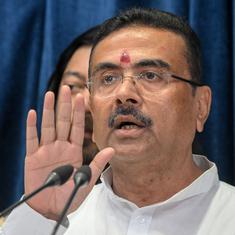


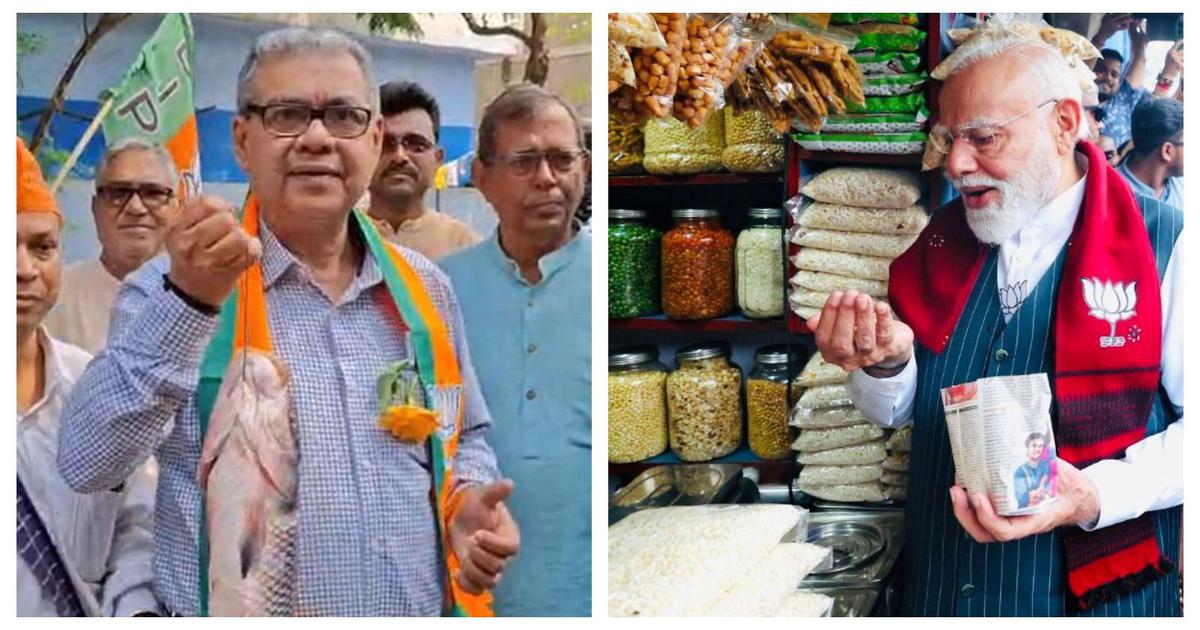
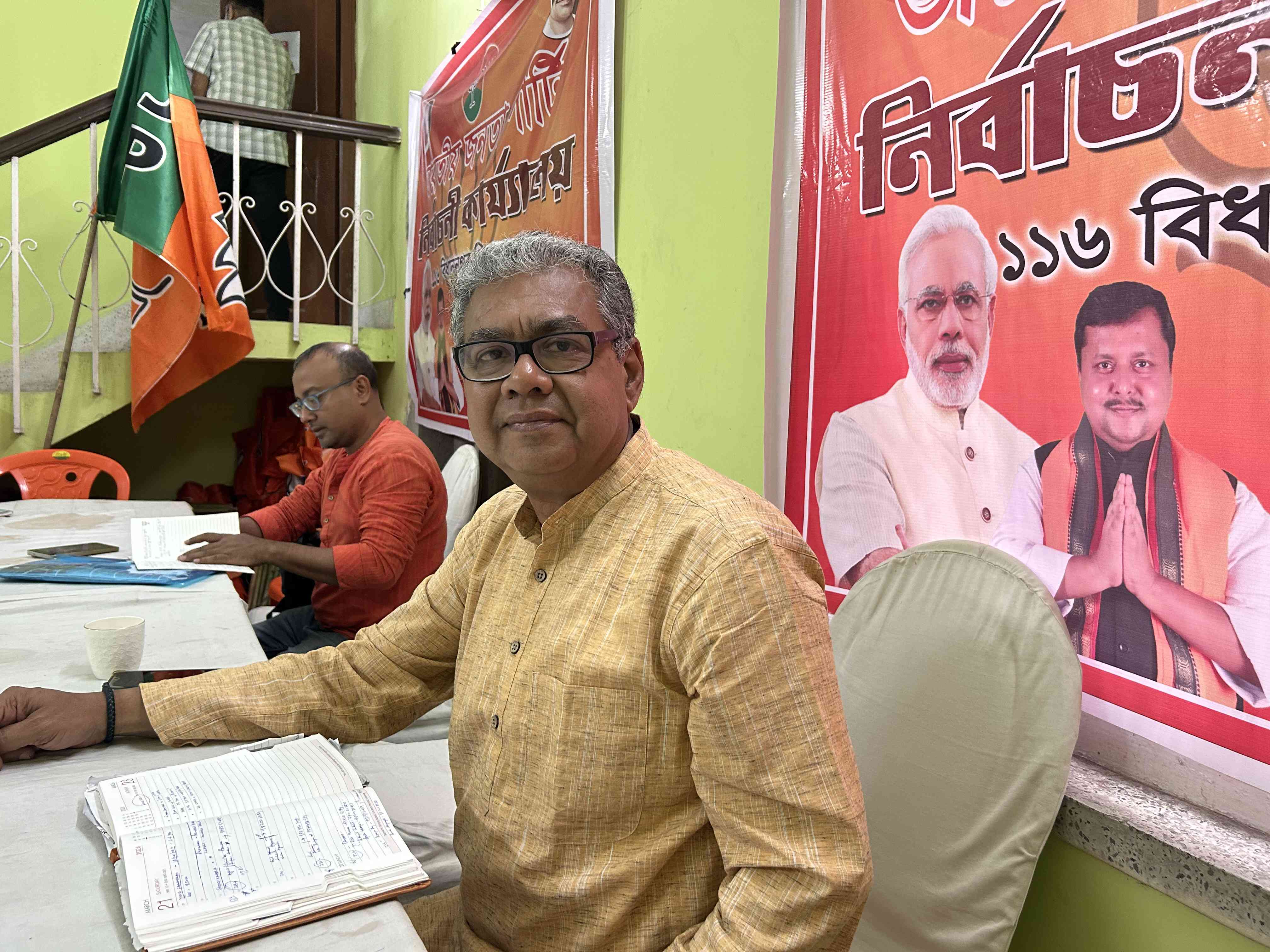
Sharadwat Mukhopadhyay got defensive when Scroll asked him if there was an element of the absurd in him going door-to-door with a large catla fish as part of his election campaign.
“It is not ridiculous,” the Bharatiya Janata Party candidate from Kolkata’s Bidhannagar seat argued. “Everything has got some meaning in politics.”
Mamata Banerjee had been lying to voters that his party would ban fish if it came to power, said the 56-year-old oncologist-turned-politician. Walking around with a fish was, in Mukhopadhyay’s view, the most effective way of convincing fellow Bengalis that the BJP respected their dietary preferences.
The gesture catapulted him to national fame last month. Soon, more visuals emerged showing several other BJP leaders carrying fish on the campaign trail or eating it in TV interviews. Clearly, Mukhopadhyay had set a trend which his party members found worthy of emulation.
Their opponents in the Trinamool Congress, meanwhile, doubled down on their allegations that the BJP might ban fish if it came to power in Bengal. To substantiate their accusations, they point to the restrictions that Bihar and other states ruled by the BJP have placed on the sale of meat, particularly beef.
.@AmitShah has announced his decision to spend 15 days in Bengal. Good. Bengal welcomes tourists with open arms. Stay for as long as you like. And do not miss out on some of our finest delicacies.
— All India Trinamool Congress (@AITCofficial) April 2, 2026
We highly recommend:
👉 Muri Ghonto
👉 Pabda Macher Jhal
👉 Ilish Bhapa
👉 Chingri… pic.twitter.com/44Nz2KSyQF
The back-and-forth between West Bengal’s two main political contenders over fish is not the only clash about Bengali identity and culture in these elections. The BJP has deployed a range of defensive and offensive tactics to counter the Trinamool’s attempts at portraying it as a party of so-called outsiders once again.
This time, the saffron party is taking care not to repeat the mistakes that cost it dearly in previous elections. On Sunday, Prime Minister Narendra Modi even stopped by a jhalmuri shop in Jhargram to buy the staple Bengali snack made of puffed rice.
However, party insiders, voters and analysts say that the BJP’s outsider image still persists in West Bengal.
Meat politics
BJP leaders claim that the question of banning fish does not arise, given that the party has not done any such thing in other states where it has been in power for years.
“We have been ruling Tripura for almost a decade now,” said Mukhopadhyay. “After Bengal, it has the largest fish-eating population. Have we banned fish there at all? She [Banerjee] is turning a non-issue into an issue.”
But the Trinamool hasn’t stopped making these allegation. The ruling party of West Bengal has been running a video series on its social media pages titled Jodi tara ashe, What if they come? Every few days, it puts out AI-generated short videos depicting what living in a BJP-ruled Bengal would supposedly be like.
One such video from last week showed men wielding sticks and wearing saffron scarves stop a truck carrying fish. They tell the driver that he needed permission from “Gujarat and Delhi” to sell fish.
Middle-class voters in Kolkata are not quite convinced by the campaign. However, journalist Sayantan Ghosh, who wrote the recent book Battleground Bengal: The Political Future of a Fiercely Contested State, said that the issue goes beyond fish and matters greatly to voters in rural Bengal, where people depend on meat for survival.
“Take Navratri, for example, when many in Delhi and elsewhere don’t eat meat for a few days,” he explained. “If the sale of meat is restricted during that period in West Bengal, every rural household will suffer. They understand this, which is why this fear is there.”
Ghosh suggested that the BJP also knows what impact such fear-mongering could have on the electorate. That is why even candidates with evidently Bengali surnames like Mukhopadhyay were brandishing fish to emphasise their ethnic roots.
Imagine having to take permission from Delhi and Gujarat to eat fish. To sell biryani. To play football. To sing Rabindrasangeet. That is not a hypothetical. That is precisely what the BJP Zamindars want for Bengal.
— All India Trinamool Congress (@AITCofficial) April 16, 2026
To seize this land of free thought and free expression and run… pic.twitter.com/fG3zfD617L
Besides tackling the messaging from the Trinamool, the BJP has launched its own offensive on this subject, too. On April 9, Modi himself brought up fish in an election rally. “Even today, Bengal has to get fish from other states,” he lamented, blaming the chief minister for failing to boost fish production during her 15-year reign in the state.
This also fits squarely with his party’s broader allegation that Bengal has experienced economic decline under the Trinamool. State BJP leaders are taking a similar line.
“Can Bengalis living under her rule afford meat and eggs?” asked Tapas Roy, the BJP’s contender for the Maniktala seat in Kolkata. “They don’t have jobs, their pockets are empty, how will they eat meat or eggs? Only Trinamool politicians are eating all that.”
The ‘outsider’ question
Beyond the politics of banning meat, though, Roy was candid that the outsider tag was a problem for the BJP in West Bengal.
In 2021, the party had brought in Hindi-speaking big-wigs such as Kailash Vijayvargiya to manage its campaign, which opened it to the Trinamool’s charge that it was a bohiragoto party – the Bengali word for outsider. While leaders from other states are still involved in the BJP’s efforts, they are staying out of the limelight in this election.
“It’s better if they don’t come to campaign for me,” Roy said. “It takes up a lot of time.”
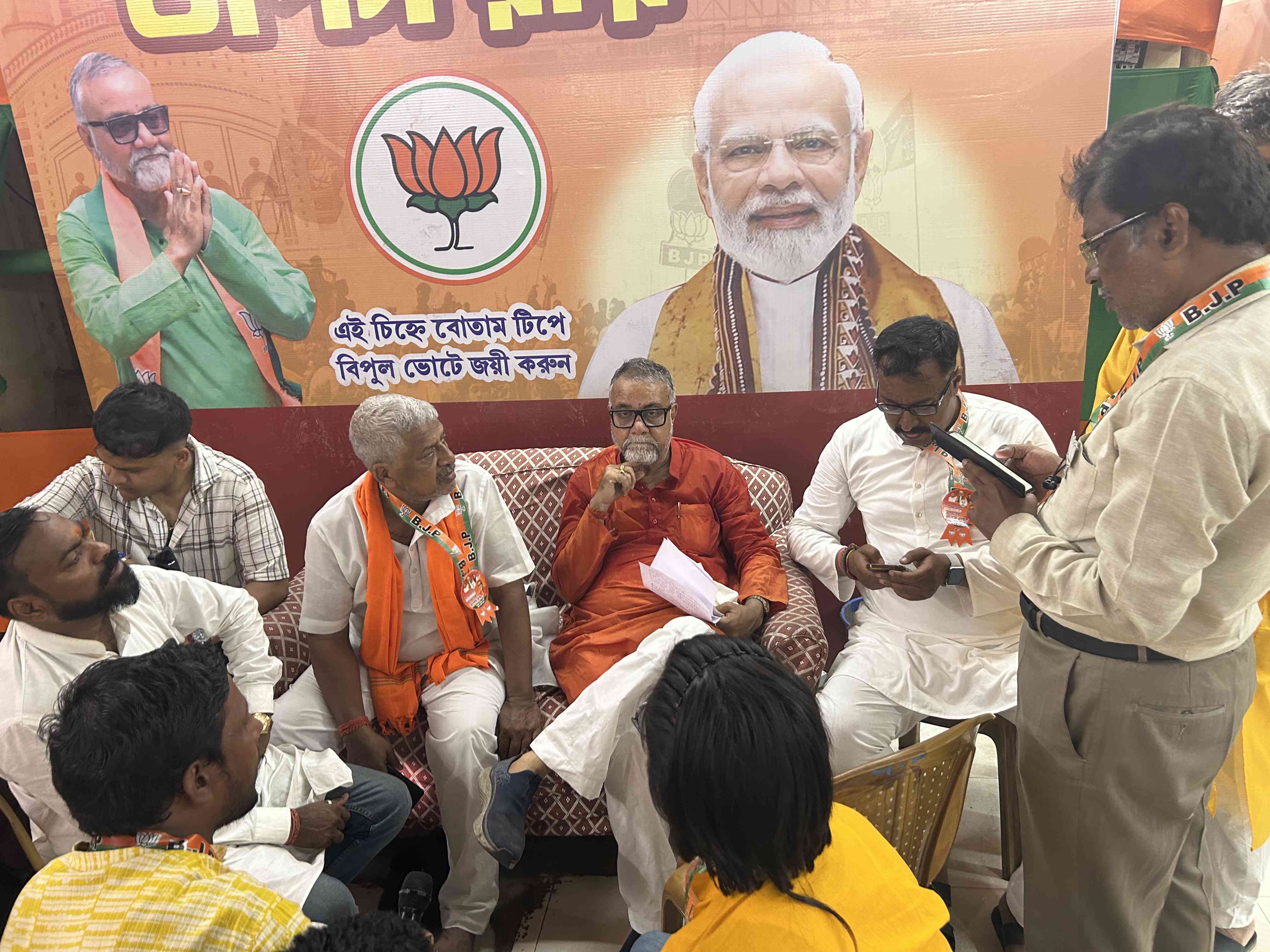
Other Bengal BJP members share this view. The wife of a BJP candidate from central Bengal, who is managing his campaign, told Scroll that her husband had to suspend all his plans for two days ahead of a visit from Amit Shah. The couple also had to play host to a minister from a Hindi-belt state ruled by the BJP as part of preparations for the Union home minister’s rally.
“They don’t understand how difficult winning elections here is,” she remarked. “Where they come from, even a potted plant can win an election on the BJP’s symbol.”
As harsh as her complaint sounds, analysts point out that this problem was much worse for the BJP five years back. Since then, it has managed to cultivate a set of local leaders.
Even though it is not projecting a chief ministerial candidate, Trinamool turncoat Suvendu Adhikari is widely seen as its top contender for the job. While the Bengal BJP still seeks votes in the name of Modi, Adhikari is at the forefront of its campaign, taking on Banerjee from her home seat of Bhabanipur and canvassing for other candidates like Roy.

The Trinamool, for its part, continues to bring up the bohiragoto charge. It recently questioned the preponderance of outsiders on the BJP’s list of star campaigners, for example.
However, the saffron party increasingly levels the same allegation against Banerjee for her choice of MPs. It cites the examples of Gujarat-born cricketer Yusuf Pathan, actor Shatrughan Sinha, who is a Bihari, and retired police officer Rajeev Kumar from Uttar Pradesh. All three represent the Trinamool in Parliament.
Pushing Hindutva
The other way in which the BJP is trying to negate the Bengali identity factor in the upcoming elections is by appealing to its voters in the name of religion. This is not an altogether new approach, but it appears to be resonating with residents of urban areas this time around.
“Hindu voters are all moving in one direction this time,” said Pinaki Banerjee, a 60-year-old businessman who lives in the north Kolkata neighbourhood of Shyambazar. “Hindu versus Muslim will decide this election, not Bengali versus non-Bengali.”
In 2021, some left-leaning members of the Bengali film industry had come together to work on a music video ahead of the Assembly elections. It directly confronted the Hindutva politics of the BJP and the Rashtriya Swayamsevak Sangh.
Riddhi Sen, who had directed that video, said that no such collective effort could be conceived of today. “In the last five years, Islamophobia has gotten into city people,” he complained. “The idea that Kolkata has become a mini-Pakistan or mini-Bangladesh has entered our minds. Middle-class Bengalis have lapped it up.”
Sen and a handful of other like-minded artists released another music video on April 14. It subtly critiques the idea of so-called bulldozer justice by showing adivasis oppose it. But their song has not had the same impact this time.
The Bengali working class, though, is still hesitant when it comes to backing Hindutva fully. Abhishek Das, 35, works in Bidhannagar, a suburb of Kolkata. He said that he had seen videos of Mukhopadhyay, the BJP candidate from his seat, carrying fish while campaigning in the area.
While he was not worried about fish, he does anticipate a ban on beef if the BJP were to win the state.
“Everybody knows that they [Trinamool] are corrupt, but there will be a lot of trouble if the BJP wins,” Das added. “I am a Hindu. That does not give me the right to stop a Muslim from eating what he likes.”
Those associated with the Bengali nativist group Bangla Pokkho say that this is the overwhelming mood in the state, something for which they claim credit. In recent years, the organisation has campaigned aggressively against what it views as the anti-Bengali actions of BJP-led governments at the Centre and in other states.
“The sentiment across Bengal is that the Trinamool is bad, but the BJP is against Bengalis,” said Kausik Maiti, organising secretary of Bangla Pokkho. “That is why the BJP is trying to pretend it is Bengali.”
