




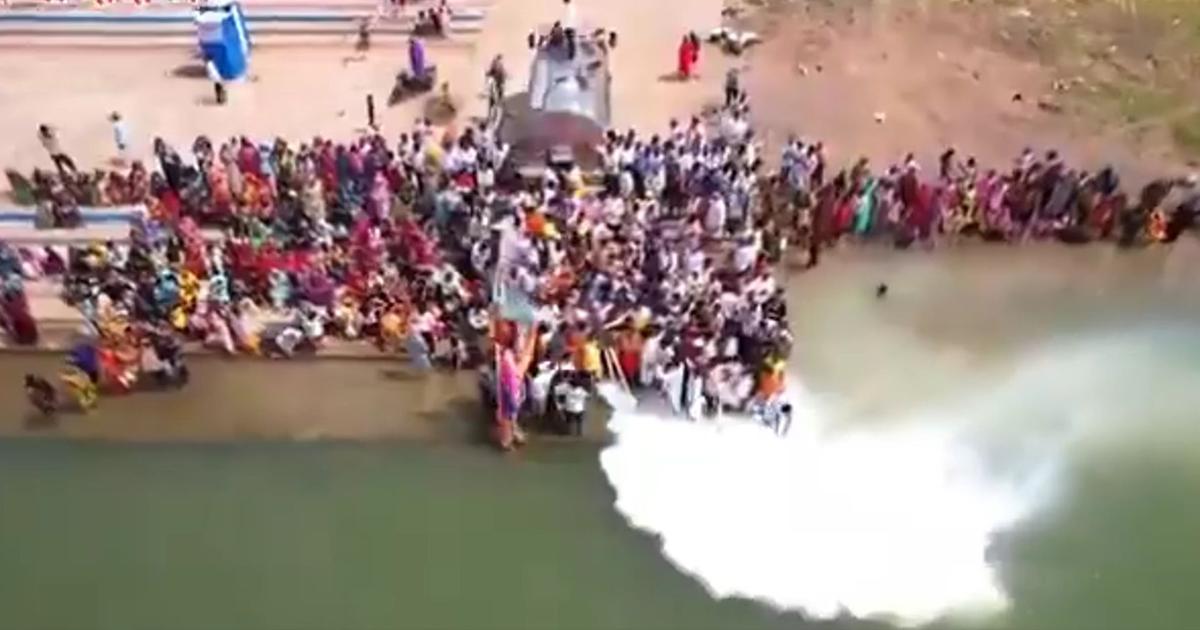
The spectacle earlier this month of thousands of litres of milk being poured into a river as a religious offering perfectly encapsulates the deep pathologies of our current religious and civic imagination. It is a moment that demands we ask uncomfortable questions about the nature of our piety, the abdication of the state and our collective loss of a grip on reality.
To critique this practice is not to be anti-religion. In fact even a deeply religious Hindu would want to rescue his religion from thoughtless, mechanical distortions.
The first issue at stake is the reduction of faith to an act of conspicuous, competitive consumption. In traditions like Bhakti, religion was an instrument of ethical transformation, a means of transcending the ego and recognising the divine in the world.
What we are witnessing now is the exact opposite. Ritual has become a hollow performance of excess, a public display that signals a comfort with overwhelming concentrations of power and wealth, even in our most sacred spaces.
The sheer scale of the waste – milk flowing into waters already choked by industrial effluent and untreated sewage – suggests a religious imagination that has entirely severed the link between the right and the good.
నర్మదా నదికి 11 వేల లీటర్ల పాలతో పాలాభిషేకం
— BIG TV Breaking News (@bigtvtelugu) April 9, 2026
ఈ ఆధ్యాత్మిక వేడుకలో భారీగా పాల్గొన్న భక్తులు
Milk Abhishekam Performed on River Narmada with 11,000 Liters of Milk
Devotees Participate in Large Numbers in This Spiritual Ceremony pic.twitter.com/yoUvjAwUpe
Second, this spectacle brings into sharp relief the total paralysis of the Indian state. The river is a public commons, an ecological lifeline that the state has a constitutional duty to protect. Yet, when environmental destruction is cloaked in the garb of religious sentiment, the state retreats into silence.
Governments are utterly terrified of intervening in anything labeled as “societal morality” or “tradition”, fearing a majoritarian backlash. The state abdicates its civic responsibility, choosing instead to pander to a form of public unreason.
Indeed, the contemporary politics of Hindutva has an even more insidious role to play here. When religious identity is instrumentalised for political ends, practices such as this – however wasteful or ecologically damaging – are implicitly legitimised, if not actively encouraged. These public performances, much like the lavish displays of wealth, become part of a nationalist project.
The ritualistic excess, draped in piety, acquires an ideological sheen, making it impervious to critique.
The state, having invested so heavily in projecting a particular brand of religious nationalism, finds itself unable to critique rituals, even when they manifestly contradict the broader public good. To question such a practice would be to undermine its own carefully constructed ideological base, turning a civic and ecological problem into a political battleground of identity, a battle the state is ill-equipped and unwilling to fight against its own avowed principles.
11,000 Liters of Milk from Tanker Dumped into Narmada River as Religious Offering in India pic.twitter.com/0LSpIn2lWf
— non aesthetic things (@PicturesFoIder) April 9, 2026
We are caught in a classic moral evasion. We worship the river not as a living ecosystem to be sustained, but as a mythical receptacle whose only purpose is to absorb our grandiose displays of piety.
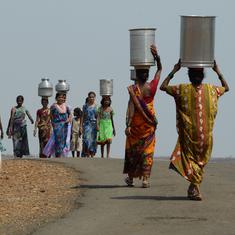
There is also a deep, unstated moral callousness here. To pour rivers of milk into actual rivers in a society where millions struggle for basic sustenance requires a hardening of the heart that is the very antithesis of spiritual grace. It is a stark reminder of how easily the discourse of religion can be mobilised by the privileged, completely abstracting away from the material deprivations of the poor.
And perhaps, the public remains unmoved by this spectacle not out of indifference, but because such displays are subtly woven into the fabric of what is presented as national aspiration and devotion.
This is not a uniquely Hindu problem: it is a problem of how modernity has deformed tradition across the board, reducing it to spectacle. But Hinduism would do itself a favour by recovering its own deeper philosophical resources – traditions that exalt inner purity over outward excess and the sanctity of creation over the mindless conformism to ritual.
Until then, these spectacles of waste will remain exactly what they are: not acts of devotion, but the hubris of a society that has replaced the difficult demands of true morality with the easy, destructive comforts of blind convention.
Milind Murugkar writes on economic and political issues.
