








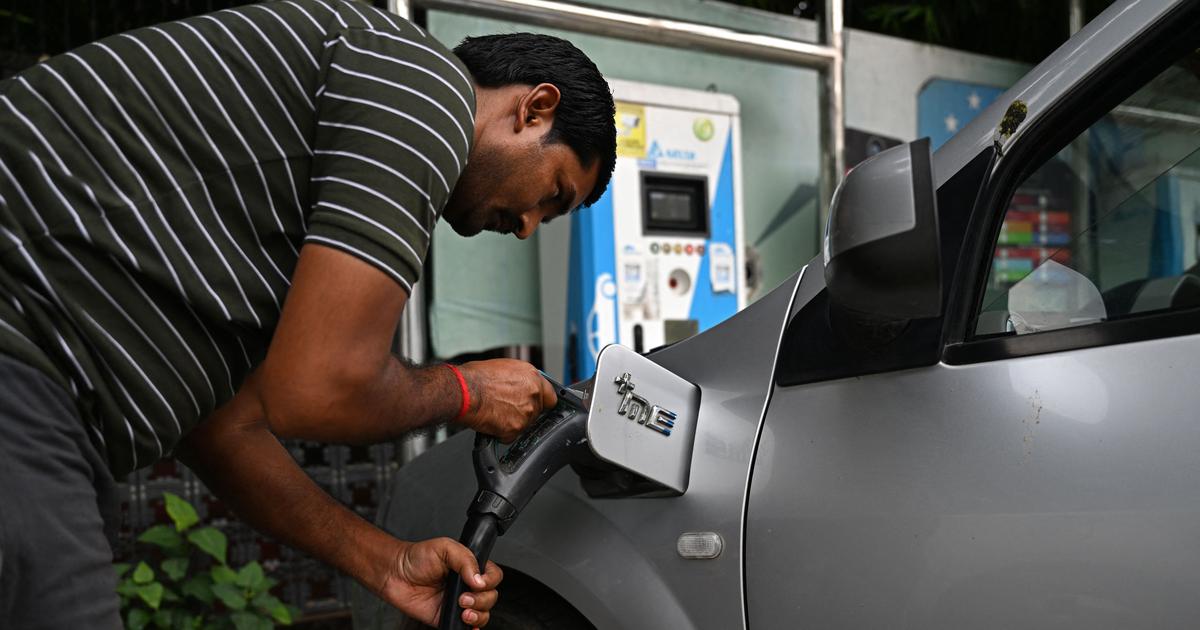
The draft electric vehicle policy issued by the Delhi government on April 11 aims to promote electrification for vehicles through a mix of incentives, road-tax waivers and restrictions on new registrations of vehicles that use petrol and diesel.
However, the policy suffers from two fundamental limitations that require urgent reconsideration. First, the policy frames the measures as a solution to air pollution and, indirectly, as a justification for extending subsidies for switching to electric to even car users who are among the most affluent in the city.
Such a framing is myopic because it assumes that air pollution is the only effect of transport. Automobile use also hurts the health of residents through traffic injuries, reduced physical activity, traffic noise and by occupying scarce public space.
Beyond health, vehicle production contributes to carbon dioxide emissions, while battery manufacturing relies on minerals such as lithium, cobalt and nickel, the extraction of which is the subject of serious environmental and social concerns globally.
By presenting electrification of two-wheelers, three-wheelers, four-wheeled goods vehicles and passenger cars primarily as an air pollution solution, the policy narrows the scope of what should be a much broader rethinking of urban mobility.
The more pertinent question is not simply how to reduce air pollution, but how to do so while simultaneously addressing climate change, improving road safety, enabling walking and cycling and reclaiming urban space for more egalitarian use.
The second limitation is more structural: the policy is almost entirely silent on the street governance of vehicle charging. Nowhere does it engage with the question of urban space, particularly the curb, the edge of the road. In a city like Delhi, where onstreet parking is widespread and largely unregulated, the curbside is already a highly contested space. There is a severe lack of formal parking locations to accommodate the rising number of cars every year.
The combined capacity of the parking facilities in the city’s two municipal areas is estimated at around 60,000 cars. Even if we assume that each parking space is used by an average of three cars per day, this is miniscule compared to the total car population of 21 lakh.
Unsurprisingly, improper parking is the largest category of on-the-spot challans given by Delhi Police totalling more than four lakhs per year.
There are also rapidly increasing cases of parking disputes leading to road-rage and some even resulting in deaths. The number of calls made to police every year to report such cases more than tripled over a brief period of 2021 to 2023.
Besides parked cars, curb space is used by street vendors, pedestrians, buses and para transit users, and delivery vehicles. Introducing large numbers of electric vehicles in the city without a clear framework for how charging infrastructure will be integrated into this space risks deepening existing conflicts.
Who gets priority access to the curb? Will charging stations displace pedestrians or street vendors? Or will they simply formalise the current practice of cars occupying public land for free, as is the status currently?
The framework to answer these questions has already been codified in the Delhi Maintenance and Management of Parking Places Rules, 2019. Despite more than five years since its notification, the parking policy has seen limited implementation. These rules recognise parking as a demand management tool and provide a detailed guidance framework for developing Parking Area Management plans in consultation with local stakeholders to rationalise the use of street space.
The rules give clear priority of using on-street spaces to pedestrians and cyclists, formal and para-transit users, and street vendors, while short-duration parking is at the end of this list.
Yet, the draft electric vehicle policy makes no mention of these rules, not even as a footnote, even while acknowledging that the land parcels will have to be identified for public charging stations.
The word parking does not occur even once in the policy. This omission has serious consequences. Planning for space for charging stations without embedding it within parking management plans risks giving automobiles precedence, which goes against the priority given in government's own parking rules.
A more forward-looking electric vehicle policy must do two things differently. First, it should explicitly integrate electrification with parking reform, making strict implementation (and not just formulation) of Parking Area Management Plans a condition for public charging stations to be deployed in areas. This would ensure that electrification goes only as fast as the governance in the city provides space for it, and that the curb space is allocated transparently and equitably.
Second, the policy should aim for a transformative impact by shifting incentives towards smaller, lighter, and slower vehicles that use less space and pose lower risks to others. The subsidy should be progressively reduced for larger passenger vehicles, based on, for example, engine size, to nudge consumers towards low-powered, smaller vehicles, and should be completely removed for personal cars.
The inclusion of electric bicycles in the previous EV policy (2020-’24) framework was a step in this direction. Their absence represents a missed opportunity.
Electrification is undoubtedly an important part of Delhi’s response to air pollution. But if pursued in isolation from questions of space, safety, and equity, it risks reinforcing the very problems it seeks to solve. A true reset would require moving beyond a vehicle-centric approach to one that places people, and the shared use of urban space, at its core.
Rahul Goel is an Associate Professor, Transportation Research and Injury Prevention Centre, at IIT Delhi. His email address is rgoel@iitd.ac.in.
