




It is an appeal from the helpless and
Voiceless of our rotten society
Now our society is going from bad
To worse because of the situation
That obtains. The people
Have forgotten to share happiness and
Enjoy their life because of the news of terror,
Massacre, rape, corruption…
How to end this suffering?
This was written by a Manipuri poet for a play called Shooting the Sun in 2020, three years before the violence in Manipur made headlines. The question remains: how to end the sufferings of the people living in Manipur?
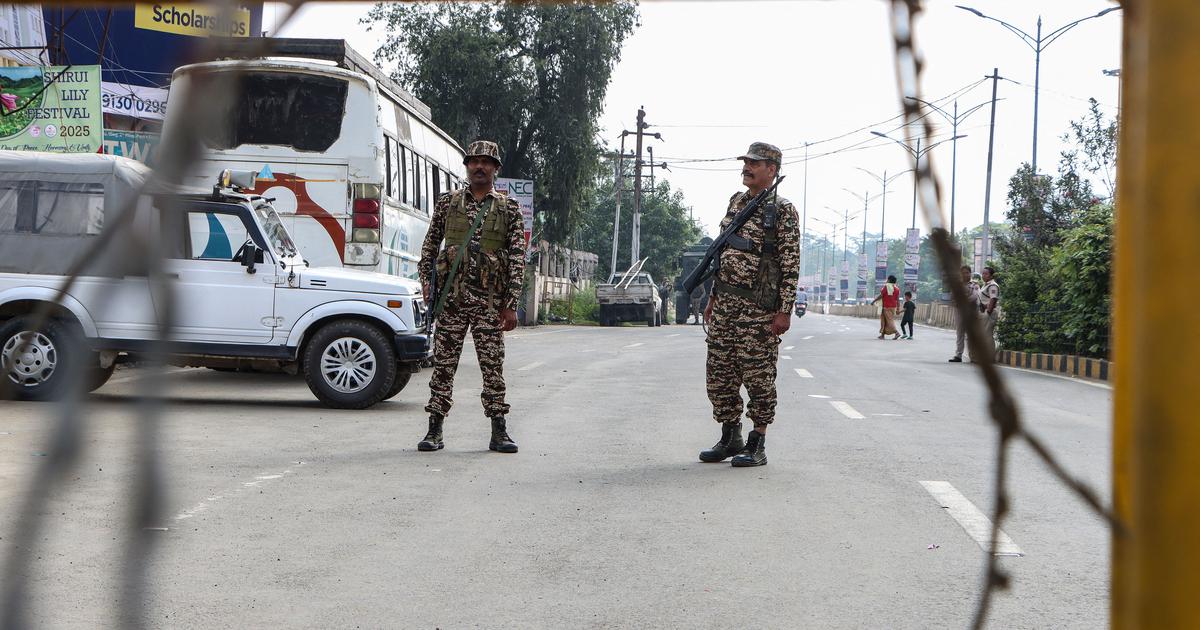
This year began with attacks on Meiteis, and then moved on to deadly attacks on Naga villages and people travelling on the Ukhrul-Imphal road despite security being provided for them. Once again, Manipur is gearing up for another deadly round of violence and this time too there are allegations that the security forces are not neutral and are not protecting civilians.
Manipur has been divided into zones which even the chief minister or a Supreme Court judge cannot cross if they belong to one or the other community. And the communities are armed to the teeth despite the claims that most of the arms looted from armories and police stations in 2023 have been recovered.
But there still are the illegal arms in the hands of insurgent groups, village defence groups, community militias, armed volunteers, criminal groups and armed vigilante outfits (such as Arambai Tenggol, Meitei Leepun) and individuals.
The people have no one to represent their interests and they turn to the armed groups for protection. Civilians going about their daily business fall victims to bullets and firebombs being thrown on their homes and to rocket launchers. Children find their schools and colleges are closed for months on end. Thousands have left Manipur in search of jobs, mostly as migrant workers in cities and towns. Ironically, far from home they share accommodation, help each other and share a meal because they share a bond of being from Manipur.
There are calls for disarming all groups but how can anyone lay down their arms when their very life or the lives of their family or community needs protection? It is a deadly and vicious circle.
Manipur today.
— Vijaita Singh (@vijaita) April 25, 2026
Imphal and Ukhrul pic.twitter.com/wvYnoUwHx3
For the security establishment, the only way to deal with the spiralling violence is by more repression and security measures with greater militarisation in the name of dealing with the flourishing trafficking in arms and drugs.
Taking advantage of this situation, various foreign interests are taking advantage. This has caused the situation to become even more complex. Even this danger has been weaponised for a narrow political agenda by the government. The issue of Chinese role is used to justify a more pro-American policy, ignoring the role of US and Western interference. In the name of fighting foreign infiltrators, genuine refugees are made the target of state repression.
All this distracts from the decades-old grievances of various communities and the negligence of Manipur, both economically and politically.
The people have no one to represent them. The state has three MPs in the Parliament and none of them can speak for all the communities of Manipur.
The intelligence agencies have an overwhelming role in deciding policy towards Manipur. The main weapon in their arsenal is divide and rule: they have succeeded in splitting the armed ethnic organisations. For instance, the government of India began talks with the National Socialist Council of Nagaland in 1997. At that time. the NSCN was divided into two groups. By 2024, there were an estimated 27 factions of Naga political outfits (not all split from the NSCN), each claiming to represent the Nagas.
With the Naga and Kuki-Zo communities straddling both sides of the India-Myanmar border, there are links between the communities living in each country. This means the insurgents have easy access across international borders and also the possibility of procuring arms and armed actions.
This leads to military action by the states. For instance, last year India carried out a series of drone bomb attacks on Naga villages in Myanmar, apparently with the permission of the military junta ruling the country then. These kinds of cross-border attacks only complicate the already volatile situation by encouraging cross-border actions by insurgents.
The number of people from Myanmar coming into Manipur and settling on land is a cause for concern.
#WATCH | Imphal, Manipur: The Coordinating Committee on Manipur Integrity (COCOMI) protest rally today turned violent. Police fired tear gas shells to disperse the crowds. The site was cleared, and protesters were sent back.
— ANI (@ANI) April 25, 2026
COCOMI today organised a mass rally across Imphal and… pic.twitter.com/krN2ubhsP3
This divide and rule policy has extended to dividing communities against each other, sometimes taking a small section of one community and creating a militia. It could be a Naga militia created from surrendered militants or Kuki commando units for counter-insurgency operations. The co-option of insurgents becomes easier because of the lack of any vision for the future except for identity politics, which has proven to be sterile and leads to nowhere.
I have been witness to the suffering of the people in Manipur: in 1982 when I first went to the newly created Ukhrul district home of the Tangkhul Nagas, the main conflict was between insurgents and the Indian armed forces. At that time, many thought that the cause of their suffering was the fact that the armed forces had too much arbitrary power under the Armed Forces (Special Powers) Act, 1958. All communities were united on the demand for the act to be repealed.
But then even this demand for repeal, which brought people on one platform, was usurped by one community and human rights movement in Manipur also split along ethnic lines especially during the historic protest by Irom Sharmila.( See: Nandita Haksar, Sharmila’s Struggle against Military Repression: A Critique.)
In 2023, the security forces too were split along communal lines with the police protecting the Meiteis and the Assam Rifles protecting the Kuki-Zo. This split has still not resolved.
And then the communities moved further away from each other and the clashes were between communities rather than with the security forces, although that too continued.
In 1988, I took up the case of human rights violations of Naga villagers in Senapati district. At the time we were a team of four lawyers, I leading and three others: one from Tangkhul Naga community, other from Kom and a third a Meitei. We worked well together.
In 1988 there was a national uprising in Myanmar and in 1990 a brutal military crackdown when Burmese refugees poured into Manipur. All communities welcomed them. The High Court was very sympathetic towards the Burmese.
When I returned to Manipur I could see that the communities had developed mutual suspicion but ordinary people still met warmly at least in the market and in public places.
Three people were killed in a firing incident this morning in Ukhrul district of Manipur. Two of them were wearing army-like uniforms. Kuki groups have accused Naga militants of attacking their homes at around 5:30 am. However, Naga militants have denied these allegations. pic.twitter.com/Xht8IPyYeW
— Bhadohi Wallah (@Mithileshdhar) April 24, 2026
Then came 2021 the military coup in Myanmar. This time when the Burmese refugees came, there was a marked hostility. The Kukis were protecting them, since many shared an ethnicity, though the state was hostile. Even when the Imphal High Court ordered that seven Burmese refugees (two journalists and their families, including three small children), I was representing be allowed to come from Moreh on the India-Myanmar border to Imphal, we were escorted by the commando unit to protect us from a possible intervention by the Assam Rifles, which was determined to deport all refugees.
Burmese refugees had become targets of hate and demonised. Among the refugees from Myanmar, the fate of the Rohingyas has been the worst.
And in 2023 I watched a video, silent but deadly. It was of ordinary civilians blowing up a government colony in the foothills of Langol in Imphal with a two-inch mortar. That was the place where I had lived with so many happy memories.
The homes of people being blown up by weapons civilians in the time of peace in a democratic country.
I was watching a video in the safety of my home in Goa. Others in Manipur were watching all their memories, their homes and their future destroyed.
Today, the chasms within Manipur society are deep, divided by trenches and buffer zones guarded by armed groups with highly sophisticated guns.
But if you walk into a café in Goa, you are likely to see a bunch of North Easterners enjoying themselves, beer and a plate of pork and laughing at jokes only they can understand and a shared sorrow hidden behind brilliant smiles.
They are no longer enamoured with guns or life of insurgents; they want to earn and have a good life. For most, it means a family and friends to share two square meals, a small home and a secure future for their children.
But even these small dreams seem impossible when they lay down their tired heads far from home, they are reminded of the scenes in their home towns, they feel angry from helplessness, from fear for their loved ones left in the villages and then the tears flow quietly.
There seems to be no end to their sorrow and to their suffering. No one to offer solace or succour.
Nandita Haksar is the author of Shooting the Sun: Why Manipur Was Engulfed by Violence and the Government Remained Silent (Speaking Tiger, 2023).
