







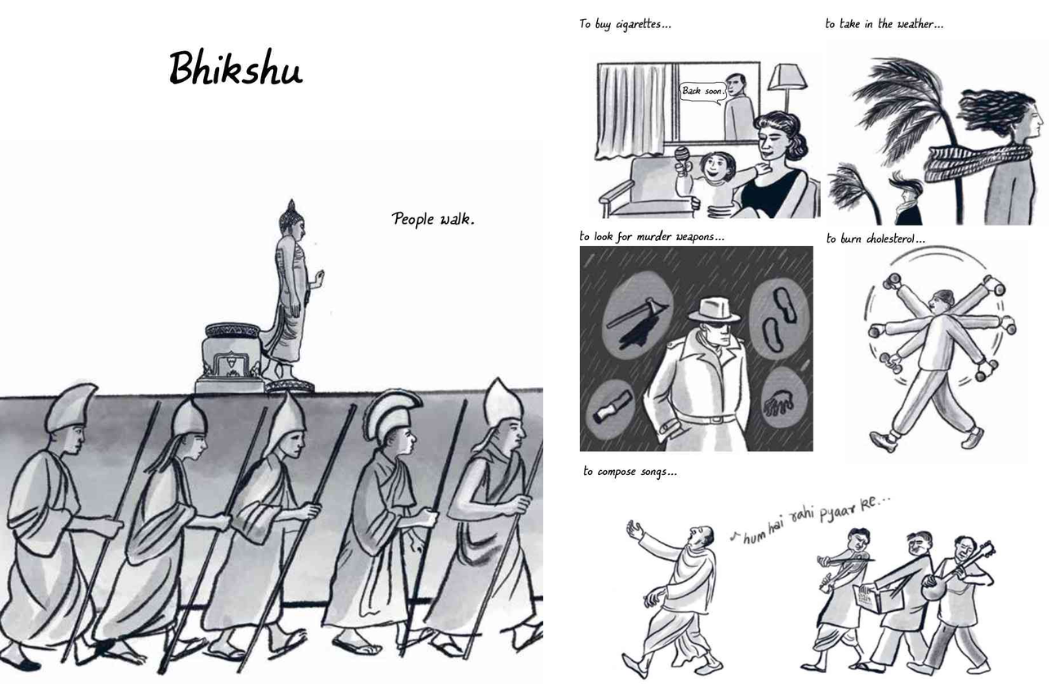
Solvitur ambulando. It is solved by walking.
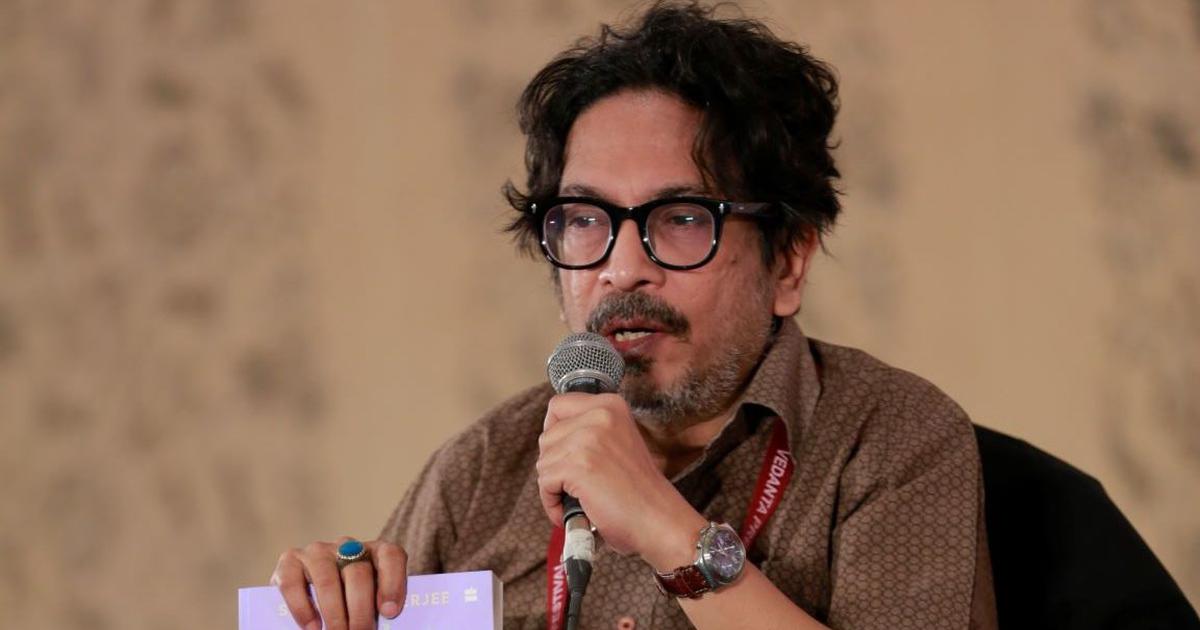
The late Japanese mangaka Tsuge Yoshiharu built a career out of characters who walked themselves into contradictions. “Though I was drawing fact,” he once said of his autobiographical “I-comics”, they differ “from a diary in that one pulls together only the important parts of fact and recomposes those fragments.” Sarnath Banerjee’s comics also revel in such truthful fabrication, except his terrain is not post‑war Japan but the Indian subcontinent and its inherited discontents.
Banerjee’s characters have always been as mobile as the slippery situations and porous panelling they find themselves drawn within. Whether housed beneath the porticos of Delhi’s Connaught Place in Corridor (2004), tracking the conspiratorial history of colonial Calcutta’s infamous duel in The Barn Owl’s Wondrous Capers (2007), found flailing in an attempt to dig up clues in The Harappa Files (2011), or boring deep into the ground for the river of stories in All Quiet in Vikaspuri (2015), fact and fiction often collapse into the overlapping spectres of history that Banerjee’s whirling dervish weaves into images and text.
As it happens, Absolute Jafar is his first long-form graphic novel in over a decade. He had impishly sworn off the format in between, his work flitting from illustration to animation, fine art to self-styled “radio” and “theatrical” comics, with the occasional collaboration with Nobel laureate Abhijit Banerjee (no relation) thrown in. Some even speculated that he had departed the practice entirely for the more respectable shores of gallery art. The enfant terrible of Indian comics has instead returned with a book that is simultaneously a love story, a family saga, a walking tour of four cities, and a stealth manifesto on what the Indian graphic novel might still become if it stopped trying to be respectable.
Finding the ‘I’ in Sarnath
Banerjee has always treated comics as working in a medium of exile, just like his forebears practising autobiographical comics in the West. The confessional moved from the privacy of prose and poetry to the markedly more lurid playground of comics art with Justin Green’s Binky Brown Meets the Holy Virgin Mary (1972). Autobio became a free-for-all no man’s land, incubating underground cartoonists depicting some of their most intimate life histories, from the hilarious extremes of Julie Doucet and Mary Fleener to the earnestness of Gabrielle Bell and Harvey Pekar, to name a few.
The European autobio that followed in the 1990s (from Fabrice Neaud to Marjane Satrapi and onwards) promised further legitimacy based on explorations of identity, no matter how beautiful or ridiculous. Banerjee’s work has taken a different route: serialising vignettes, making meaning out of relentless juxtaposition, and rendering his characters as vessels for the ideas he is dealing with. This tendency reached its zenith in how his Doab Dill (2019) raced through reflections, threatening to become illustrated trivia: pure non-fiction, where phantasmagoria and history come together, albeit with the precision and whimsy of a miniaturist.
It was beginning to feel like this was his point: comics are a nomadic form for a deracinated age. One can meet Robert and Aline Kominsky-Crumb in Daryaganj or Joe Sacco in Sonipat, but the gag ends there and it is time to move on to the next. Absolute Jafar breaks this illusion by holding the artist ransom to his trail of cause and effect. The form is the same but Banerjee’s god is in the tonal details of this realist fantasy whose internal coherence holds the autofiction from devolving into the familiar territory of ironic metafiction.
The cold opening is a walking essay (or an essay on walking) that holds the key to reading this renewed Sarnath, whose returning protagonist, the tonsured Brighu, does more than stand in for his maker’s perambulations. Sincerely walking in Banerjee’s shoes, Brighu narrates a version of his life that pits the history of a devolving nation and an increasingly fracturing world order against the nostalgia of an artistic life ensconced in Delhi’s many comforts and community, while also rocked by the necessity of chasing different forms of existence in a new(er) India.
Central to this journey is Mahrukh, the Pakistani-origin artist whom the migrant Bengali Brighu falls in love with, uncharacteristically follows back to the US, and happily begins a life together in Delhi, followed by occasional visits to Karachi and, eventually, a final move to Berlin. The journey from their marriage in the UK, to the birth of their son (the titular Jafar) in Berlin, and eventual separation is paved by the Kafkaesque circuits of Indian immigration law and the wimpy bureaucrats who uphold it, punctuated by a soundscape that flits from Rabbi Shergill to Mohammed Rafi, as the scenes shift from a militarised compound in Karachi to a Lyari infested by djinns that father and son tell each other detailed stories of. This Karachi is notably more similar to the breakfast kochuri stall-laden lanes of Calcutta than the “peak detailing” being hawked by the movie Dhurandhar.
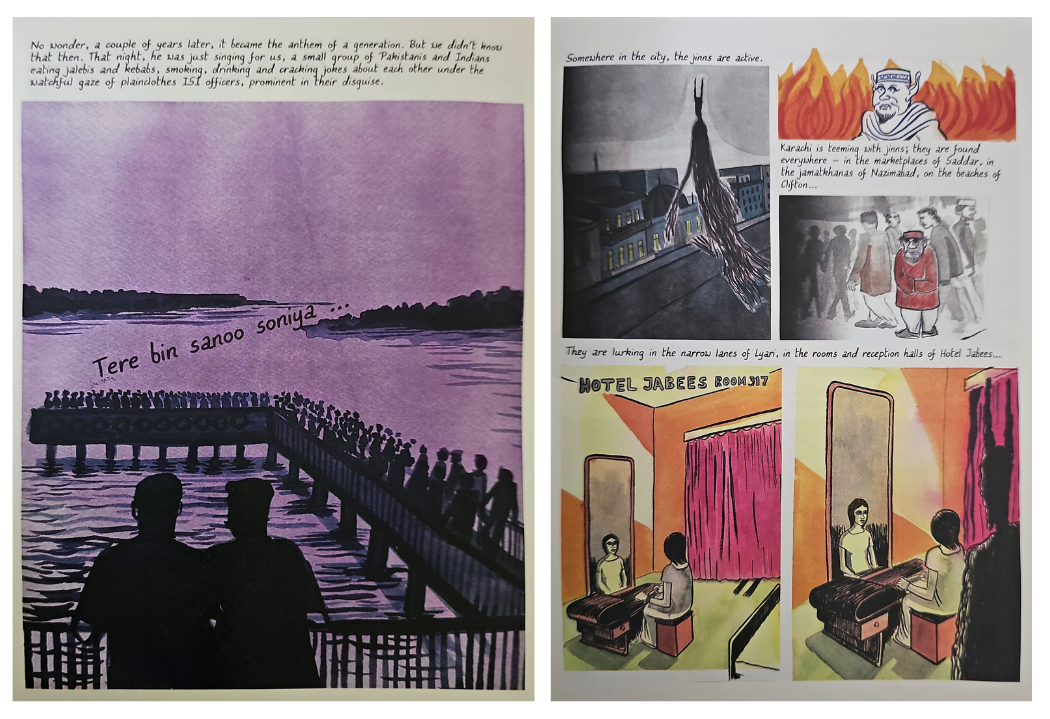
The memories of cinema that populate Brighu’s life stories instead display a nigh inexhaustible well of images, from Saeed Akhtar Mirza’s Arvind Desai Ki Ajeeb Dastaan (1976) to Sushil Mukhopadhyay’s Ami Sirajer Begum (1973). The existential wanderings of the former are closer to the drifting persona he cultivates in Delhi, whereas the rooted, pulpy histories of the latter define how he imagines his future as a parent crossing continental borders. Truer to the cliches of the melodrama, however, it is love that changes everything. It even makes him run.
Banerjee’s janky collage and wisecracking text are undone by Brighu’s monastic reticence: equal parts the Bodhisattva (bhikshu) he phonetically associates his name with, and the stillness of an artist who has finally stopped performing. “Straight answers were beyond the powers of Rashid Khalifa,” Salman Rushdie said of his titular hero’s storyteller father in Haroun and the Sea of Stories (1990), “who would never take a shortcut if there was a longer, twistier road available.” Brighu is Rashid Khalifa's more laconic, but no less neurotic, cousin. The detour frequently becomes its own destination, illuminated by an absurdist sunshine that camaraderie and care bring into his changing world. There are a few modern artists who have taken the term “graphic novel” as seriously.
Also read:
‘A history of the emotions of living in a particular period’: Sarnath Banerjee on ‘Absolute Jafar’
Traitor, thy name is Jafar
From Disney’s Aladdin (1992) to the Battle of Plassey, Jafar stands for the ultimate betrayal. Brighu recounts this history, wondering what it means to have saddled his Indo-Pakistani son with such a name, even though the Berliner Jafar seems more than content to recount and spin his stories, even asking his father for a salary as remuneration for their collaborations. The same history that the father cannot take a break from refuses to weigh down the son, even though his memories of them are equally fantastic, equally unreliable, equally his own.
A similar approach to the history of Indian comics is why Absolute Jafar stands out among a crowd of new pretenders. Towards the end, Banerjee includes a set of walking sequences that step across the boundaries of his world. Berlin becomes Delhi, Karachi bleeds into Calcutta, voices from the past mingle with the future, and the panels begin to loosen their grip on space and temporal order.
Banerjee even excerpted the colour-splashed originals from this silent section for an exhibition in Kolkata without revealing the existence of the whole. Dubbed “The Maulana’s Walk,” the exhibit centred on the many labours (or craft) that comics entail began in November 2025, closing just days before Absolute Jafar was announced. Having anonymised the distinction between art and comics, the doff of his hat to the great Bengali mid-century comics artist Mayukh Chowdhury does the rest. This is called out in the acknowledgements, but the yellow watercolour cheetah that bookends his story could not have made it any clearer.
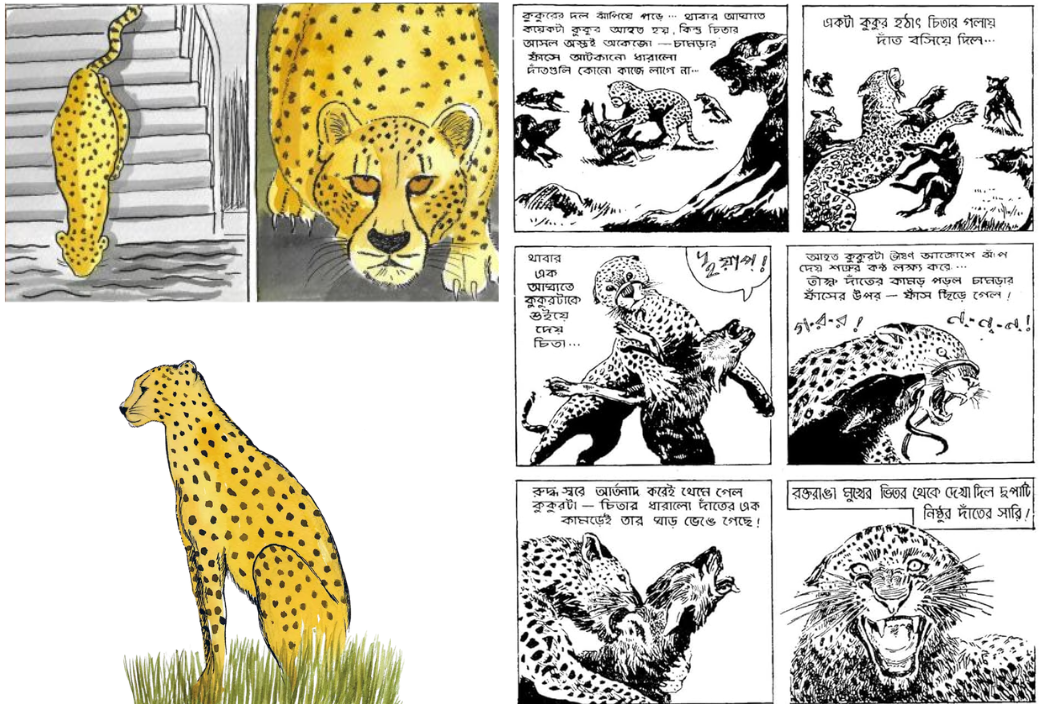
A reference to the creatures airlifted from Namibia into Kuno National Park, Madhya Pradesh in 2022 to repopulate the country’s cheetah population, the majestic migrant whose glance Brighu holds in the closing moments is also a direct invocation of Chowdhury, whose passion for illustrating animals and painstaking accuracy won the admiration and mentorship of Satyajit Ray himself. These are the comics Banerjee himself grew up on, even though his approach has so far had more in common with the long tradition of political cartooning in Indian print media and the persistent strain of Bengali humorous comics (“funnies”) typified by Narayan Debnath, famous for creating strongman Bnatul the Great and his sustained work on the schoolboy Hnada/Bhonda series. Chowdhury’s playground, instead, was intrigue, adventure, and a penchant for historical accuracy with the soul of a literary illustrator (including for several of Ray’s stories). The alchemy this engenders in Banerjee’s approach to Absolute Jafar, makes all the difference.
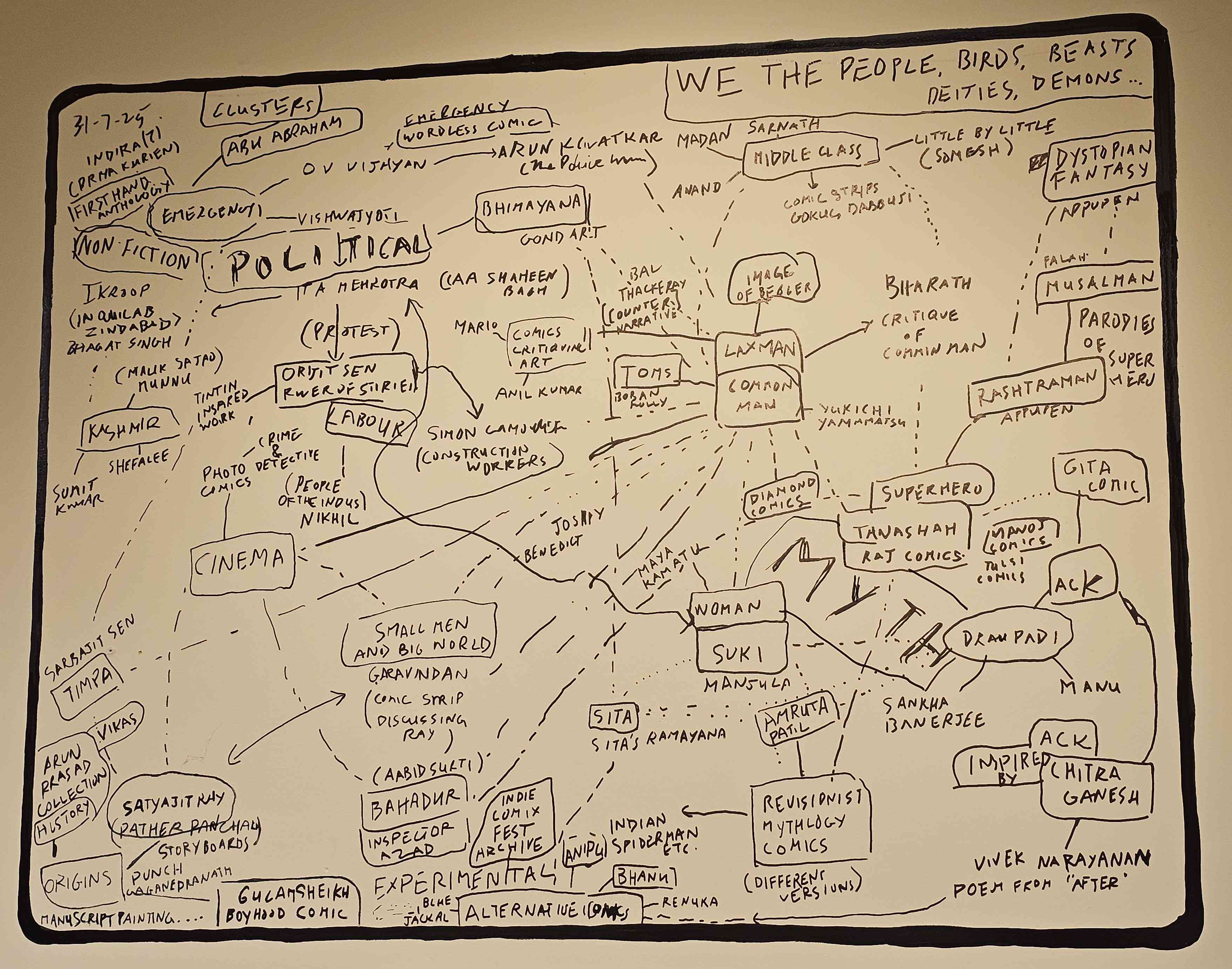
None of these vareities of comics has any particular history of representation within the graphic novels that succeeded them, whose real form is actually one of the more successful marketing fictions of our time. They remain a collective fantasy that continues to find tremendous purchase across the subcontinent.
Every day springs new claimants going further back in time trying to establish themselves as the first Indian graphic novel in English, belying a migrant status for a form that is always arriving, unsure of its own passport in an SIR world. Banerjee exposes his own work as carrying forward Chowdhury’s legacy in how it oscillates between his globetrotting fantasy and a detailed taxonomy of the real. Above all else, the commercial artist (he also painted film posters and book covers) Chowdhury also presents a figure of the working cartoonist distinct from the litterateur, fine artist, or auteur. The patronage of comics as art cannot be cut off from cultural memory. He embodies the labours of illustration and narrative plotting with a particular knack for effective and ornate hand lettering: built into the same artist, but free from Western and other moulds.
Not all looking back is nostalgia, not all homecoming requires heimat: “We are all in the gutter,” Oscar Wilde once wrote, “but some of us are looking at the stars.” The high and low being closer than ever, Absolute Jafar seizes the opportunity, looking up from the gutter of comics, the city’s gutter, and the many gutters of history where the subcontinent’s partitions and displacements pool and stagnate. Building on years of shorter provocations, experiments, and essays in nonfiction across different formats, Banerjee returns to seriously engage with what it means to be a graphic novel without disavowing the many truths and possibilities of comics making. Brighu has tried his best to prepare him, just like Sarnath, Jafar too will have to do his own walking, even if that means risking being mistaken for the traitor he is named after.
Arunava Banerjee is a comics critic and scholar of media art. He also communicates climate change for a living.
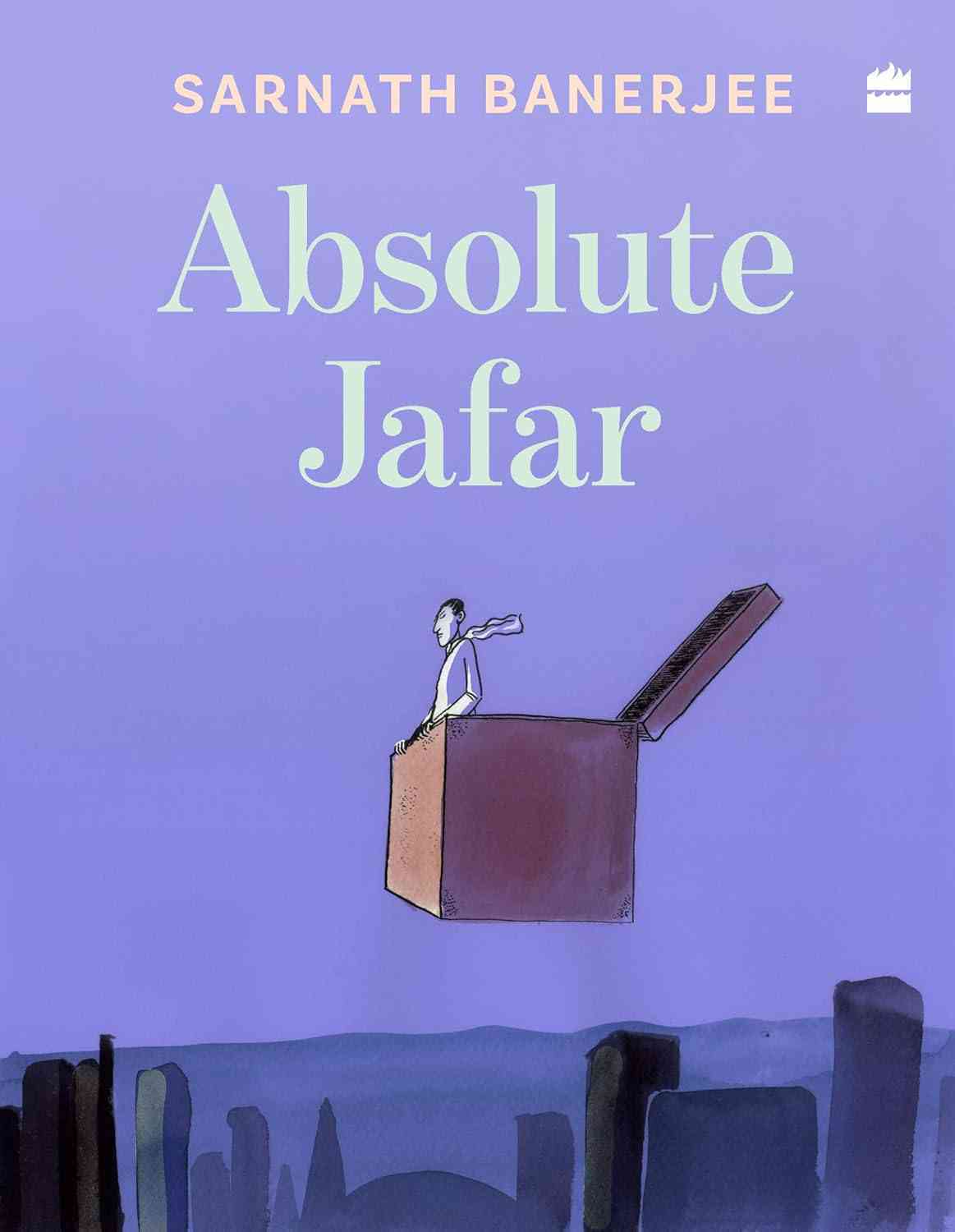
Absolute Jafar, Sarnath Banerjee, HarperCollins India.
