


Raavana Mavanda; Othaiyil Nikkira Yamanda…
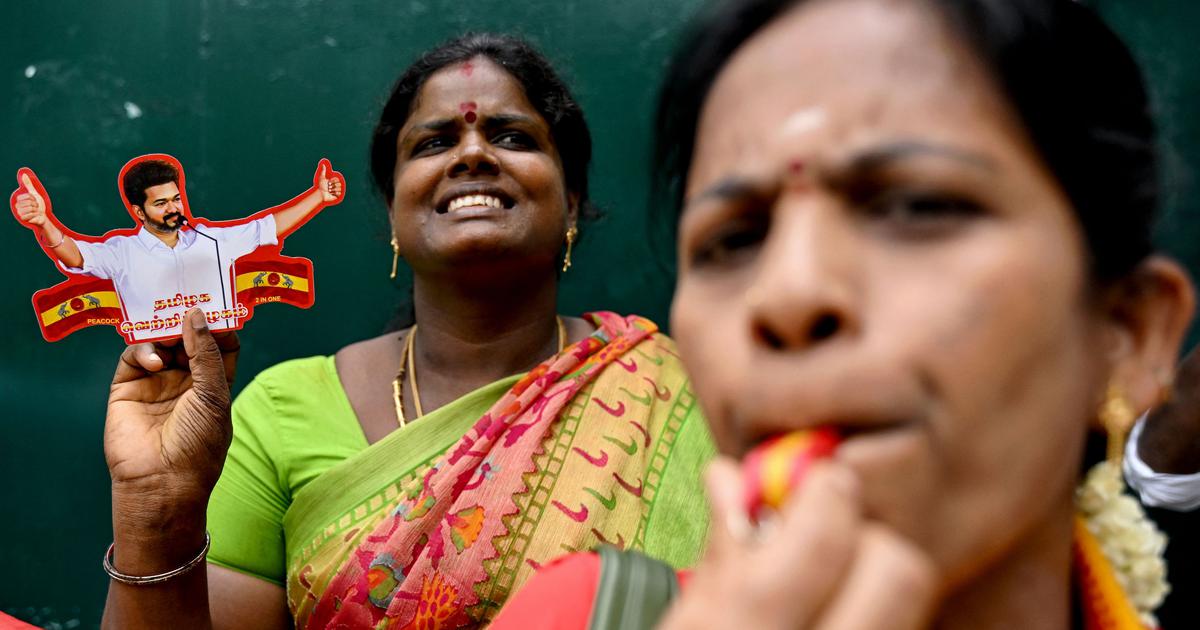
This popular song from the upcoming film Jana Nayagan was widely used by Tamilaga Vetri Kazhagam supporters in their social media campaign during the Tamil Nadu state elections. It loosely means, “The son of Ravana; the destroyer [Yama] standing alone.”
On Monday, actor-turned-politician C Joseph Vijay was transformed into the electoral Yama for both the Dravida Munnetra Kazhagam and the All India Dravida Munnetra Kazhagam in the state – standing alone to defeat the two Dravidian behemoths who have taken turns ruling the southern state for nearly 60 years.
As of 5 pm on counting day, the Election Commission of India website showed that the Tamilaga Vetri Kazhagam or Tamil Nadu Victory Federation had won three seats and was leading in 107. The Tamil Nadu Assembly has 234 seats in total, with 118 being the halfway mark required to form a government.
In terms of vote share, the TVK had nearly touched 35%. The DMK was a distant second, with leads in 52 constituencies and wins in six, while the AIADMK was third with leads in 45 seats.
By this point, sitting Chief Minister and DMK president MK Stalin had lost his race in Kolathur in Chennai, while party general secretary and veteran Duraimurugan trailed in Katpadi. The TVK completely dominated the Chennai region, leading or having won in at least 14 of the 16 seats there.
Vijay, who had contested from Perambur in North Chennai and Tiruchi East in the Cauvery delta region, looked set to win both with large margins. Several sitting DMK ministers and former AIADMK ministers across the state were facing routs.
This was a political tsunami that most observers either failed to see or adamantly refused to acknowledge. Only one exit poll, by My Axis India, predicted the outcome. The popular Tamil cinema hero launched the TVK only two years ago and sat out the 2024 Lok Sabha elections. His rhetoric echoed the programmes of the two Dravidian parties: welfare politics, secularism, social justice and federalism. He even borrowed their icons like social reformer Periyar as his guiding lights.
Almost immediately after the party’s launch, Vijay made his position clear. He repeatedly stated that the Bharatiya Janata Party was his ideological enemy and the DMK his political enemy. The charismatic star hardly ever referenced Tamil Nadu’s principal opposition, the AIADMK, choosing instead to frame the contest as one solely between TVK and the DMK.
What Vijay has achieved is no small feat. The Dravidian parties, over decades, built not only dependable core vote banks that held firm even in the toughest of times, but also deep pockets and organisational machines that TVK simply did not possess. In a state notorious for its cash-for-votes strategies, this was considered an insurmountable disadvantage.
Perhaps the first lesson from Vijay’s extraordinary victory is that money power can be defeated in Tamil Nadu if voters are presented with a credible alternative. But that is not the only lesson.
#WATCH | Tamil Nadu | TVK chief Vijay arrives at his parents' residence in Chennai pic.twitter.com/Of3def4Bys
— ANI (@ANI) May 4, 2026
A youth uprising
The signs of this surge were visible to anyone willing to look with an objective eye. Since September, when Vijay launched his election campaign, his roadshows and public meetings had drawn enormous crowds. And the profile of those crowds was unmistakable. Young people cutting across caste, religion, and gender poured into the streets to catch a glimpse of their favourite “Vijay Anna”, often dangerously following his caravan on motorbikes or simply running behind his entourage.
Notable too was the sizeable presence of women across age groups at these meetings. In interviews conducted by television channels and YouTubers across Tamil Nadu during the campaign, what stood out was not only that young voters loudly proclaimed their intention to vote for TVK: they also made clear they would persuade their parents and grandparents to do the same. Indeed, many elderly voters mentioned after polling day that they had chosen Vijay because their grandchildren had insisted they do so.
Election Commission data shows that following the Special Intensive Revision of the electoral rolls earlier this year, Tamil Nadu had 5.73 crore registered voters – 2.8 crore men and 2.93 crore women. New voters numbered 14.59 lakh, and approximately 40% of the total electorate was under the age of 40, making them the most decisive group.
Unlike older cinema stars such as Kamal Haasan and Vijayakant before him who achieved only moderate electoral support when they ventured into politics, the 52-year-old Vijay was a youth icon with an unprecedented following among younger voters. Many observers dismissed these crowds as mere cinema fandom, predicting that supporters would turn up to see the star but ultimately vote for one of the Dravidian parties, as had happened with Haasan and Vijayakant. The results have shown that this was a dismissive reading, one that lacked substance.
The enormous and at times uncontrollable crowds led to the tragic stampede in Karur on September 27, in which 41 people who had gathered for a TVK roadshow died and over 100 were injured. In the aftermath, Vijay retreated to his Chennai home, not even visiting the families of the dead and injured. Bizarrely, rather than travelling to Karur, Vijay brought the affected families to Chennai weeks later to offer his condolences.
His opponents cited this response as a mark of immaturity, unbecoming of a leader. Vijay refused to accept any responsibility for the incident and instead pointed fingers at the DMK and its Karur strongman Senthil Balaji, alleging they had orchestrated the tragedy. Such a narrative might have floundered, were it not for the AIADMK, the DMK’s old nemesis, choosing to validate Vijay’s claims and questioning the government’s handling of security and planning at the event.
At that stage, AIADMK general secretary Edappadi K. Palanisami was hoping for an alliance with the TVK, which ultimately did not materialise given his party’s existing alliance with the BJP, the very party Vijay had already declared his primary ideological enemy.
On Monday, the trends showed the TVK leading in four of the five Assembly seats in the Karur region. Senthil Balaji of the DMK, perhaps sensing the growing sympathy for the TVK there, had shifted his base to Coimbatore.
காரைக்குடியில் கழகத் தலைவர் அவர்கள்...
— TVK Party HQ (@TVKPartyHQ) April 10, 2026
(1/2) pic.twitter.com/2yaqsYuLzM
In essence, despite the Karur tragedy and the scathing criticism that followed, Vijay’s charisma and a broader public yearning for change appear to have propelled the party to a sweeping victory. Also failing was a concerted effort to paint the TVK as the BJP’s B-team. Vijay’s party officials often reiterated that the party will never align with the “communal BJP”.
Another boost came from the Central Board of Film Certification’s attempt to stall the release of his film Jana Nayagan. Having certified the film once, the censor board subsequently placed roadblocks to its release in January, forcing the producer to fight the matter out in court. This saga once again cast Vijay as a victim, further strengthening his anti-BJP image. If the censor broad controlled by the Union government moved to block the release of Vijay’s film, the obvious implication – not lost on voters – is that the BJP considers him a threat.
In the run-up to the election, the prevailing assumption was that minorities, constituting roughly 14% of the electorate, would predominantly back the DMK alliance, which had positioned itself as the primary anti-BJP force opposing the National Democratic Alliance led in Tamil Nadu by the AIADMK.
However, the results suggest that Vijay may have cut into these votes substantially. A preliminary look at voting patterns shows that the DMK suffered severe damage, with its vote share falling from 37.7% in 2021 to around 24% by 6 pm on Monday. The AIADMK’s vote share similarly declined, from 33.29% in 2021 to approximately 21.35%.
A more granular analysis will be needed to determine whether the TVK has also made significant inroads into the Dalit vote. Regardless, given the size of its vote share and its spread across the state, it is reasonable to conclude that the party has established a cross-community, cross-regional base.
Compounding the problem was the analytical blind spot of much of Tamil Nadu’s media, whose openly pro-DMK leanings – sometimes bordering on the kind of sycophancy seen among television channels operating out of Noida in relation to the BJP – led them to dismiss the surging crowds as blind fandom.
Even those who conceded that the TVK might perform well argued it could only dent the AIADMK by absorbing anti-incumbency votes. On Monday, several of these anchors and commentators faced severe backlash on social media and from fellow panellists.
#WATCH | Tamil Nadu CM MK Stalin arrives at the DMK HQ Anna Arivalayam in Chennai after losing the Kolathur constituency seat to TVK leader VS Babu. pic.twitter.com/j28ErHhxiY
— ANI (@ANI) May 4, 2026
The nature of leadership
Electoral success aside, Vijay has displayed some unconventional leadership traits that warrant closer scrutiny.
Much like Prime Minister Narendra Modi, who has not held a press conference since his election in 2014, Vijay has consistently avoided taking questions from the media. Even after the Karur tragedy, the party’s position was communicated only through second-rung leaders or written statements, and his campaign remained suspended for weeks. Among heads of political parties, Vijay spent the least time on the ground, frequently citing obstruction by police or the administration.
Throughout the campaign, Vijay did not give a single interview. When prominent television networks invited him to high-profile conclaves held in Chennai, he chose to meet them in private rather than engage in public discussion.
This was unlike Stalin and Palanisami, both of whom are accessible to the press. This raises serious questions about his conception of accountability and, more broadly, about the difficulty of reaching him.
While Vijay was eager to challenge the DMK, the party he had declared his political enemy, it was apparent that he was considerably less forthright in his attacks on the BJP, which he claims is his ideological enemy. In addition, the Karur tragedy remains under an inquiry by the Central Bureau of Investigation, with a Supreme Court-appointed committee monitoring the probe.
Should the BJP choose to use this case – which carries criminal liability – as a pressure point, it remains to be seen whether Vijay will hold his ground in ideological opposition. The fact that the BJP is set to win either no seats or just one, despite its alliance with the AIADMK, should offer some reassurance to democratic forces in Tamil Nadu that Vijay will find little incentive to align with the Hindutva outfit.
This is also a sobering outcome for the Dravidian parties. Despite the state recording strong economic growth and impressive gains in social indicators, voters have chosen to reject them in favour of an alternative. This returns Tamil Nadu squarely to the era of cult politics that characterised the tenure of MG Ramachandran, the cinema superstar and AIADMK founder who served as chief minister three times between 1977 and 1987. The DMK, as principal opposition during that era, found it impossible to dislodge MGR given his overpowering hold on public imagination.
Now, the two Dravidian parties, who have been locked in half a century of mutual enmity, may be forced to coordinate in order to mount an effective opposition to Vijay.
In historical terms, what Vijay has achieved is closer to NT Rama Rao’s feat in undivided Andhra Pradesh in 1983, when he won the Assembly election within months of launching the Telugu Desam Party. Unlike MGR, who spent 20 years in the DMK before founding the AIADMK in 1972 and then worked for five more years before attaining power, Vijay has won office just two years after floating his party.
Serious introspection is also warranted on the part of the Dravidian parties about how they have managed to alienate the youth. While DMK supporters have condescendingly labelled TVK supporters as tharkuris, the ignorant, part of the responsibility for Tamil society’s depoliticisation must rest with the two parties themselves. The state has systematically dismantled student politics on its campuses, and education has been progressively commodified through the proliferation of private colleges and universities.
The dynastic character of many parties in the state, the DMK in particular, has created conditions in which those without money or political lineage find it nearly impossible to participate in public life. The parties had thus far evaded defeat to a third force largely owing to the absence of a sufficiently charismatic challenger. That absence no longer exists. Despite the presence of Deputy Chief Minister Udhayanidhi Stalin, marketed as its youth icon, the DMK has been tamed by the votes of young people.
#WATCH | Chennai | Tamil Nadu Elections 2026 | AICC In-charge Tamil Nadu, Girish Chodankar says, "The people of Tamil Nadu, they voted for a change. Especially the youngsters and women have moved towards TVK and that's why TVK is getting such large numbers. I have already… pic.twitter.com/oYogeWESCI
— ANI (@ANI) May 4, 2026
An alliance government
The possibility of the TVK falling short of a single-party majority may offer a measure of structural accountability. Should the party need a post-poll alliance to reach 118 seats, its most natural partners would be the DMK’s existing allies the Congress and the two Communist parties.
A large section of Congress leaders had in fact proposed a tie-up with the TVK before the elections, only to be overruled by the central leadership, which opted for the safer route of an alliance with the DMK – a decision it will likely regret. Nonetheless, the party has won one seat and was leading in four as of 5 pm on Monday.
The Communist Party of India had won one seat and was leading in one, while the Communist Party of India (Marxist_ was leading in two. If these trends hold, the Congress and Communist parties together could provide the numbers the TVK needs to form a government. The party may also look to the Indian Union Muslim League and the Viduthalai Chiruthaigal Katchi if required.
This would effectively mean the DMK’s alliance partners shifting wholesale to the TVK, driven by their shared priority of keeping the BJP out of power in the state. At the time of his party’s launch in 2024, Vijay had made clear that he would offer a share of power to alliance partners. Having been unable to attract any major party to a pre-poll coalition, he will now find smaller parties eager to lend their support in exchange for cabinet berths, with the majority mark only a few seats away.
An alliance with the Left and the Congress would, one hopes, act as a check on the cult politics on display within the TVK – a tendency that could easily degenerate into an unaccountable exercise of power. A common minimum programme could also give direction to a party that enters government with little administrative experience.
With the former AIADMK leader KA Sengottaiyan expected to hold an important position in a TVK-led government, having jumped boats before the election, Palanisami may have to brace himself for a possible exodus of his party legislators.
All of this aside, Monday’s results have confirmed that Tamil Nadu, unlike Kerala – the other southern state whose results were declared on the same day – remains unable to decouple cinema from politics.
Sruthisagar Yamunan is a journalist and researcher.
