




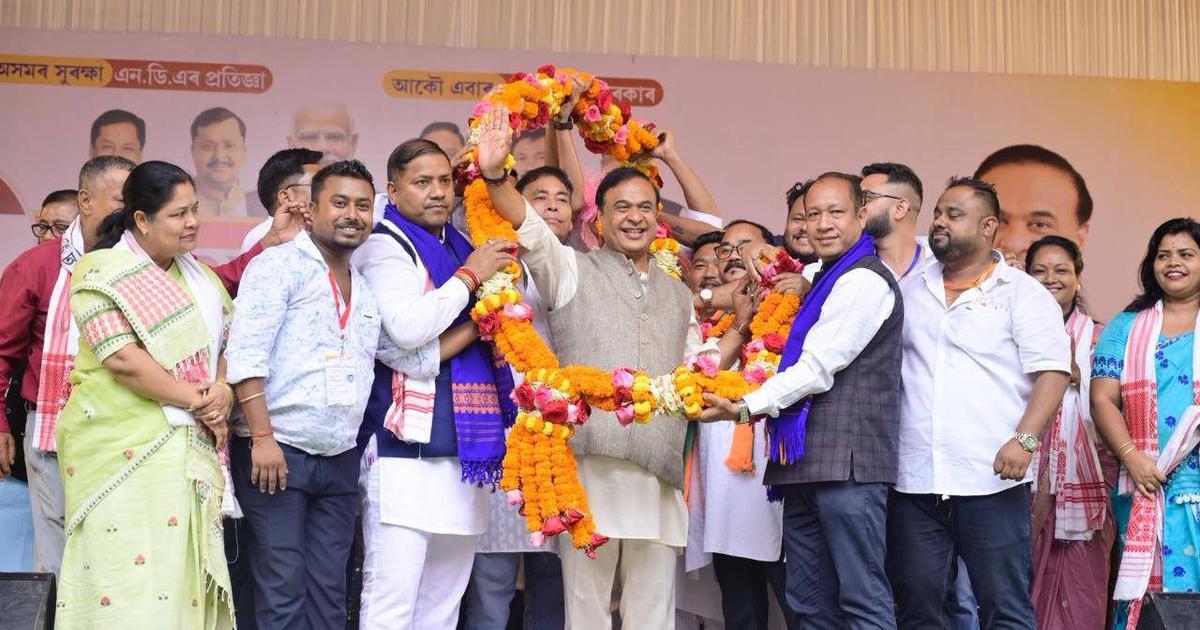
The landslide victory of the Bharatiya Janata Party and its allies in the Assam assembly elections came as no surprise to Chief Minister Himanta Biswa Sarma.
One of the reasons, he told reporters after the result, was the delimitation exercise carried out in 2023, which ensured that Muslim voters would play a decisive role only in 23 of the state’s 126 constituencies.
“So we knew that at least 102-103 seats were winnable for us,” he said.
As Scroll had reported, the delimitation exercise in Assam had been conducted ostensibly to protect the political rights of the state’s indigenous people. But the manner in which constituency borders were redrawn effectively reduced Muslim representation in the state.
Sarma was not far off the mark. The BJP ended up with 82 seats, and its allies, the Bodo Peoples Front and the Asom Gana Parishad, won ten seats each, taking the tally of the alliance to 102.
In the last two Assembly elections, the BJP had peaked at 60 seats. This time around, it increased its tally by 22 seats.
How much was delimitation a factor in this boost? Scroll’s analysis shows that the BJP-led alliance benefited from the exercise in 19 seats.
This includes five new seats created in the tribal areas of the state, two erstwhile Muslim-majority seats that were reserved for Scheduled Caste and Scheduled Tribe groups and 12 other seats that saw a significant restructuring of demography.
Opposition leaders have described the delimitation exercise in Assam as gerrymandering – redrawing the boundaries of constituencies to give an advantage to a particular political party.
Assam and Bengal are clear cases of the election being stolen by the BJP with the support of the EC.
— Rahul Gandhi (@RahulGandhi) May 4, 2026
We agree with Mamata ji. More than 100 seats were stolen in Bengal.
We have seen this playbook before:
Madhya Pradesh.
Haryana.
Maharashtra.
Lok Sabha 2024 etc
चुनाव चोरी,…
Fewer Muslim MLAs
The 2023 delimitation exercise led to a fall in the number of Assembly constituencies in Muslim-majority districts and a rise in seats in areas inhabited by communities considered indigenous to Assam.
Typically, the number of constituencies in Assam that have a significant Muslim population and that send Muslim legislators to the Assembly is around 30.
Delimitation brought that figure down to around 23.
This was done by scrapping several Muslim-majority assembly constituencies, selectively adding villages in which the community was present in large numbers to Hindu-majority constituencies, reserving such seats for Scheduled Caste or Scheduled Tribe communities or merging two constituencies traditionally won by Muslim legislators into one.
The outcome of the exercise can be seen in the 2026 results.
While 31 Muslim legislators were elected in the 2021 Assembly election from the Congress and the All India United Democratic Front, this time only 22 Muslim legislators from the Opposition were elected. The BJP did not give tickets to any Muslim candidates.
The NDA gains: Two seats reserved for SC
The effect of delimitation can also be read into the rise in the BJP-led National Democratic Alliance’s tally, even in areas in which it has traditionally been weak.
Take the Barpeta and Goalpara West constituencies in Lower Assam, where the large population of Bengali-origin Muslims is concentrated. This community has been in the crosshairs of the Sarma government.
Both these seats were typically represented by legislators from the Bengali-origin Muslim community, sometimes pejoratively called Miya Muslims. This was a function of demography, as both these constituencies had a large Miya Muslim population.
But the delimitation exercise redrew the constituencies in a way that the proportion of Hindus went up, while Muslim voters were parcelled off into other seats.
That was not all. Both the seats were reserved – Barpeta for Scheduled Caste candidates and Goalpara West for Scheduled Tribes – barring minority leaders from standing for the election.
In the 2021 elections, both seats were won by the Congress. This time, they switched to the BJP and its ally, the Asom Gana Parishad.
The delimitation exercise also led to an addition of five seats in tribal areas of the state – one seat was added to the Karbi Anglong Autonomous Council and four new seats to the Bodoland Territorial Region. All five seats were won by the BJP and its allies this time.
#Assam's delimitation has changed the shape of electoral boundaries. Here are some maps of - Mangaldoi, Gauripur, Golpara East, Abhayapuri. These boundaries split roads, rivers, mountains. Mangaldoi is not even spatially connected. Why doesn't #ECI publish delimitation maps? pic.twitter.com/8l61381O5X
— Srinivas Kodali (@digitaldutta) April 8, 2026
NDA gains: Seats scrapped or redrawn
Scroll’s analysis shows that the delimitation exercise benefited the National Democratic Alliance in at least 12 other seats – three in the Barak Valley, six in Lower Assam, two in Middle Assam and one in Upper Assam.
All these seats saw radical restructuring in the delimitation exercise. They were won by the Opposition in 2021 and switched to the National Democratic Alliance in 2026.
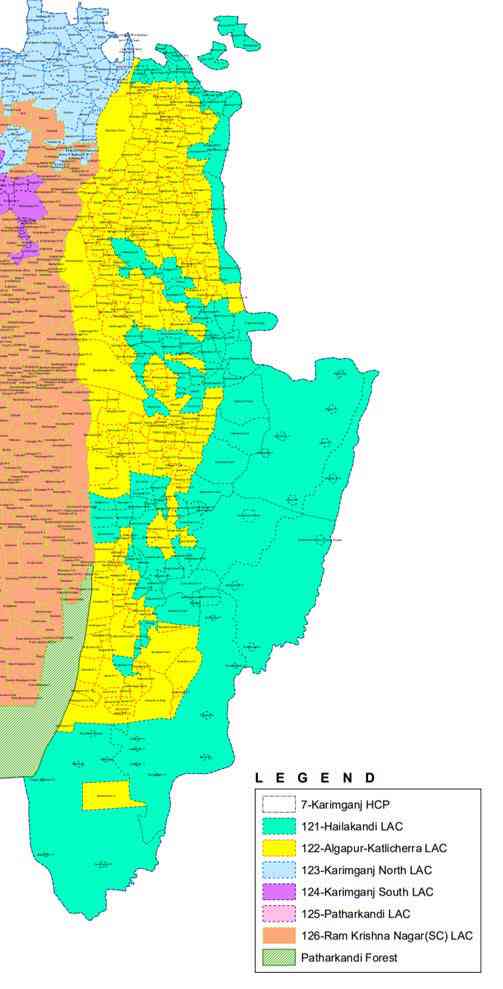
Take Hailakandi, one of several constituencies in Assam that have been redrawn with blatant disregard for geographical boundaries.
Since 1952, Hailkandi, which is a constituency in Barak Valley, has elected Muslim legislators all but three times.
The delimitation exercise broke up the seat into four geographically disconnected pieces. This had the effect of consolidating Hindu voters and reducing the Muslim population from 59% to 37%, according to estimates by observers and parties.
Most of the Muslim-majority areas of the seat were added to Algapur-Katlichera, a Muslim-majority seat. Hailakandi was won by the BJP this time.
A similar pattern was visible in Katigorah seat in Barak Valley’s Cachar district, which the Congress had won in 2021. First, 12 Muslim-majority villages of the constituency were surgically removed from its borders and the Hindu-majority town of Badarpur added to it. As a result, the proportion of Hindus in the seat went up to 70%, said constituency observers. In the 2026 election, Katigorah was won by the BJP.
The third seat in Barak Valley, Barkhola, also saw a reduction in the number of Muslim voters. It has been won by BJP, a departure from the last few decades. It was mostly represented by Muslim legislators since 1951.
In Lower Assam’s Dhubri district, delimitation reduced the proportion of Muslims in two seats – Golakganj and Bilasipara. Both seats have gone to the NDA, although the AGP won Bilasipara by a narrow margin.
In some regions, two constituencies were merged to create one, unsettling traditional vote alliances of the Opposition.
Take Bhowanipur-Sorbhog in Barpeta district, which was created by collapsing the two seats of Bhowanipur and Sorbhog into one. The BJP and its allies had lost both seats in the previous election.
In fact, Sorbhog’s unfavourable demography had led former state BJP chief Ranjeet Kumar Dass to contest from Pathacharkuchi in 2021.
The delimitation exercise, however, sliced off Hindu-majority areas like Howly town from the nearby Barpeta seat and added them to the new seat, leading to a fall in Muslim numbers.
Dass won the Bhowanipur-Sorbhog this time.
In Middle Assam, the BJP gained in Raha and Nagaon-Batadraba seats, both restructured by delimitation.
In Upper Assam’s Titabor, delimitation led to the increase in the population of tea tribes, to the disadvantage of Ahoms, the community to which Congress leader Gaurav Gogoi belongs.
Tea tribes now form nearly one-third of the electorate, while Ahoms were the dominant group before delimitation.
Titabor was a Congress stronghold since 2001, having been represented by Gogoi’s father and former chief minister Tarun Gogoi.
Both Congress and BJP fielded candidates from the tea tribe community. The BJP candidate won with a margin of 23,000 votes, on the back of solid support from the tea tribes.
