


It did not take much for long-standing political alignments in Tamil Nadu to break down after the stunning election results on Monday. After the loss by the two Dravidian parties, which had between them ruled the state for six decades, the Congress ditched the Dravida Munnetra Kazhagam alliance and backed the largest party, the Tamilaga Vetri Kazhagam.
The TVK, led by the charismatic actor-turned-politician Vijay, secured 108 seats in the 234-member Assembly and needs 118 to reach the majority mark. The Congress, with five MLAs in its kitty, grabbed the opportunity gleefully.
With smaller outfits like the Left parties considering Vijay’s request for support, it looks likely that the TVK will manage to muster the numbers. On Wednesday, Vijay formally staked claim to form the government though it was still not clear on Thursday morning if the governor would invite him to form the government.
In the meantime, media reports emerged that a strong section within the All India Anna Dravida Munnetra Kazhagam want the party to extend support to the TVK, even though Vijay had not officially reached out to it as he had to the Left and the Viduthalai Chiruthaigal Katchi.
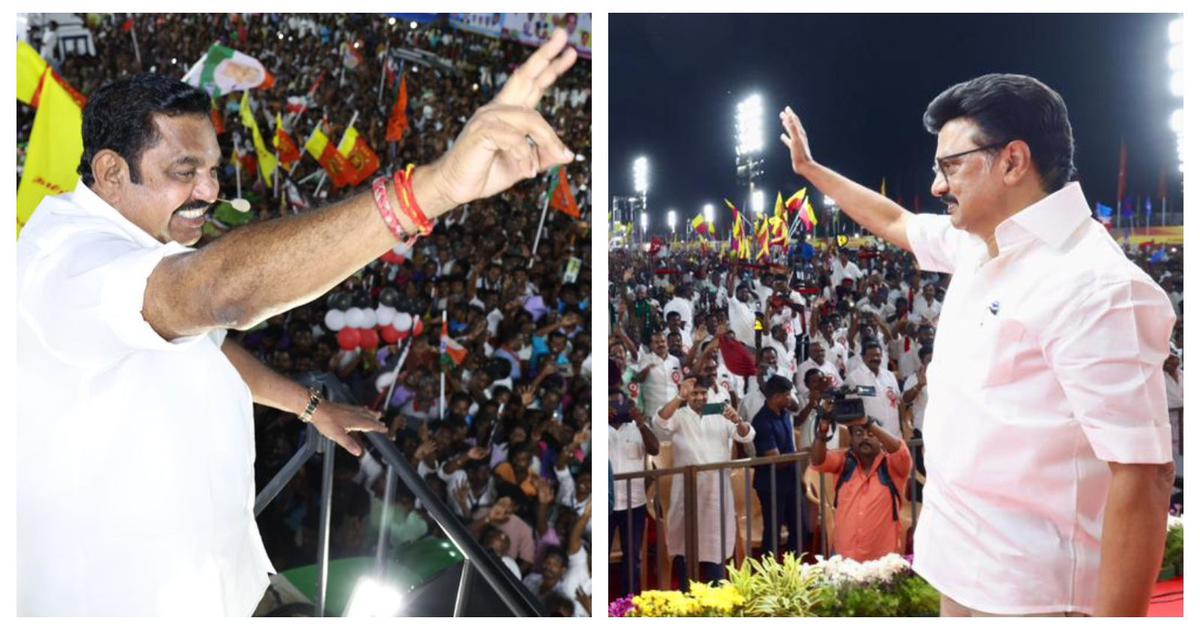
These developments point to a crisis for both Dravidian parties, albeit of different degrees. The internal coherence of the Dravida Munnetra Kazhagam, where ousted Chief Minister MK Stalin’s leadership faces no challenge, may help the party weather the electoral setback. Even so, the Congress’s departure could strain the alliance’s position as the primary ideological challenger to the Bharatiya Janata Party and create uncertainty ahead of the 2029 Lok Sabha elections.
For the AIADMK, the future looks even more uncertain, given the string of defeats since 2017 and the possibility of a challenge to Edappadi K Palanisami’s leadership. The party’s main asset was its position as the principal rival to the DMK. With that identity now under threat, the AIADMK may have to reinvent its strategies drastically.
#WAYCJ | TVK leader VS Babu defeats Tamil Nadu CM MK Stalin to win the Kolathur constituency seat in the state assembly elections 2026. pic.twitter.com/BM7HkFHURd
— ANI (@ANI) May 4, 2026
Congress ‘backstabbing’
When news emerged on May 5 that the Congress had decided to back the TVK, the DMK immediately denounced it as a “backstabber”. DMK spokespersons went on television to question the Congress’s reliability as an alliance partner. Could any regional party count on the Congress to consistently support them in their fight against the BJP? Is it not opportunism to abandon the DMK, which has been a consistent ally for over a decade despite the repeated setbacks the Congress has faced?
While the spokespersons insisted that the Congress’s departure would not cause too much damage, senior leaders are more cautious. A DMK parliamentarian told Scroll that it may create difficulties for the 2029 Lok Sabha elections.
The DMK leader said the Congress’s value to the alliance was that its presence made the coalition the definitive anti-BJP front in Tamil Nadu, which is why the DMK had accommodated demands disproportionate to the Congress’s actual strength.
“So we have to make sure people do not start seeing the TVK camp as the primary opposition to the BJP,” this person said.
With the DMK clear that it cannot align with the BJP given its strident anti-Hindutva position, the leader argued that this could have a consequences in 2029.
“If the AIADMK retains its alliance with the BJP and the Congress is with the TVK, that may leave us without a PM candidate,” the leader said.
While this scenario is not entirely new in the Tamil Nadu context (the AIADMK won 37 of 39 seats in 2014 without being allied with either the BJP or the Congress), it could mean a far more difficult campaign.
The official was quick to add, however, that politics can change swiftly and that pressure at the national level and results in other state elections may yet force the Congress to reconsider its position.
The Congress’s move also sharpens the contest for minority votes. Even in the 2026 Assembly polls, the TVK had made inroads into a vote bloc long seen as loyal to the DMK and impenetrable for other parties. With the Congress now in the TVK camp, this trend is likely to intensify.
That said, the DMK does not consider its position as dire as the media is portraying it. The party won 59 seats with a sizeable vote share and will hold the post of Leader of the Opposition. While DMK president Stalin lost in the Kolathur constituency, his leadership faces no challenge. “We retain both ideological and leadership coherence, unlike the AIADMK,” the MP pointed out.
https://t.co/k3NW4nsIAZ
— TOIChennai (@TOIChennai) May 6, 2026
Let #Vijay form govt, we won’t disturb for six months: #Stalin
An existential crisis
The AIADMK faces a tougher challenge.
A leader who spoke to Scroll on condition of anonymity said the party’s biggest problem is that the TVK has usurped its anti-DMK plank.
The leader argued that the majority of Tamil Nadu’s electorate has always voted against the DMK. “You must remember that the AIADMK has ruled Tamil Nadu for far more years than the DMK, even though the DMK is the older outfit,” the leader said.
Whenever the anti-DMK vote split, the party suffered. “Whether it was 1989, when the AIADMK contested as two factions, or 2006, when Vijayakant’s DMDK [Desiya Murpokku Dravida Kazhagam] entered the fray for the first time, the split in anti-DMK votes cost us,” he said/
Nevertheless, for the last 50 years, the AIADMK has enjoyed the position of principal challenger to the DMK. The 2026 election has upended that, with Vijay positioning himself as the main anti-DMK force and poaching several AIADMK leaders in the process.
“We really have to think about how to confront this problem,” the leader said. “The more he is seen as the DMK’s primary enemy, the more we lose relevance.”
It is Edappadi K Palanisami, the general secretary of the AIADMK, who may have to bear the blame for this. The general feeling was that Palanisami lacks the charisma that Vijay plainly possesses. In a strategic misstep, he also failed to sense Vijay’s growing support and did not think it necessary to criticise him during the campaign.
“We should have assessed him better,” the party leader said, particularly after the TVK began using pictures of AIADMK founder MG Ramachandran widely and positioning Vijay as his political successor, given their shared background as actor-turned-politicians.
Beyond this, Palanisami has also disrupted the social engineering that the AIADMK had benefitted from for decades. Both party founder Ramachandran and later leader Jayalalithaa hailed from minority caste groups, the former a Malayali Nair and the latter a Brahmin.
This was no accident. Because neither belonged to any of the numerically dominant intermediate castes, their leadership was acceptable to all of them, in the sense that a figure from outside their ranks posed no threat and spared them the indignity of serving under a rival group.
It was precisely this factor that allowed the competing factions within the party to coexist, each content that no single dominant caste had captured the top. Even though the influence of VK Sasikala, Jayalalithaa’s former aide, had made it appear that the Thevars held the upper hand, the caste balance was in reality preserved through a patronage model that distributed party positions, lucrative contracts and ministerial berths equitably among these groups.
Interesting: now RESORT politics in Tamil Nadu! A group of AIADMK MLAs have been moved to a resort in Puducherry amidst uncertainty over govt formation .. Surely this is not what people in Tamil Nadu voted for! (Wonder who is footing the bill for the resort, any guesses?😃) pic.twitter.com/eU4AqpaQYL
— Rajdeep Sardesai (@sardesairajdeep) May 7, 2026
Under Palanisami, however, this balance has unravelled. His identity as a leader of the Vellala Gounders, a numerically dominant backward caste in west Tamil Nadu, and his decisions to expel former Chief Minister O Panneerselvam, Sasikala and her nephew, former parliamentarian TTV Dhinakaran, have made him unpopular among the Thevars, a dominant group in south Tamil Nadu. The party has also seen its base among Dalits being eroded over the last decade.
In the 10 districts that make up south Tamil Nadu, the AIADMK managed victories in only five seats, down from an already poor tally of 18 in 2021. Adding to the damage was its dismal performance in western Tamil Nadu, where the party’s vote share fell by about 15 percentage points compared to 2021, ceding ground to the TVK.
“We also need more youngsters in the party,” the leader said.
Whether the AIADMK’s poor performance leads to another internal revolt remains to be seen. Given the lacklustre tally in west Tamil Nadu, Palanisami may not be able to rely on caste patronage alone to retain his leadership. All aside, the party may also have to break the perception that it has become a satellite outfit of the BJP in Tamil Nadu, something that has clearly hurt its standing.
While the DMK has not won consecutive terms since the AIADMK came to power in 1977, the AIADMK has never been away from power for more than five years. In that sense, the DMK know the art of survival without power, which the AIADMK does not.
Both parties believe the upcoming local body elections in early 2027 will be crucial. Now that they know the TVK’s strength, they will go all out to gain any advantage and boost the morale of their cadre.
Sruthisagar Yamunan is a journalist and researcher.
