









Religious scriptures and associated traditions have rarely been kind to women. If scriptures would have it, we would still be legally allowed to stone an “unchaste” woman to death or enslave a harem of women for sex or class one’s wife alongside cows, mares, ewes and female camels.
As evolutionary biologist Richard Dawkins says, while responding to an audience member’s question on atheism and morality, “people in the 21st century believe in the equality of women and in being kind to animals”. These are things that are entirely recent, says Dawkins.
“They have very little basis in (religious) scripture. These have developed over historical time through a consensus of reasoning, sober discussion, argument, legal theory, political and moral philosophy,” said Dawkins. “These do not come from religion.”
What is unthinkable in modern society was perfectly acceptable before because religious scriptures and traditions permitted it. It is thanks to reasoned debate and deliberation that we eventually became sane enough to reinterpret problematic verses in sacred texts and reject misogynistic traditions.
Even if extreme patriarchal practices like female foeticide and dowry continue without qualm in India today, reasoned debates, leading to laws, ensured that in a civilised society these can never be considered as legitimate.
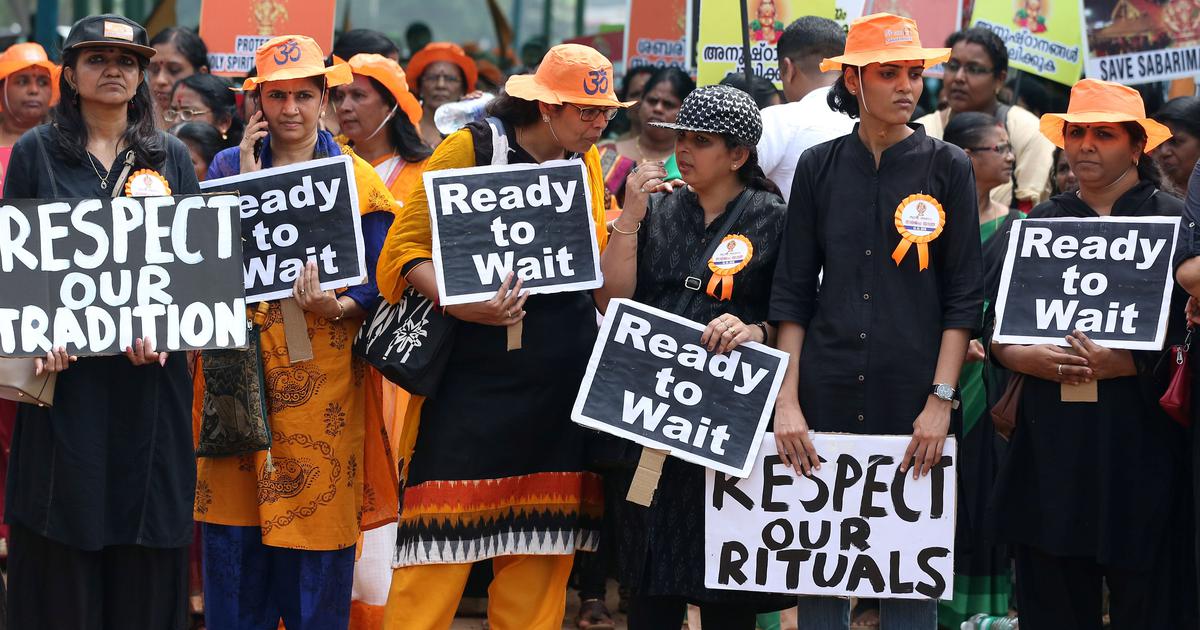
A hot topic in India occupying the minds of the legal, the rational, and the religious today is the entry of women into religious sites – temples and mosques. The rational argue that reason must be the proper test of belief, an argument that the Supreme Court agreed with in its 2018 judgement when it lifted a centuries-old ban prohibiting the entry of menstruating-age women into the Ayyappa shrine at Sabarimala Temple in Kerala. The Court held that the religious practice was illegal and unconstitutional.
Former Chief Justice of India, DY Chandrachud, who was part of the five-judge bench, underlined the fact that menstruation does not make a woman impure. The religious were unconvinced. How can courts interfere with religion and tradition? Rights of an individual cannot supersede centuries-old traditions honoured by many, they lamented. An inevitable review by the Supreme Court followed whose judgement is awaited.
J Nagarathna: amongst hindu, when there is birth and death, they don't go because there are restraints. somebody tomorrow will file a petition and say I will go next day after death
— Live Law (@LiveLawIndia) April 29, 2026
Jaising: there is custom that woman who has given birth can't go. they go during the rice feeding…
It is a fact that menstrual taboos are central to banning women between ages 10 and 50 from religious sites, including at Sabarimala. Menstruation as “ritual pollution”, as defiling, unclean or unsuited for worship, is found in some shape or form in all major religions and traditions associated with them – Judaism, Buddhism, Islam, Christianity and Hinduism. Scores of restrictions on menstruating women, making her a pariah for most of her life, belie the egalitarianism and morality professed in religion. It is easy to control a woman if much of her life is spent in worrying about bodily etiquette.
The larger issue, therefore, is this. Assuming that egalitarianism between the sexes is the hallmark of a civilised democracy, would blanket bans by the judiciary or legislature on misogynistic religion-based practices help women? Or should it be a process based on thought-out deliberations within civil society over time? Or both? Tough questions that have no simple answers.
It could be argued that so long as bans are motivated by the rights of the individual, they may produce the desirable outcome. The operable word is autonomy or the right to make decisions without external interference. Let us take two examples. One, already discussed, is the refusal of entry to women in religious sites. Two, is the observance of the veil, hijab or ghoonghat. Both are examples of the control of women and must be resisted. But the approach will need to be different for each.
In the case of the hijab, and the ghoonghat, there is no dispute that it is patriarchal, as I have argued before. Yet, despite the political stigma over a woman in hijab and societal coercion of a woman who wants to reject hijab, the ultimate decision is hers. She has control over what she wants or does not want to wear. Mandating or banning dress codes is an insult to her autonomy and dignity.
Muslim women in Iran and Muslim women in India seem to be fighting different battles – the former rejecting hijab mandates by the state, the latter rejecting hijab bans by courts and the state, but, in truth, they are both fighting the same battle. A battle for rightful autonomy.
“There must have been a reason why my mother gave birth to me, right? It couldn’t have been to just slog it out in the kitchen and scrub the bathrooms.”@Johanna_Deeksha on the anger and despair of young Muslim women, one year after Karnataka’s hijab ban https://t.co/k1IsBbFuLW
— Supriya Sharma (@sharmasupriya) January 11, 2023
This is why sartorial bans and mandates have often resulted in unintended consequences – women have dropped out of education, when forced to remove their hijab or, worse, given up their life fighting against hijab. Paternalistic bans and mandates are unlikely to reduce the practice. The recent withdrawal of the three-year-old hijab ban in Karnataka is likely a political stunt, but it could benefit Muslim women in education and attune them to decide for themselves.
On the other hand, barring menstruating-age women from entering temples and mosques is not the same as banning (or forcing) her from observing religious garb. As it stands, either women are completely prohibited from entering religious places, such as Hindu temples, or refused access from the main entrance and packed into smaller segregated spaces, as in mosques.
Menstrual taboos and segregation of sexes emerge from the scriptural logic that men and women may be equal in the realm of religion but are different by virtue of their biology. Because they are built different, their roles are different and, therefore, they cannot be treated as equals.
Experts disagree with this logic: patriarchy has nothing to do with anatomy. Fact is, humans show a more extreme pattern of male domination of females than is characteristic of most other primates despite the same biological dichotomy. As the legal scholar Catharine MacKinnon writes, “Women are constrained to be men’s social inferiors; they are not men’s biological inferiors… It is an ordinal hierarchy. This power division, not our bodies, is what makes women a political group.”
Barring women from entering religious sites because she is menstruating or anatomically different from a man, is discrimination over an aspect of life that is beyond the woman’s control. She is barred simply because she menstruates and has a vagina. She has little control over a natural process that scriptures and traditions have reduced to being impure and sinful. That is discrimination.
Dignity and freedom are innate to us. Without altering the foundational nature of religious scripture, centuries-old traditions have been reinterpreted through consensus and nuance without losing sight of individual autonomy. If the status of women over the world has improved and if men have become more egalitarian, it is because these deliberations have ensured that the basic principle of equality trumps dogma.
Raheel Dhattiwala is a sociologist.
