







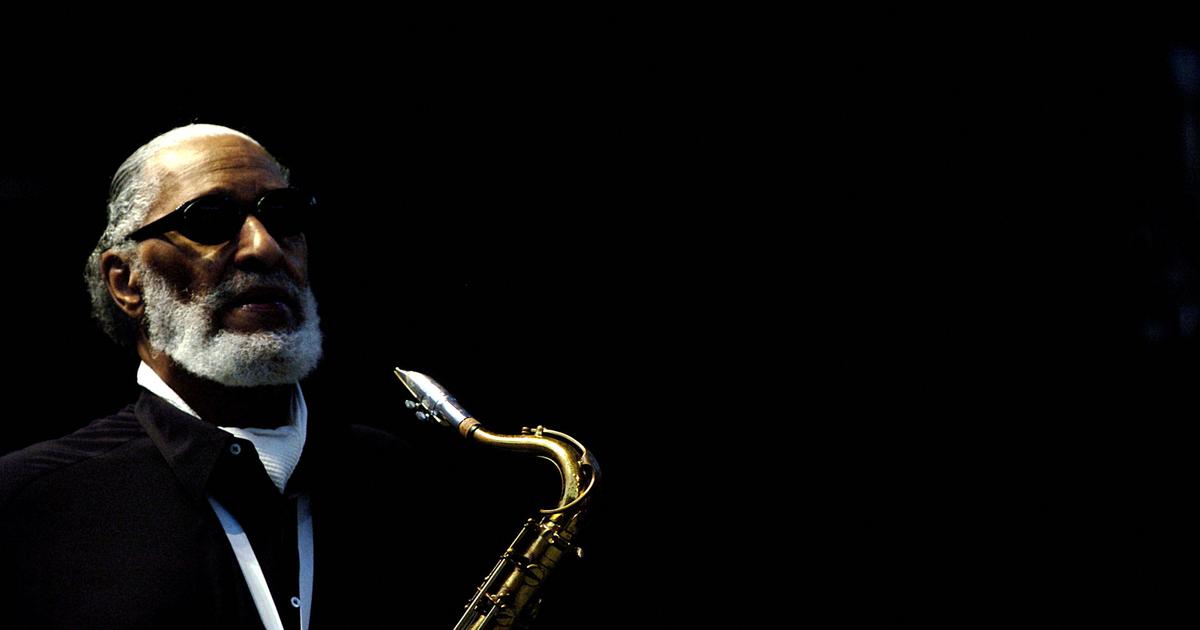
Lord – use my troubles to bring beautiful harmony to my life
Lord – shine your light on every problem I have and show me its beauty
These are two prayers from the notebook of Walter Theodore “Sonny” Rollins, who passed away on May 25 in his home in Woodstock, New York. He was 95 years old, the last of a generation.
He was the final surviving member from A Great Day in Harlem. I hung a copy of this photograph on my wall as a teenager and my eyes often drifted to Sonny Rollins and Thelonious Monk in their sunglasses.
🎶 Iconic Photo Spotlight — A Great Day in Harlem
— Huey K. Bridgeforth (@hkb73) May 18, 2025
On August 12, 1958, photographer Art Kane (1925–1995) captured one of the most legendary images in jazz history—57 musicians gathered on a Harlem stoop for Esquire magazine. pic.twitter.com/3v6fyIKZ3q
Several years ago, I went to Harlem myself to read some of Rollins’s personal papers, which the Schomburg Center for Research in Black Culture acquired in 2017. I was especially interested in Rollins’s extended engagement with India, where he visited for the first time in 1968 during one of his self-imposed sabbaticals from public performance.
While his hiatus from 1959 to 1962 is ingrained in jazz lore, Rollins took another break between 1968 and 1971, during which he spent time studying yoga at an ashram in Bombay.
At the peak of the Vietnam War and backlash against the Civil Rights movement, he got to the essence of his decision: “In order to avoid becoming a hateful person, I have to remove myself from this society.”
In the same year that Rollins visited India for the first time, he also sought refuge on the outskirts of the city whose Williamsburg Bridge was his second home between 1959 and 1962. A 1968 film shows him practicing with the trees and flowers outside of New York City, where he went to find peace alone, together with nature.
When asked why he withdrew from public appearances, Rollins said, “Of course I want to communicate, you know? But it might take being alone to communicate.”
Rollins introspects on his double consciousness as a black man and an American. He expresses a realisation that his youthful faith in American ideals was “foolish” and “naive” while also affirming that “jazz means actually the best parts of America. It really means true recognition regardless of race, creed, or colour”.
He strove to reconcile the irreconcilable, what WEB Du Bois referred to as a “two-ness – an American, a Negro; two souls, two thoughts, two unreconciled strivings; two warring ideals in one dark body, whose dogged strength alone keeps it from being torn asunder.”
Rollins’s personal papers stand as a testament to his struggle for spiritual oneness in the face of irreconcilable twoness. In a journal entry, he writes that
“people want to control you / present you / picture you as they want you to be / fit you into their category. This constitutes what life out here is all about; the battle lines. as it were. this is where the system tries to crush us as it did me one time. watch yourself.”
His struggle against the “hateful people” who wished to “destroy” his “basic spirituality” pushed him toward a study of India, Indian music, and yoga, but also to an investigation of Rosicrucianism, American Indian music, anatomy, nutrition, CS Lewis, Léopold Sédar Senghor, among other diverse topics, traditions, and thinkers.
What tied all of these threads together was his lifelong belief that “there was more to reality besides the obvious”.
Sonny Rollins’s diaries reveal struggles with “mental depression” and feelings of “physical draining,” as well as joyful breakthroughs in understanding the fruits of an integrated mind, body, and musical practice:
“When I start in the morning with a smile and do my daily duties (such as light exercise and healthy food) I am sure of the way I’m going to sound before I even blow air through the horn. So what we have is this. An inside the self knowledge which brings confidence as an attribute. Or in other words by living true to those things in life which are of proven [value] over the years (health + exercise, good disposition, golden rule, etc.) I am able to create the sound of my saxophone in my mind (at that to create the sound I want to hear) and then after hearing it, play it.”
Art and life were never separate for Rollins. Reading his diaries, one does not get the sense that the role of the artist is to bring the two together; rather, they are always already intertwined. Food, musical notation, religious introspection, physical exercise – all appear in seamless succession across his journals.
The purpose of the artist, then, is to discover the spiritual substrate upon which all of this rests and express that perennial discovery to the world.
Thursday, May 31
Diet still uncontrollable.
But am fighting!?!
more music please
I am a singular artist
I do a singular thing.
In May 2020, during the early days of the Covid crisis, Rollins stated that “technology is no savior”. He positions modernity’s obsession with speed and novelty against art, which is “beyond modern culture’s political, technological soul.”
He continues:
“I believe in reincarnation, which means that a person playing music has got a lot of things in his mind that he’s heard already. He puts them together and that comes out in his style. So you might recognise Louis Armstrong’s style, but it’s still derivative of every kind of music that exists. Any experiences that he’s had, or things that he’s played, he takes and folds into himself, and they become something new. Charlie Parker, Dizzy Gillespie, John Coltrane – their styles are ultimately made up of many lives, spanning back to…[the] first sound. And that material is there for all musicians and artists to access. It’s an accumulation of wisdom, the context art gives us that puts life into perspective.”
In a May 1964 journal entry, Rollins said another prayer: “Nature take me back / I am yours.” Sixty two years later, nature has taken Sonny Rollins back once and for all. But Rollins wouldn’t want us to lament his passing for too long. Though he has moved on to the next existence, the reverberation of his music – and the perennial truth it expresses – is here for all of us to discover and rediscover, should we have the courage to hear beyond the distortions of politics and technology.
Vincent Kelley is a researcher, writer and musician whose work can be found on Substack at Handful of Earth.
