




At some point between June and July this year, you will be watching the FIFA Men’s World Cup. Whether you’re a fan, locked-in and ready for the ride, or the peripheral watcher, you’ll be swept into the World Cup’s current. You’ll overhear conversations about Mbappe and Bellingham, about Lamine’s hamstring and Raphinha’s knee.
The World Cup, by design, is simultaneously heavy and weightless. Weightless because name counts for nothing. You could be Cameroon, in just your second ever World Cup, facing defending champions Argentina, and you have an equal chance at victory. Heavy because its quadrennial cycle brings tension and anxiety. Four years is a generation in football; lives change in that time.
A cultural event
And the best way to experience a World Cup is to ditch the abstract and watch it through the 3D glasses of history, the past breathing under the surface, the stakes of the future. For example, apply just one layer of context to Cameroon’s victory against Argentina in 1990: Argentina were led by the world’s greatest player of the time, or perhaps ever, Diego Maradona; the World Cup was happening in Italy, where Maradona played his club football; and Cameroon, African champions but a motley crew to the global eye, beat them 1-0 on the opening day.
Jonathan O’Brien’s new three-volume series, Glittering Prize, is a distillation of the complete history of the World Cup, giving the reader a snapshot in time, an illustration of what the world looked like then – the world at large and in football.
When a World Cup ends, we often compress it for documentation, with scores and scorers and winners and losers. In Glittering Prize, O’Brien narrates a tournament as a cultural event, its spectacle impacted by the threads of stories crisscrossing each other.
Consider Italy, which will not be playing the 2026 World Cup, marking their third straight absence from a tournament they won just two decades ago. And consider their greatest ever attacking player, Roberto Baggio. It is day two of the 1998 World Cup, and Italy are trailing against Chile. The Bordeaux sky is faint white, awaiting dusk. With seven minutes left in the game, the referee points to the penalty spot and gives Italy a lifeline. Baggio, 31 years old, wearing number 18, places the ball on the penalty spot and takes four steps back. Both sections of the crowd are on their feet. Behind his restrained face is a raging storm.
The significance of this penalty has nothing to do with the score. Neither does it have much to do with Baggio potentially becoming the first Italian to score in three World Cups. All its weight comes from another penalty, four years earlier.
Baggio then wore jersey number 10, the number reserved for artists and maestros. He was the best player in the world. He stood above the penalty spot in Pasadena, California, with the 1994 World Cup on the line in the final against Brazil. And then he hit his penalty over the bar, into the crowd behind the goal, sealing the fate of the game and his life. Many in Italy still consider Baggio one of the greatest to have ever worn their blue, but the defining image of his career was that ball sailing into the Californian sky. He would later say it was the one episode he would erase if he had a magic wand.
So when, four years on, in Italy’s first World Cup match since that wretched afternoon, the referee blew for a penalty, everyone looked at Baggio. Did he have the heart to go again?
He scored; Italy salvaged a draw. That’s the kind of pulsing plotlines that O’Brien illustrates in Glittering Prize.
Hidden histories
The World Cup’s story, as the book’s, begins in 1930. Brought to life by French lawyer Jules Rimet, the World Cup was an entrepreneurial exercise, a championship that could platform all the professionals the more prestigious Olympic Games wouldn’t. Several Romanian players, enlisted in their country’s military, nearly missed the boat to Uruguay – literally, because their two-week sea voyage hadn't been factored into their military leave.
Then, consider the 1950 World Cup, hosted by Brazil – the first World Cup after the Second World War. France pulled out of the tournament entirely when they realised the distances they would have to fly between Brazilian venues. Turkey withdrew for similar reasons, baulking at the financial costs of travelling. These were the economics of an earlier world, and they shaped who played and who didn’t.
Brazil, desperate for glory, reached the final. O’Brien details how, in the days before the decisive match against Uruguay, the Brazilian government and press had already crowned their team champions. The newspaper O Mundo ran a photograph of the squad under the headline “These are the world champions.” Over half a million commemorative T-shirts had been sold. Rio de Janeiro’s mayor delivered a pre-match speech over the stadium’s public address system, as though they had already won. Politicians visited the team’s training camp, delivering jingoistic speeches. Then Uruguay scored twice in the second half and won 2–1. The match, and its repercussions, were of such seismic scale that it got a commemorative nickname: Maracanazo.
#/media/File:Urug1950.jpg "The team of Uruguay, 1950 FIFA World Cup champions.")
The Brazilian journalist Nelson Rodrigues called the result “our Hiroshima.” Around the country, roughly 70 distraught Brazilians took their own lives. The streets were near-deserted. Mário Filho, the football writer, saw a young man fall face down on the ground as if dead, while everyone around him ignored him. The city closed its windows and plunged into mourning. In a small town far from Rio, a nine-year-old boy named Edson Arantes do Nascimento followed the game on the radio. He saw his father cry. That afternoon, he promised his father he would win the World Cup for Brazil.
Eight years later, in Stockholm, Pelé kept the promise. He was 17, precocious beyond measure, and O’Brien captures the astonishment his arrival provoked. In their quarter-final against the USSR, Brazil produced what the book evokes as perhaps the most concentrated distillation of attacking power the World Cup had ever witnessed. Within three minutes, Garrincha had struck the post, Pelé had struck the other post, and Vavá had scored. The Soviets, seen as an impermeable footballing monolith, were sandblasted.
In the final against Sweden, Pelé scored a goal of outrageous invention – chesting the ball sideways, scooping it over a defender’s head without breaking stride, then crashing a volley past the goalkeeper. O’Brien calls it one of the most magnificent pieces of improvisation in football history. Pelé wept at the final whistle.
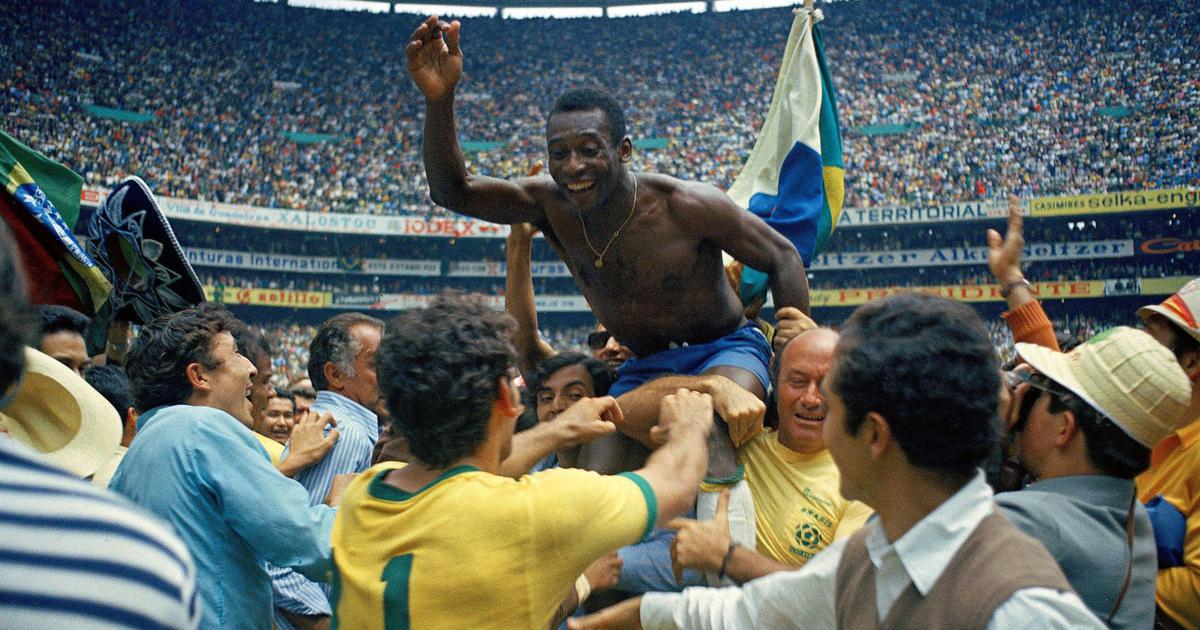
By 1970, in Mexico, Pelé was 29, still a platinum-grade superstar. That team – Pelé, Jairzinho, Gérson, Tostão, Rivellino – is remembered as the truest embodiment of the beautiful game. The final goal of the tournament, a 30-touch move culminating in Carlos Alberto's thunderous strike, remains one of the sport’s most replayed sequences.
Volumes Two and Three of Glittering Prize illuminate a different era. By the 1980s, the World Cup was no longer a curiosity or a side event – it was the most important football tournament on earth, and the world was watching.
In Mexico in 1986, you felt the shift. The tournament had been wrested from Colombia, whose drug-cartel economy could not support it, and handed to Mexico through the backroom dealings of FIFA president João Havelange and media tycoon Emilio Azcarraga. Thirty-five of the 52 matches kicked off at midday, when the Mexican sun was at its fiercest – European prime-time television schedules had been prioritised over players’ health. The slogan was “We’re prepared,” even though an 8.0 earthquake had devastated Mexico City months earlier. Maradona scored the two most famous goals in World Cup history within four minutes of each other, and Argentina beat England in a fevered match under the ashen air of the Falklands War.

The new era
By Volume Three, covering 2006 to 2022, the game has changed again. The Qatar chapter opens with O’Brien noting that a small rock in the Persian Gulf got to host the greatest show on earth, ripping up world football’s fixture list in the process. He lays out the corruption plainly – how the then UEFA president Michel Platini allegedly received instructions from France’s president to support Qatar’s bid, how fighter jets were subsequently purchased, and how FIFA’s president Gianni Infantino delivered a speech in which he claimed to feel Qatari, Arabic, African, gay, disabled, and a migrant worker.
O’Brien reports that a Guardian investigation confirmed at least 6,500 migrant workers – mostly Indian, Nepali, and Bangladeshi – had died over the previous decade, most in industrial accidents at the half-constructed stadiums or from heart failure in the blazing sun. The number was almost certainly a colossal underestimate. The matches were effectively being played in graveyards.
To the author’s credit, the books aren’t hagiographies. From the very first World Cup, when Uruguay’s promise to cover visiting teams’ expenses was described as the first step in a process that culminated in FIFA securing tax-exempt status from all host countries, to the modern era of bought bids and dead migrant workers, the governing body’s approach to organising and distributing hosting rights is exposed. Every World Cup since the 1960s, O’Brien writes, had been awarded to the country which offered FIFA the most money. The 1934, 1938, and 1978 World Cups were given due treatment for the dictatorial regimes they platformed.
“World Cups don’t change the world,” Simon Kuper wrote in World Cup Fever, “but they do illuminate it.”
The 2026 World Cup is upon us. It should be a summer of celebration, but we are living through a genocide, a war, and an energy crisis. The major host nation is bombing a participant country, while charging thousands of dollars for tickets to group-stage matches. Fans from many countries will have to pay thousands more in visa bonds to enter the US.
O’Brien's three volumes are a record of the progression of the world’s biggest sporting tournament and everything it has picked up along the way. Reading Glittering Prize, you’ll know that the current version of FIFA isn’t an accident and neither is Infantino conferring Donald Trump with the FIFA Peace Prize.
As the main event inches closer, it’s worth immersing in this guided tour through history, even if to emerge with a clear understanding of everything that makes the World Cup, the World Cup.
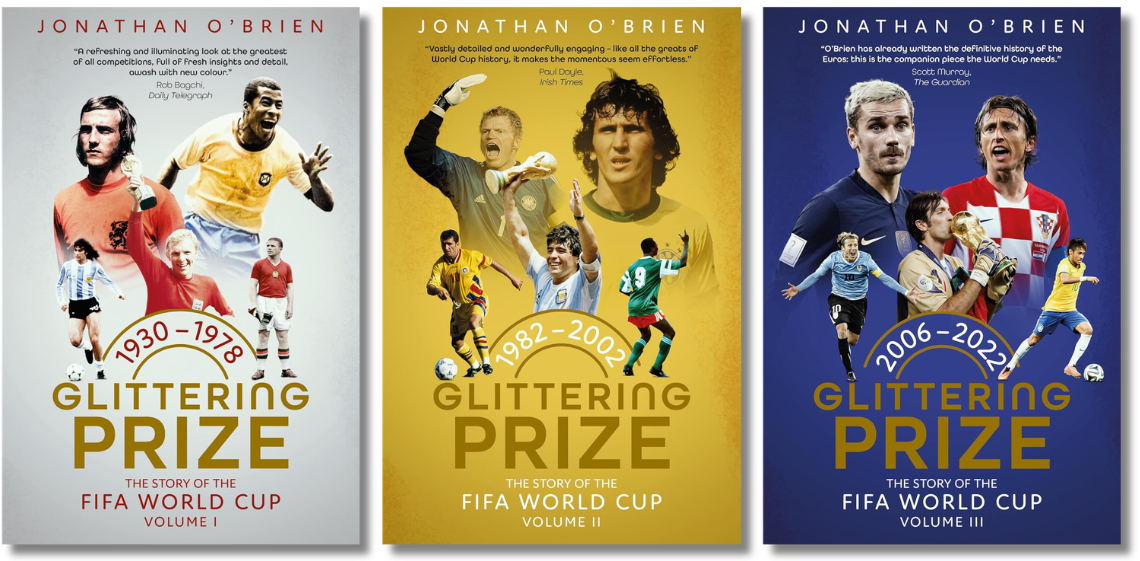
Glittering Pitch, Volumes I, II, III, Jonathan O’Brien, Pitch Publishing.
