







Polycarp Joseph has been making annual visits to the Shaktikulangara and Vaddy fishing harbours in Kerala’s Kollam district, since 2019, to track birds. On his visits, Joseph, who is a district head for the Kerala State Annual Heronry Survey, an annual citizen-science monitoring project by the Kerala Bird Monitoring Network, counts active nests of the little egret (Egretta garzetta). As part of this monitoring effort, he has visited both harbours after dark to study the effects of nighttime light pollution on these birds.
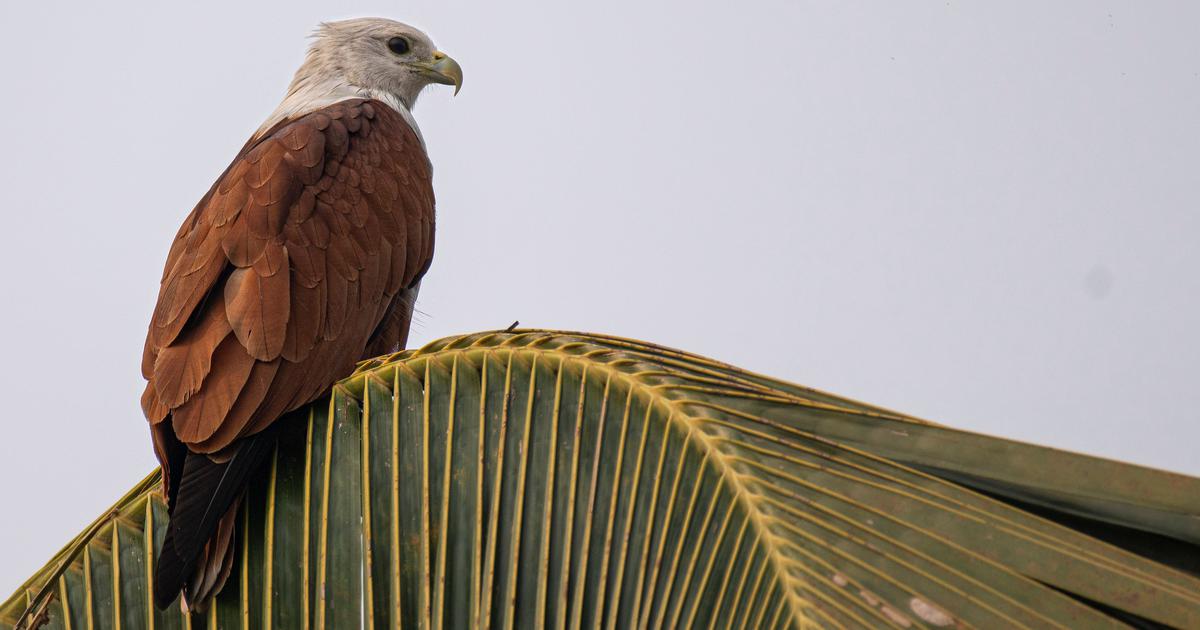
It was on one such visit that he came across a few brahminy kites (Haliastur indus), a “strictly” diurnal (active during the day) raptor with a distinctive bright white head and rump, scavenging late at night at the Vaddy fishing harbour in Kollam.
If it were late evening hours, he might have assumed that the kites were returning home or making one last foraging attempt, said Joseph. “The harbour [at night] is like a floodlit stadium, with LED lights in the auction yard and on boats, which allows these kites to perceive prey availability,” he added.
On February 5, 2024, from 11pm until 12.30 am, Joseph recorded three brahminy kites flying in short circles above the harbour, diving to scoop fish from boats, and snatching discards from fishers. On subsequent nights, too, he observed one or two kites scavenging between 9 pm and 11pm.
This observation was recorded in a recent paper by a research team, including Joseph.
According to the authors, this is the first documentation of the typically diurnal brahminy kites, feeding at night in India. Although it is only a single observation, it adds to growing evidence that artificial light at night can change the activity patterns of birds of prey that are normally active during the day.

The nighttime hunters of Vaddy
Located in the heart of the densely populated Kollam city, the Vaddy fishing harbour is where local artisanal fishermen who operate gillnet and hook-and-line fisheries from small fishing vessels land their catch every day.
According to Joseph, there are 500-600 brahminy kites in the area, who compete with hundreds of black kites, house crows, little egrets, and feral dogs for discards and freshly caught fish landed during the day. So far he has seen two-three brahminy kites scavenging under artificial light at night (ALAN) at the harbour .
Billions of organisms are responding to artificial light at night every day, says Nishant Kumar, head of Thinkpaws, a New Delhi-based think tank whose research focuses on interactions between people, animals and waste systems. “ALAN [artificial light at night] affects cue-outcome mapping (whereby animals learn that a specific signal predicts a certain result) that foregrounds animal decision-making,” Kumar said. “In this case [of brahminy kites], ALAN is prompting certain individuals to take the decision to feed under artificial light.”
Old-world kites have good low-light vision, notes Kumar, who has extensively studied black kites in the capital city. “Black kites in Europe and Delhi have been observed flying to/away from roosts around 9 pm. If you stay at landfills, you can see kites arriving to forage as early as 5 am, before the break of dawn,” he said.
In their research paper published in the Journal of Ornithology, Joseph and fellow authors cite prior studies that have identified typically risk-averse individuals using artificial light at night as an opportunity to forage during hours of reduced competition. “We think ALAN [artificial light at night] allows this small subset of the [brahminy kite] population to minimise competition and maximise access to food,” Joseph said.
Kumar agrees that bold or malnourished animals can engage in such unusual resource exploitation. It may also spread in the region as other kites and opportunistic birds socially learn this behaviour from them, according to the Delhi-based researcher.
Joseph’s conversations with local fishermen revealed that nocturnal foraging behaviour in brahminy kites has been a regular phenomenon at the Vaddy harbour for some time now. However, it seemed to be restricted to the area, as fishers at Shaktikulangara, roughly 8km up the coast, had never noticed it before.
The size of fish landed at each harbour could be a factor, according to Joseph. “Brahminy kites require prey that they can pick up and fly away with, like mackerels and sardines. Though both harbours have nighttime fish landings, Shaktikulangara is mainly occupied by large trawlers that land massive fish like tuna,” Joseph said.
“The excessive noise pollution from the large engines of these heavy barrages could also be a factor,” he added.
How artificial light affects birds
In a new research paper published in Ecology Letters, scientists analysed 36 light pollution studies across 30 bird species to test if ALAN [artificial light at night] alters their physiology, behaviour and life-history traits (such as lifespan and body size). The results showed consistent avian physiological and behavioural shifts under ALAN [artificial light at night], but these adjustments appeared to minimise the impacts on their life-history traits.
According to the paper’s findings, the major behavioural shifts in birds due to ALAN were the extension of their daily activity beyond daylight hours and a marked increase in nocturnal foraging. Sleep disruption was one of the clearest physiological impacts, which the authors suggest has broader impacts on metabolic rate, melatonin production, and immune function.
“Our results showed that ALAN commonly extends avian activity into the night, which may affect circadian rhythms, sleep, physiology, and energetic balance,” said Sayuri Díaz-Palma, a PhD candidate at the Institute of Environmental Sciences, Jagiellonian University and one of the paper’s authors.
Increased nocturnal activity was one of the primary behavioural disruptions under ALAN, which was amplified in brighter light. Aligning their analytical study with the case of nighttime foraging in brahminy kites, Díaz-Palma said: “We found that stronger light intensities were generally associated with activity shifts, accelerated ageing, and sleep disruption. Therefore, powerful LED lighting could plausibly facilitate nighttime foraging behaviour.”
Inter-individual variation could be why only certain individuals forage at night, according to Díaz-Palma. “[It] may reflect inter-individual variation in behaviour, habituation, or ecological opportunity,” she said. “However, species-specific interpretations would require observations from a larger number of individuals and a more targeted study of the system,” she added.
The study concludes that avian responses to artificial light at night remain poorly studied, presenting valuable opportunities for future research. Kumar shares this inference that research on the effects of anthropogenic environmental impacts on biodiversity is understudied. “ALAN is a vital component in this, given the high correlation of urban [spaces] with night light. Except for its impacts on migratory birds and insects, the research is limited,” he said.
Kumar hopes that this documentation of nocturnal foraging in brahminy kites from Kerala encourages more people to observe and record such natural history, which can aid understanding of artificial light at night and its impacts on birds.
This article was first published on Mongabay.
