



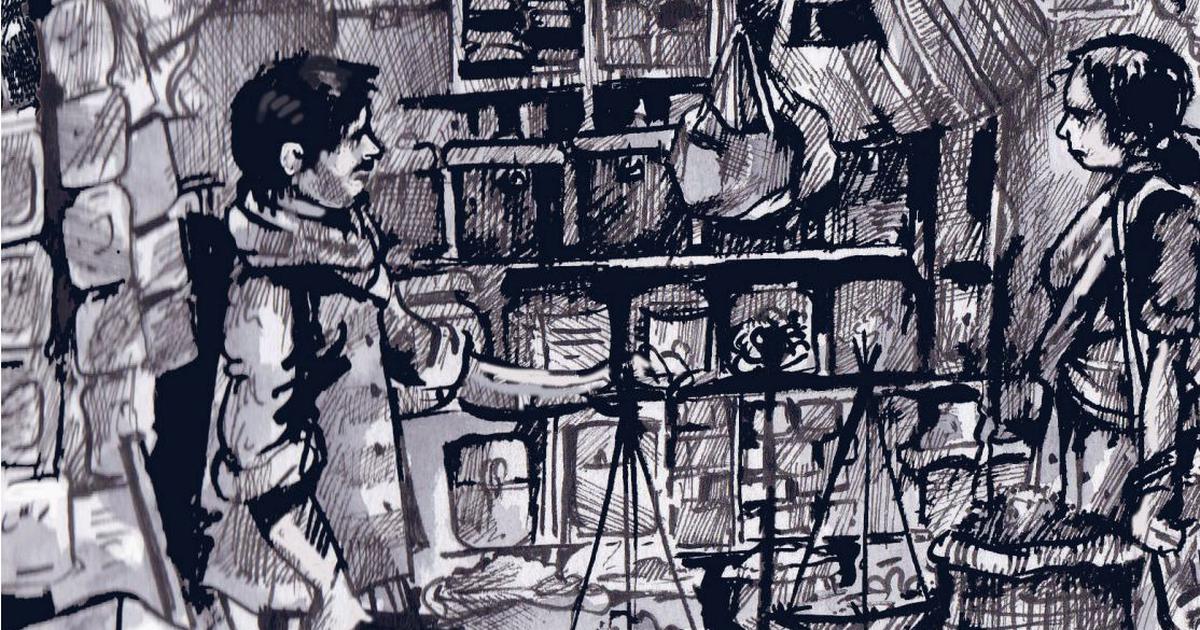
Maria brings me my morning coffee. It is a day or two after October 7, 2023.
I present to you, m’lord, exhibit number one in my defence: Maria.
No, that is not her real name. You will not be able to pronounce or remember her real name. It is not a name easily translatable to English, framed as it is by the frayed onomastics of at least (I guess) three cultures and languages. You see, m’lord, there are some people in the world – including in this part of my country – who have resisted translation, not as a theoretical or political process, for that would not strike them, but simply as a way of living. They pick up a leaf, a stone, a feather, and they know it and can name it intimately, but they see no need to translate it into a name that you can recognise. Any yet, I need to give her a name, for what’s the use of an exhibit that cannot be recalled by the judge?
I wish I could recollect the kind of day it was. If this were a novel, I would pretend to do so. I would create a day of sunshine or of clouds, of indolence or of activity. There are many possibilities in fiction. But when you have grown up in a small place of slow movements, each hour fuses into the other in your memory. When you look back, there are few – and at times, no – daily landmarks. There seem to be seasons, but no days. And, as a consequence, life is unbearably sluggish and incredibly fast. Each cup of tea is an eternity – and all of it is just one moment. It is easier for me to recall not the day but the person.
But how do I present Maria – her face? I won’t say that she is coloured or white or black or yellow or something similarly superficial. Because whether she is black or white or yellow or coloured a shade in-between, she will still be what she is – a short woman, broadly built, hands coarsened with work, dressed in neat but cheap clothes, the sort of clothes that last and come in shades meant to hide wear and tear; actually, clothes that are not usual here. Since her parents or grandparents converted to Christianity from some aboriginal faith, she wears long, shapeless dresses, sometimes shirts (with local embroidery) and loose trousers, and a large, silver-plated metal crucifix slipped through a thin silver chain around her neck. She could be anywhere between 40 and 70 years old – I can remember, from the time I was a child, the lines on her face, the furrow between her eyes; and if they have deepened with the years, it has happened so gradually that I have failed to notice. She does not talk much and seldom smiles with her lips – it is her small, dark eyes that do the smiling when required.
Only when absolutely required. And, yes, she is a mother.
She is a mother of two.
Or, should I say, at the moment of my narrative, she was a mother of two?
That, m’lord, is part of the case I wish to make to you.
See, exhibit number one (Maria) was hired by my mother as a nurse and house-help around the time I started school. It was a period when my mother’s migraines had increased, as had my father’s financial worries related to the plantation – we were not in a region where tea estates had ever made too much money, for the quality of our tea leaves was not excellent and hence, our produce was ferried only to the national market.
When the last British owners and most of the “Anglo-Indians” (some not “racially” but culturally Anglo-Indian, having practised the whiskey and pool rituals of the club house for generations) sold off their inheritances, the lands were bought up not by corporations, but by other individual owners – “Another good grief Gupta or damned Dutt,” as my father used to call them – and were slowly converted into other types of farmsteads. Even as the old families disappeared from the estates around us, and my father’s inherited memories of Pondicherry – memories imposed on me as French tutorials – were slowly leached of colour, he clung on to a past with ferocity and hired only Christians as house-help. Maria’s large silvery crucifix must have convinced my parents of her worthiness.
I was four or five. She was already a woman, but how old … who knows? They grow up fast in the fields here and the factories further down. She might have been 18 or 28, and she had two children – a boy, let’s call him Pedro, who was a year or two younger than me, and a daughter, who was not even a year old. Their father was nowhere around. I still have no idea who he was. Perhaps my parents, especially my mother, knew, for they were more familiar with the people working for us than I was, but all I ever heard from Maria, when I grew older and could register such matters, was that he had “gone away”. I assumed that he had gone to some other town or state, but I later realised that Pedro thought he had left for the “next world”. Maria’s references to his whereabouts were meagre and ambiguous, though she did, on one or two occasions, express the sentiment that his final destination, whether it had been reached or was still pending, would not be heavenward, but quite perversely in the opposite direction.
“A contrary man,” she said about him, using a dialect for the word which was weighted down more with the mud of calumny than with any kind of “contrariness”.
Another time, she commented, “That man could choose hell just to spite god.”
Such, however, was not Pedro’s recollection of the father. Pedro must have been three or four when his father “went away”, and he remembered – or had constructed – a man with a bushy moustache, a booming voice and an easy laugh, who was always accompanied by a friend or two when he came home, usually just for a day or night, before leaving again.
“Why did he leave again?” I asked Pedro, astounded, for my parents hardly ever left the plantation and our many-shuttered, single-storey house at the head of it, built, unusually for these parts, to resemble the kind of Thinnai that my ancestors must have known in the south.
“He was a truck driver,” Pedro replied.
But when I mentioned this to Maria, she sniffed and said, “Life would have been a different matter if it was just a truck that he drove.” That, by Maria’s standards, was a long sentence.
Excerpted with permission from Drown All the Refugees, Tabish Khair, HarperCollins India.
