









Amidst the crisis in West Asia, Prime Minister Narendra Modi has urged restraint on gold purchases. But asking Indians to abstain now is like asking them to swim against the tide.
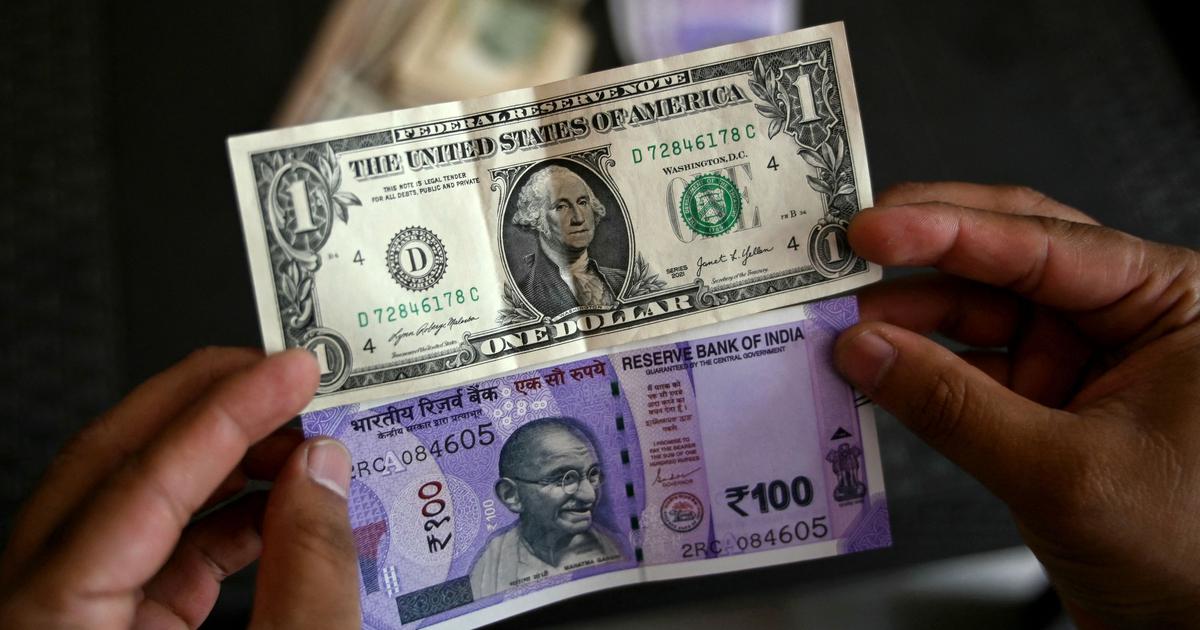
Modi, it is clear, is attempting to conserve precious foreign currency as the rupee has weakened from Rs 85- Rs 86 per US dollar in mid‑2025 to around Rs 95 by mid‑2026 – roughly a 10% year‑on‑year depreciation.
In the 2025-’26 financial year, India imported $71.98 billion worth of gold, about 721 tonnes – second only to China. Every slide in the value of the rupee makes gold imports more expensive.
But the economy’s fragility cannot be solved merely by piling up foreign exchange reserves. Abstaining from gold or working from home will not fix the fundamentals.
The weakness of the rupee is, at heart, symptomatic of the fragility of the domestic economy – a problem that predates the West Asia crisis. The rupee’s slide reflects a deeper structural challenge: foreign investors repatriating their profits and investors pulling money out of India.
A main reason foreign investors hesitate to commit to India – and why even Indian firms are reluctant to undertake long‑term capital investment – is the persistent weakness of the domestic economy.
This weakness stems from wage stagnation and slowing consumption growth. Real wage growth has hovered between -0.4% and 3.9% during the years 2021-25. The projected 4% rise in 2025 is still below the pre-Covid level of 5.2% in 2019.
When real wages stagnate or fall, the spending power of households weakens, putting pressure on domestic demand.

Second, the latest official data show that growth in per capita consumption slowed to 3.8% in the 2023-’24 financial year from 6.9% in 2022-’23. At the same time, the share of private final consumption expenditure in India’s gross domestic product fell to 56.9%, the lowest in a decade.
People’s final consumption reflects the ability and willingness of households to spend beyond their current income. When consumption weakens, it signals stress in real incomes and often reveals deeper structural pressures on the domestic economy.
Third, on the saving side, the latest Reserve Bank of India data show that household savings remain high – but much of it is flowing into gold, silver and being held in cash rather than into productive assets.
In the 2023-’24 financial year, households saved Rs 54.6 lakh crore, of which Rs 65,000 crore went into gold and silver ornaments, while deposits and pensions grew only modestly.
This domestic stagnation is the core reason India’s private capital expenditure cycle has stalled.
When real incomes stagnate and consumption spending declines, domestic demand fails to expand, leaving firms with low capacity utilisation and little incentive to add new capacity.
As sales stagnate and revenue dwindles, profitability falls, reducing the internal funds that typically finance private investment.
This results in heightened uncertainty about future demand, prompting firms to delay or abandon investment plans.
Together, these forces create a self‑reinforcing cycle in which domestic stagnation suppresses demand, profitability and confidence – the three pillars of private investment.
With stagnant wage growth for much of the period and real wages repeatedly eroded by inflation, average real wage growth between 2021 and 2025 was only about 4% per year.
In this environment of weak purchasing power and fragile domestic demand, Indian households naturally prefer to park their savings in gold or cash rather than to spend, reinforcing the very stagnation that constrains growth. That weak demand leaves corporations with little incentive to expand capacity.
The result is a vicious loop: weak demand discourages domestic investment, capital flows abroad, and the rupee weakens further.
Preserving foreign exchange reserves and designing financial instruments to attract foreign exchange flows, such as reviving deposit schemes for non-resident Indians, will not solve the fundamental fragility of the domestic economy.

Strengthening the domestic economy
As a consequence, India’s foreign currency reserve strategy must shift from preserving foreign exchange to strategic mobilisation of inflows. The government needs to break the vicious cycle of weak domestic demand, capital outflows, and rupee depreciation by making private investment profitable at home again.
But private capital expenditure needs a spark – strong demand. Government spending on housing, infrastructure, and renewable energy could provide that impetus.
The government must offer supply‑side incentives – lowering input costs, expanding credit, improving logistics and using targeted incentives to raise productivity.
This must be paired with an active demand‑side push to break the cycle of domestic stagnation. This requires boosting household consumption through generating employment and income transfers; accelerating public investment in housing, logistics, and infrastructure; and scaling up affordable housing to spur construction and demand for consumer durables.
To finance that expenditure, the government need not undermine people’s trust in gold. Instead, it could harness it by channeling savings into gold-linked bonds or similar instruments that fund roads, housing, and renewable energy infrastructure, creating jobs and expanding demand.
Unlike earlier gold schemes, the new approach should offer the same sense of security by linking returns to gold and other safe assets such as government bonds, inflation-protected securities, and high-grade sovereign reserves.
This would ease pressure on the rupee by reducing the economy’s dependence on imported gold.
The fragility of the domestic economy could be turned into strength if fiscal policy plays an active role in job creation.
Global capital today is mobile yet highly selective. Countries such as Taiwan and Vietnam have attracted waves of foreign investment by positioning themselves as hubs for integrating artificial intelligence, offering investors a clear, technology-driven growth narrative.
India’s export sector will inevitably move toward AI integration across supply chains. But this is a double-edged sword: it could cut costs, but – by eliminating the need for workers, who spend their wages on goods and services – would also suppress demand.
This would leave the domestic economy more fragile and the rupee more vulnerable.
In a world torn between the uncertainty of AI and the safety of US Treasury bonds, India must tell a different story: a rupee anchored in confidence, backed by the strength and resilience of its domestic economy.
Srinivas Raghavendra teaches Economics at the J.E. Cairnes School of Business in the University of Galway, Ireland.
