






The rattling kudu-kudu sounds from Satyettan’s autorickshaw could be heard from the alleyway. That’s because he won’t fill up the diesel, people teased. It would be running all right – and then there would be a big sound from inside somewhere, like a firecracker’s burst, and it would go phut. Stuck in the middle of the road. But he would simply get up from the driver’s seat, come over, open the diesel tank, and spit into it. Actually, spit hard, three or four times. No clue how, but the autorickshaw would start coughing again, coming back to life! All the children who had set off for the Girls’ School in Satyettan’s autorickshaw would fall over each other laughing and giggling. Shahitha, who would not let even the little ones sit on her lap, would throw Satyettan a scornful look. That gladdened Umaiba’s heart. Good. Let her get all sneery.
Umaiba couldn’t help thinking: Muthumma had five children – no, five girls. But she still coddled and cosseted Shahitha so much. And Shahitha? She mollycoddled herself. Oh, so precious, so dainty, so twee was she. So yeah, let her get all riled up with disgust!
There would be a bunch of chekkanmaar, young fellows, loitering at the bus stop, totally jobless types, out to stare at girls. Actually, to stare at Shahitha. Because of Satyettan’s autorickshaw’s bad behaviour, she lost face in front of these chaps.
Looks as though she’d just been to a wedding in her Uppa’s family, thought Umaiba. Muthumma would dress her up really well before a wedding. Want a good piyyapla? A handsome bridegroom? For that you need to look pretty, with a bit of monch. Shahitha had much monch – big, round eyes, a fine, fair-skinned face. Her teeth jutted out a bit, but that wasn’t so noticeable. Her limbs were fair-skinned and rounded and smooth.
There are only two kinds of women in Mahe: the lanky sort and the rounded sort. People keep feeling sorry for lanky-looking women, and so when they talk of them, pity brims over in their words. But when they talk of the rounded ones, their eyes sparkle without fail.
Shahitha’s hands were always covered with pretty henna patterns. Moyilanchi, as it is called in Mahe, and not mayilanchi, as elsewhere. The henna paste was always ground by Sulleetha, who was from the Kunniparamba family. She was older than Shahitha, but no one in Kunniparamba seemed to be discussing her marriage. Maybe because she was stick-thin?
Shahitha was the youngest of five girls, and her skin was radiant. Umaiba was the only sister to four brothers, but she was wheatish. Is it that they want to comfort me and so they say “wheatish”? Umaiba mused sadly. Maybe I am really dark-skinned…
And just because she was the only sister of four brothers, they wouldn’t let her wear glass bangles. Big advantage of being the precious only sister. Umaiba looked longingly at the green and pink glass bangles jingling on Shahitha’s lovely arms – bangles that she could wear simply and solely because she had no brothers.
Shahitha sat down on the veranda, carefully removed the bunch of wilted strings of jasmine from the braids of her long hair which fell right below her knees, and threw them on the raised platform, the thana. So haughty it looked – as though she was doing someone a favour. Sumi and Simi and Sunaira who were playing hopscotch in the yard ran to get them.
Oh, she did that on purpose, that quick thrust of her wrist. Wouldn’t that make the bangles jingle all the more? No matter how hard she tried, Umaiba couldn’t get her eyes off those bangle-clad arms.
But of what use, being so full of monch and dressing so fine? She is brainless. No good at studies.
Shahitha had wriggled out of writing the final exam in the tenth standard saying that she had caught a fright, seeing a thief at the window when she was studying at night.
“Allah! Ente molu bejaaraaye!’ fussed Muthumma, and she rushed Shahitha to a doctor. Her becoming bejaar – scared, worried, rattled – was a trick of course. She conned them so that they would get her married soon. Only Umaiba noticed it, though.
She stopped swinging and went in. As she stepped into the house through the veranda, Umaiba sneaked a glance at Shahitha’s glass bangles. Bangles with gleaming dots of gold scattered all over; Umaiba loved them.
As she lay that evening in her grandmother’s – Bellumma’s – room, Umaiba’s thoughts were about bangles. When she grew up, she would make lots of glass bangles, in many colours, in many intricate designs, designs that no one had ever seen. In her mind, she prepared. What all colours would she choose?
The icebox that the fishmonger Nasarka carried on his bicycle was a very pretty blue – that blue she’d choose. Then the gold-tinged rose shade of Bellumma’s headscarf with the brocade border, the white of Dechoma’s cotton towel. When she washes the big vessel in which they made biriyani, Dechoma always takes out one such towel and wears it around her sari. It has a nice red border. I’ll take that red and draw stripes of it on white bangles… All those who see would be left cooing in sheer admiration. Ooh, how did you manage to make that. They’ll pay cash to buy my bangles. Shahitha’s going to line up for these bangles too. She’ll come asking…
“Will you give her, Umaiba, if she asked?” Her mind whispered a question.
No, never. Let her keep wearing the old pink and green ones still. Let her burn with yearning and longing – the poothi for my bangles with their fancy paintwork. A poothi she’s never going to slake!
Umaiba looked around the room. So many glass bangles, yellow and blue and red and white. Bangles with gold dots on bright colours, hanging in bunches all around. The lovely tinkling sound when they gently brushed against each other. How alluring they looked in the light from the lamp with the red handle that Uchuka had brought back from Dubai!
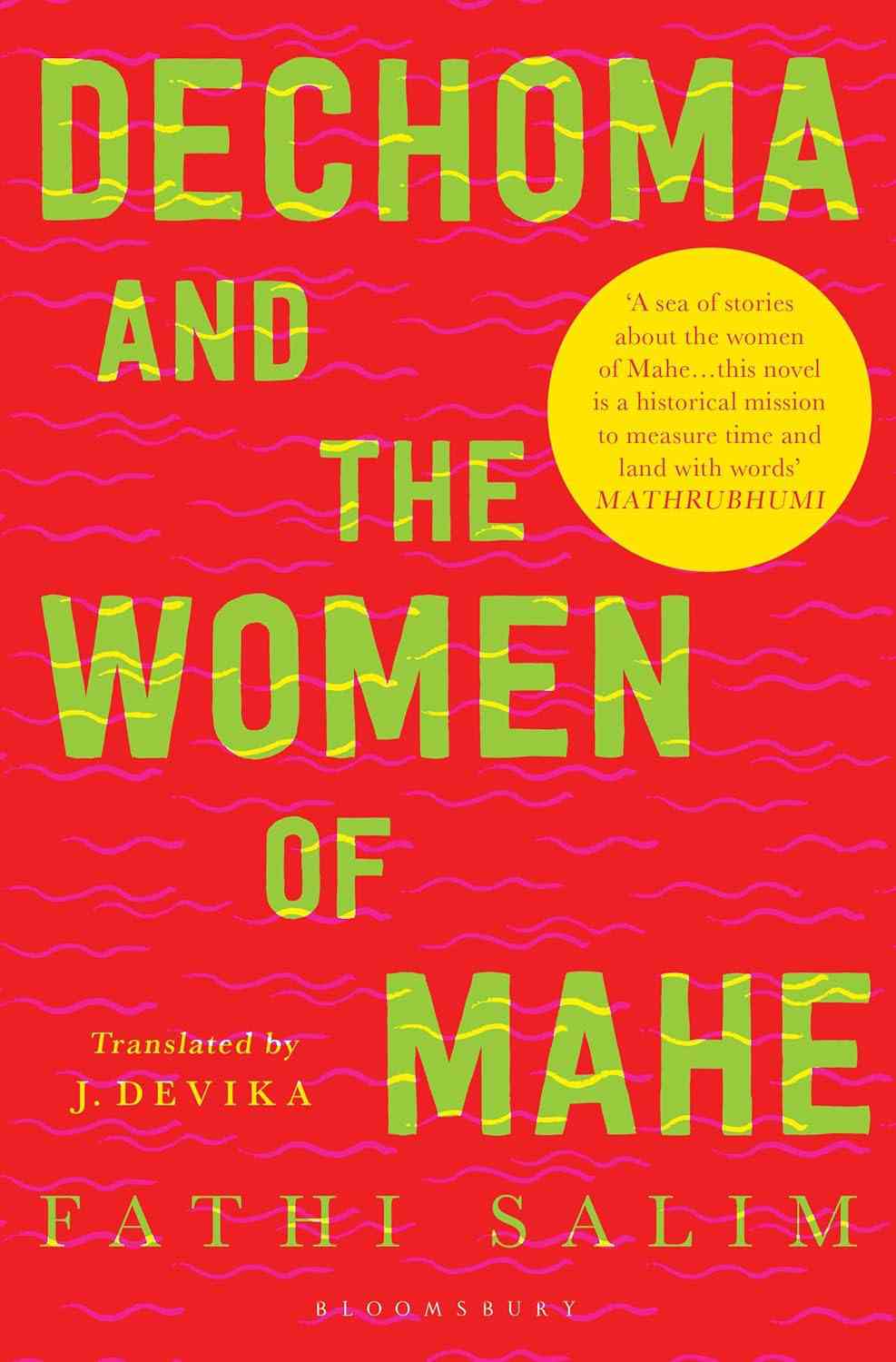
Excerpted with permission from Dechoma and the Women of Mahe, Fathi Salim, translated from the Malayalam by J Devika, Bloomsbury India.
