









Welcome to The India Fix by Shoaib Daniyal. A newsletter on Indian politics. (This is the second one this week – a record.)
As always, if you’ve been sent this newsletter and like it, to get it in your inbox every week, sign up here (click on “follow”).
One nation, one tax. One nation, one ration card. One nation, one election.
The Modi government loves this slogan format. So much so that it is working hard towards adding another to its arsenal: one nation, one party.
Over the past month, the Trinamool Congress has practically ceased to exist both in the West Bengal Assembly as well Parliament. Last fortnight, 20 Lok Sabha MPs from the Trinamool wrote to the speaker extending support to the Modi government. A few days later, this group announced a merger with an little-known outfit called the Nationalist Citizens Party of India.
Ending the Opposition
The Nationalist Citizens Party of India has fought one election till now. It contested two seats in the last Tripura assembly elections, receiving a total of 822 votes. With this merger, it now becomes the fifth-largest party in India’s lower house.
This absurd turn of events has come about because the MPs are trying to seek refuge in a clause in the anti-defection law that allows mergers if two-thirds of legislators support it. However, if this is itself legal or if a merger is only valid if the parties themselves merge (and not just their legislators) is an open question. More on this later in the newsletter.
This development came after 58 of the 80 MLAs of the Trinamool in the Bengal Assembly rebelled against the party and elected an expelled partyman, Ritabrata Banerjee, as the leader of the Opposition.
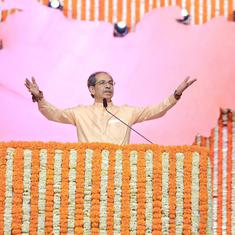
At the other end of the country, the western state of Maharashtra is also seeing something similar. There are reports of the Shiv Sena (Uddhav Balasaheb Thackeray) being split, with both its MPs and MLAs allegedly being induced to leave the party.
This comes just a couple of months after seven of the Aam Aadmi Party’s 10 Rajya Sabha MPs announced they had merged with the BJP.
Anti or pro?
Given the scale of defections happening right now, one would scarcely believe that India actually has a long-standing law to prevent legislators from disobeying their party. Called the anti-defection law, the provision has never worked very well. But now it might be all but dead.
The law was passed in 1985 by the Congress. Though the party had won an astounding 414 seats in the previous Lok Sabha election in 1984, it was clear that this result was a one-off anomaly – more a sympathy vote for Indira Gandhi after her assisination than a true measure of the Congress’ strength.
In reality, the party had been declining for more than a decade. Under Jawaharlal Nehru, the party functioned as a coalition of satraps. Now those satraps were increasingly turning political entrepreneurs and forming parties of their own – and often taking away Congress legislators. The Congress under Rajiv Gandhi felt itself so weak at the time, that rather than internally enforce party discipline, it used its control of Parliament to simply outlaw defections altogether.
India today, is of course, very different from what it was in 1985. Far from being helmed by a declining Grand Old Party, the ruling Bharatiya Janata Party today is on the ascendant. Though the Modi government does not even have a simple majority in the Lok Sabha, its control over state instructions, mainstream media and backing from big capital means it is powerful like few governments in India’s history and has, hence, no need for a law to keep its flock in check. Few legislators, even if disgruntled, would dare disobey the party leadership.
BJP, courts weaken the law
On the other hand, the powerful BJP is keen to suck in leaders – using both carrot and stick – from other parties. For it, any law against defection is a hindrance to establishing dominance and maybe even hegemony over Indian politics.
In theory, India’s judiciary could stymie the decline of the anti-defection law. Instead, it seems to be helping kill it. In Karnataka in 2019 as well as in Maharashtra in 2022, the Supreme Court effectively froze the law, allowing non-BJP governments to be toppled and for the BJP to assume office.
In 2022, the Goa bench of Bombay High Court also upheld the merger of 10 Congress MLAs with the BJP in spite of the text of the law stating quite clearly that mergers only apply to “original” political parties and not their legislative arms.
Since the “original” Congress and BJP have clearly not merged, the High Court’s decision is befuddling to say the least. This judgment is the basis of the present splits in the Trinamool, Aam Aadmi Party and potentially the Shiv Sena.
A real problem
The anti-defection law has come in for sharp criticism over the years for weakening a critical aspect of democracy: the power of elected legislators. In effect, the law empowers parties over elected representatives.
But the law has been unable to achieve its stated aim of preventing defections. Since it was enacted, defections have gone on unabated. All it has done, as we can see in the Trinamool’s case, is that it has made defections a bulk game. To try and meet the law’s supposed stipulations, two-thirds of the Trinamool’s MPs have merged with an obscure party.
Nevertheless, the problem that the anti-defection law tries to solve, however insincerely, is real. Parties play a significant role in getting a legislator elected. And this phenomenon is getting more and more acute. The BJP, in fact, has run actual slogans telling its voters that they are voting for Modi directly – rather than the candidate on the ballot.
In the Trinamool’s case, almost none of the defecting MPs and MLAs would today hold their seat if the Trinamool had not given them a ticket. It is obvious that the party gets votes in Mamata Banerjee’s name. In fact, the Trinamool’s defecting legislators have all but ended their careers since they would be unable to win elections on their own – neither the Trinamool nor their current benefactor, the BJP would give them tickets. (The Trinamool and Shiv Sena in fact allege that the defections are being made for obscene sums of money, which, if true, might explain this career suicide.)
Ending trust in elections
And here lies the problem. If MLAs and MPS get elected due to their party but can simply ignore their mandate mid-term, allegedly driven by bribes, then the sanctity of Indian elections are severely hit.
If no matter who one votes for, that person will end up in the BJP, why even bother to vote?
This comes after a spate of allegations that already undermine trust in Indian elections: the massive advantage the BJP enjoys when it comes to funds, allegations that referees like the Election Commission and even the courts bend towards it and accusations of election fraud.
We can already see the effects of this with the rise of movements like the Cockroach Janata Party, which embody a sort of anti-politics, driven at least in part by the idea that the BJP cannot be removed from power using elections.
