




Rajiv Gulati and his family have been running a fish shop in Punjab’s Amritsar city for 56 years.
On April 20, the city authorities forcibly sealed the shop in Amritsar’s Hall Gate Fish Market, allegedly without giving him any notice. “This has been our source of livelihood since the time of my grandfather,” said 39-year-old Gulati.
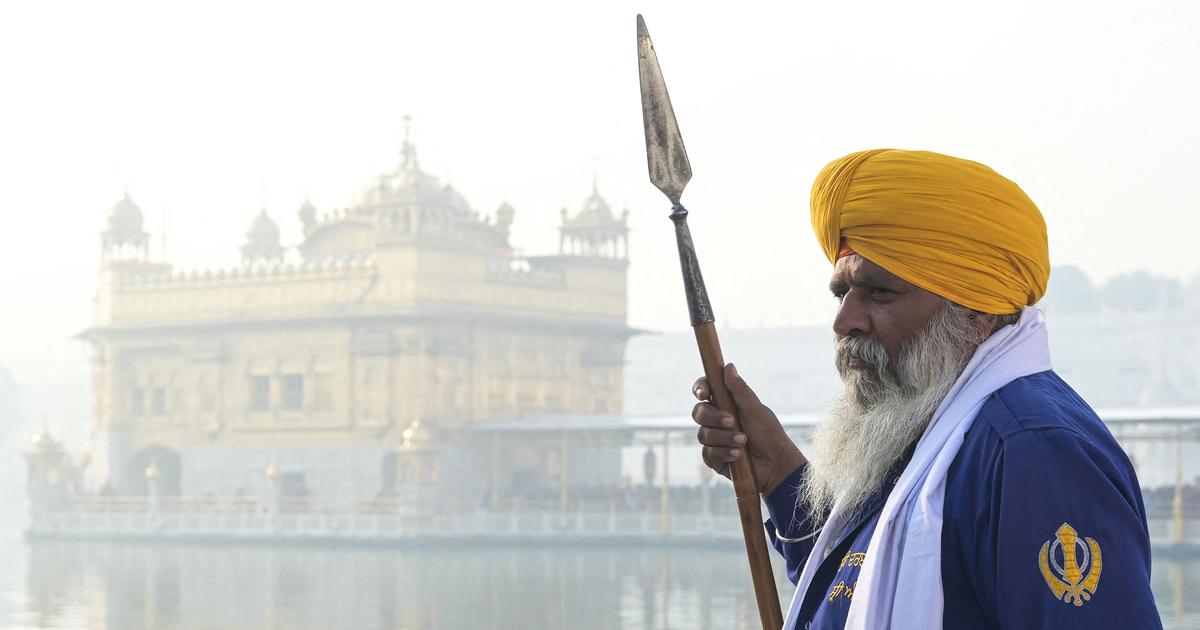
The action was based on a Punjab government notification that disallowed the sale of meat, alcohol, cigarettes and tobacco within the walled City of Amritsar, in effect the area around the Golden Temple.
The order followed the Aam Aadmi Party government’s decision in November last year to declare three cities – Amritsar, Anandpur Sahib and Talwandi Sabo – as holy cities.
Gulati said more than 250 businesses, including small meat vendors, food carts and wholesalers have been affected by the decision in Amritsar alone. “We have been sitting idle since then,” said Gulati. “The government should have given us some alternate space to run our businesses.”
On May 29, Gulati moved the Punjab and Haryana High Court, challenging the legality of the closure. “The notifications have no statutory backing,” said advocate Vikas Chathrath, his legal counsel. The petition questioned the state’s power “either to declare an area as a ‘holy city’ or to prohibit an otherwise lawful and licensed trade within municipal limits” in the absence of “any enabling act, statutory provision, regulation, bye-law or delegated legislative instrument.”
The Punjab and Haryana High Court issued a notice to the Punjab government, asking for its response.
The legal challenge aside, critics of the Punjab government’s decision say this falls into a pattern of the AAP government trying to cash in on sentiments around the Sikh religion. “It is totally a political decision,” said Dr Amarjit Singh, former head of the department of Guru Nanak Studies at Guru Nanak Dev University in Amritsar.
The demand for a holy city tag for Amritsar was once championed by Punjab’s Sikh-centric party Akali Dal, while Khalistan ideologue and hardliner Jarnail Singh Bhindranwale had campaigned for a ban on tobacco in the city.
By pushing both through, the Bhagwant Mann government has got an edge over its opponents, Singh said. But it has also drawn criticism of attempts to “brahmanise the Sikh religion”.
The Sikh code
On November 24 last year, the Punjab government held a day-long special Assembly session in the religious city of Anandpur Sahib to mark the 350th martyrdom anniversary of the ninth Sikh Guru, Guru Tegh Bahadur. This was the first time in the history of Punjab that an Assembly session was held outside the state capital Chandigarh.
Coloured in religious symbolism, the special session concluded with a resolution that declared Anandpur Sahib, Talwandi Sabo, and the Amritsar Walled City – revered in Sikhism as seats of spiritual authority – as ‘holy cities.’
The resolution, passed unanimously, said that the sale or consumption of liquor, meat and tobacco would be prohibited in the three cities.
Less than a month later, the Punjab government came up with an official notification, defining the territorial limits of the new regulations.
The prohibitions mandated by the notification baffled many in Punjab.
According to Sikh Rehat Maryada or code of conduct, tobacco and halal meat (animals killed according to the Islamic way) are prohibited to followers of the religion. However, Sikhs are allowed to consume jhatka meat (from an animal killed with a single blow).
Kiranjot Kaur, a member of the Shiromani Gurdwara Parbandhak Committee, said the ban on the sale and consumption of meat has “brahmanised” the Sikhs. “Tobacco and halal meat are abhorrent to Sikhs. Alcohol and other intoxicants are also forbidden in Sikhism, but jhatka meat is our right,” Kaur said in a social media post in December.
Singh, the former academic from Guru Nanak Dev University, underlined the political calculus behind the decision. “For AAP, the most important point before the public will be that only they were able to do it [holy city status] when a religious party like Akalis could not,” he explained.
A contentious history
The formal demand for granting ‘holy city’ status to Amritsar, home to the Golden Temple, goes back to the early 1980s.
It was part of a charter of demands submitted to the central government in 1981 by Shiromani Akali Dal, Punjab’s grand old Sikh-centric political party, which at the time had been demanding greater autonomy for Punjab, according to A History of Sikhs by veteran journalist Khushwant Singh.
A year before, Gurcharan Singh Tohra, then president of the Shiromani Gurdwara Parbandhak Committee, had also urged Prime Minister Indira Gandhi to declare Amritsar a “holy city”.
Simultaneously, several Sikh religious groups in 1981 demanded a complete ban on smoking and sale of tobacco in Amritsar, which was opposed by Hindu groups including the Bharatiya Janata Party.
The Hindu opposition to the demands stemmed from a growing suspicion of the stand of Sikh religious organisations, according to historian Gurmit Singh. In March 1981, the Shiromani Gurdwara Parbandhak Committee had declared that “Sikhs are a separate and distinct nation”, Singh recounted in his seminal work History of Sikh Struggles: Volume II.
In May that year, groups like Arya Samaj, the Rashtriya Swayamsevak Sangh and other Hindu organisations were led by then BJP legislator Harbans Lal Khanna in a protest in support of their “right to smoke” in Amritsar city. In History of Sikh Struggles: Volume II, historian Gurmit Singh writes that “provocative slogans” against Sikhs were raised during the demonstration which “inflamed anti-Hindu feelings among the Sikhs…”
Days later, the Damdami Taksal chief Bhindranwale – the religious leader who became synonymous with the idea of a separate state of Khalistan for Sikhs – led a march in Amritsar demanding a ban on tobacco in the city.
As the law-and-order situation in Punjab worsened in the following years, and the state cracked down on the Khalistan movement, the demand for the holy city status eventually went into cold storage.
The demand resurfaced in 2016, when the Aam Aadmi Party, ahead of its first electoral contest in Punjab, promised holy city status for Amritsar and Anandpur Sahib.
A debate within Sikh community
Despite some misgivings, the ban on sale and consumption of meat has not elicited any strong reaction from the Sikh religious establishment.
One explanation for that may be the internal debate in Sikhism about vegetarianism. “There’s a debate within Sikhism if one's allowed to have meat or not,” said Dr Gurmeet Singh Sidhu, professor at Guru Gobind Singh department of Religious Studies at Punjabi University in Patiala.
Many Sikhs who do consume meat avoid having it publicly around these holy sites. “This is the reason why only vegetarian food is served in the langar of Golden Temple,” Sidhu said.
Damdami Taksal, the influential seminary led by Bhindranwale, prohibits the consumption of meat. “Many scholars believe they [Damdami Taksal] have a Brahmanical influence,” Kaur, the SGPC member who criticised the ban, added.
The Sikh religious establishment’s silence on the ban on the consumption of meat has to be seen in the context of Punjab's turbulent history, Kaur added.
“Since 1984 and Operation Bluestar, there has been a shift in the Sikh psyche,” Kaur said.
She was referring to the Army storming the Golden Temple in 1984 to quell Bhindranwale’s violent campaign for autonomy for Punjab. “Since then, shahidi (martyrdom for religion) is held in great reverence and the fact that Bhindranwale did not run away from the Darbar Sahib [Golden Temple] during the army attack and chose to die fighting, puts him on a pedestal,” Kaur said. “He was a vegetarian and since then voices for vegetarianism in Sikhi have grown.”
