



Anbu poked his head inside the house, calling, “Semba?” She was not there. By some instinct, he jogged to the deserted tenements a few blocks away, climbed up two flights of stairs to reach the terrace. He had heard Maari grumble about how her sister disappeared to the terrace of the buildings on and off.
The wind almost knocked him off his feet when he got there. The humid air made his eyes water and he rubbed them to see clearly. She was standing with her back towards him, facing the sea. Her sari’s pallu was billowing behind her and the setting sun gleamed through a tear, the size of a coin, on it. Her blouse hung loosely off her shoulders and her hair tumbled out of her loose bun.
Anbu smiled. Semba was the most unkempt woman he knew. She turned when she heard his approaching footsteps and faced him, her eyes bloodshot from lack of sleep. “Maari wants you at the…” he started, but couldn’t finish the sentence. He took in her overgrown eyebrows; her long, curving eyelashes; thin nose, and lips that were beginning to form a smile. This was the first time he was paying attention to her features. Anbu smiled to himself, wondering at the incredulity of the thought: he was drawn to that woman for reasons he did not know.
When he first saw her, he was actually taken aback by her cold nature. She scared him. Although she was not the in-your-face kind like Maari, there was something about her that drove men away. Perhaps it was her quiet, resilient aura? And yet, standing close to her, hearing her breathe over the sound of the waves far away, and seeing how even the faintest traces of a smile transformed her, Anbu knew. He was falling in… he was scared to think that word.
A sea-shattering bolt of lightning struck behind them, and the spell was broken. “Maari wants you at the market,” he told her, looking at his feet. Semba cleared her throat, and they walked downstairs. They spoke not a word until they reached the fish market. “The city corporation is at it again. The prime minister is coming to Chennai tomorrow for a campaign and they want to clear the market to widen the road for his convoy,” said Anbu.
Semba shook her head. “This is the fifth time in the past eight years. Who do they think they are? Is the seaside their family property to keep asking us to vacate as and when they please?”
They walked together to reach a huddle of people in front of the market. Durai, the president of the Tamil Nadu Fishermen Welfare Association, was at the centre, addressing everyone. “If they succeed in clearing our stalls, there are chances that we will never be allowed to put them up again,” he said, his tone grave. “I heard that the corporation has secured a huge amount of funding from the central government to build an indoor market for us nearby.”
The people from the market started speaking in unison and Durai hushed them. “Let me finish!” he cried. “I can understand your fears. This strip of land is where we unload our fish from the nets, where we clean our nets, dry our fish, where our children play…We have the right to use it. The market has been here from the time of the British! If not us, who?”
The crowd buzzed again and quietened when Durai continued: “We are an eyesore to many people. They find us smelly, ugly. Our nets, fish, boats…they form the very soul of this city. We will fight it out till the very end. No one can make us leave.”
“What do we do now, anna?” Maari asked.
“Officials are on their way to remove our shops. I have asked Murali and his men to drag a fibreboat onto the road. We will place it across Loop Road and sit in protest beside it. Traffic will come to a standstill. They definitely will not want anything untoward to happen when the prime minister is visiting the city, and will mostly let us off. This, of course, is not a permanent solution. They will not bother us for a few months. Perhaps until some other official comes up with a plan to beautify the city.”
“Is there a permanent solution to this, thalaiva?” asked a fisherman, to which Durai replied: “Yes, I plan to file a petition in the high court for a stay order on the new market. If that comes through, they will leave us alone for good.”
Dusk was setting in but for the people of Lighthouse kuppam, the day had just begun. They were preparing for a battle their ancestors had long been fighting: a battle for their land. Maari, Semba, Chithra and several other women and men were seated behind a fibreboat that stood awkwardly on the tar road.
Durai was standing nearby, talking with a few fishermen. The hum of conversation filled the air. Anbu was watching the protestors from the side of the road, leaning on his auto, his hands crossed over his chest. His eyes were only on Semba, who sat there rather self-consciously, trying her best to be involved in the conversation among the women. She knew he was looking at her and kept tucking in loose strands of hair behind her ears. For the first time in years, she wished she had paid better attention to her appearance.
An hour later, two police patrol vehicles pulled over, and the men walked straight to Durai. “Ask them to move, we will remove just a few shops for formality’s sake. Just keep the market closed tomorrow, we’ll cover it up with plastic sheets or something. Just till the PM leaves the city.”
“Ayya, this is a seaside city. I’m sure the PM knows that. I’m sure he also knows that such markets define a city like Chennai. We cannot erase them just because some people find them ugly,” replied Durai, his voice loud and firm.
The policeman let out a loud breath and whispered something to his colleague. Then, one of them called someone on the phone, speaking for a brief while in a hushed tone. Once he cut the call, he looked at Durai and the people who had gathered and said, “Alright, please disperse. We’ll leave the market alone this time. Just don’t create any trouble.”
Durai grinned, turned to quickly glance at the sea and held his hands together in salutation. “Kadalamma…” he whispered.
The elated fisherfolk started homeward, some of them a little surprised at how the policemen did not raise their voices even a little bit. Usually, their protests were long-drawn, lasting a minimum of a week. “It’s all because of the PM’s visit,” Semba overheard Durai tell a fisherman. “They would’ve otherwise torn down at least a handful of our shops. Anyway, there’s no more trouble for now.”
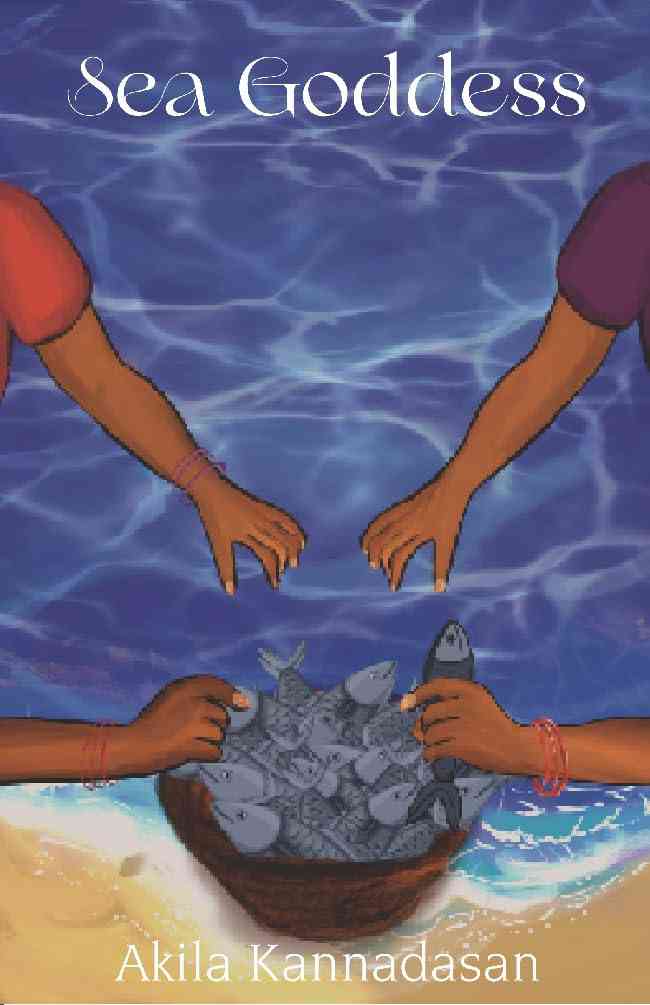
Excerpted with permission from Sea Goddess, Akila Kannadasan, Vishwakarma Publications.
