





Ilaiyaraaja’s Western classical symphony Valiant recently had its grand premiere in India, with a performance in Chennai in May. It immediately made me think of another beautiful meeting point between Indian and Western music: Calcutta-Nagar, the piano suite by Indo-jazz pioneer John Mayer. It may not have the sweeping scale of Ilaiyaraaja’s symphony, but it carries a quieter magic of its own.
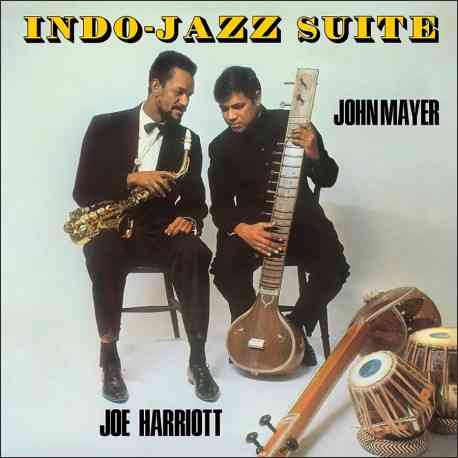
Mayer, the Anglo-Indian composer, was born in 1930 on Chandni Chowk Street in Calcutta. He is best remembered for Indo-Jazz Fusions with Joe Harriott, which is widely regarded as one of the finest works in British jazz.
He studied at the Calcutta School of Music, worked as a violinist and jazz drummer at the Lighthouse Cinema and then studied classical music with Mehli Mehta – Zubin Mehta’s father – before a scholarship took him to England.
This 1993 suite shows a different Mayer: a composer looking back at the city of his childhood and hearing it through a Western classical piano. Restaurants, roads, markets, temples, churches, mosques, rickshaws, and nursery rhymes all are mentioned.
John Mayer wrote Calcutta-Nagar, but it was Fali Pavri who first brought it to life on record. Some years ago, I was lucky enough to find a CD copy of the album, released by Guild Records in 1995.
Pavri, a Parsi pianist born in Mumbai, had his own deep Indian connection. He began his piano lessons with Shanti Seldon, a prominent Indian pianist and one of the influential teachers of Western classical music in India. From there, his journey took him far beyond India – first to Moscow, where he studied with Victor Merzhanov, and later to London as he built an international career.
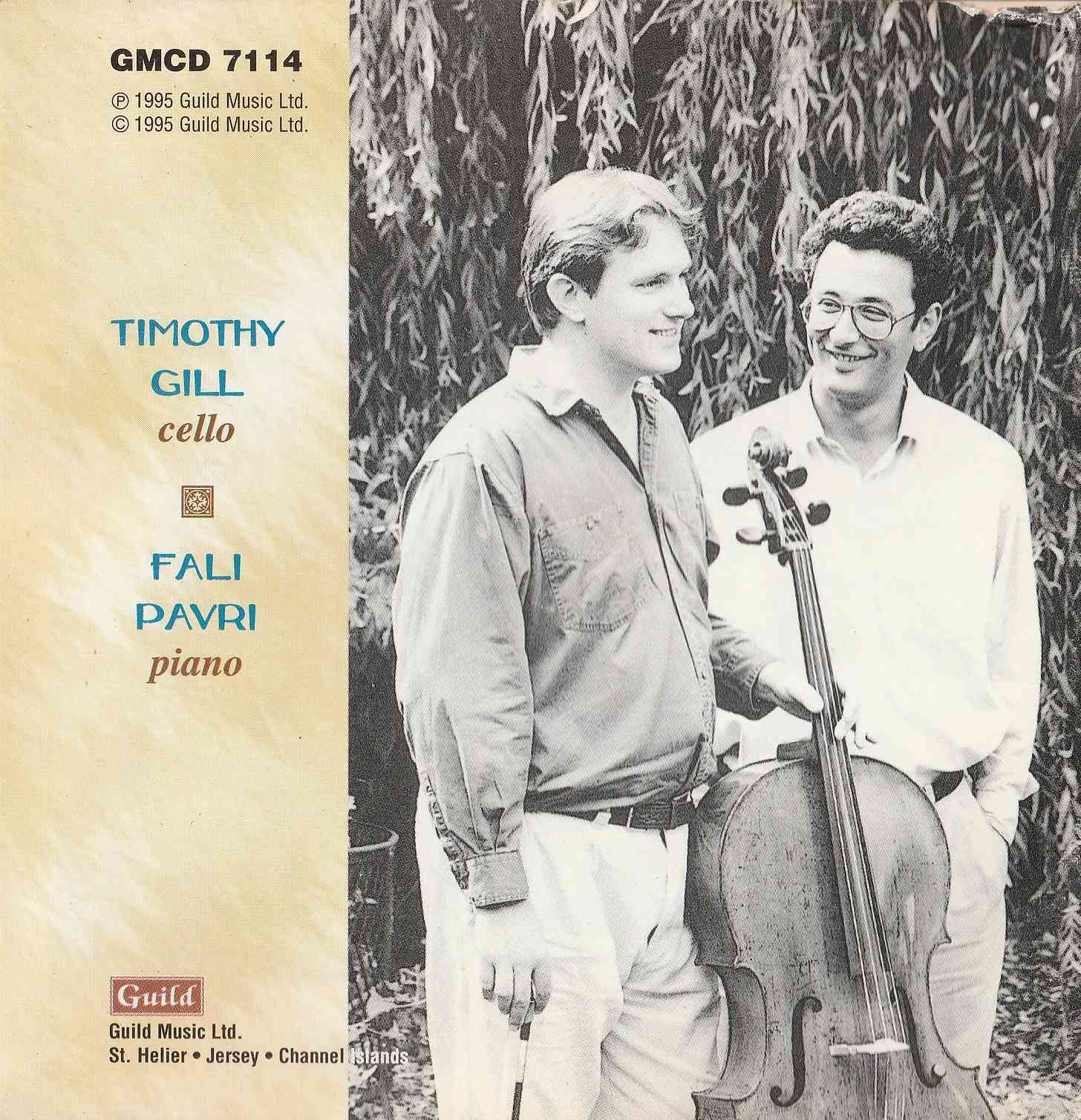
While he was still a student, the legendary cellist and conductor Mstislav Rostropovich heard him play and was impressed enough to invite him to accompany him on a major tour of India in 1998. Years later, Pavri would record John Mayer’s solo piano works for Guild Records. Today, as Head of Keyboard and Professor of Piano at the Royal Conservatoire of Scotland, he remains one of the most convincing voices for Mayer’s demanding, deeply personal, cross-cultural music.
Calcutta-Nagar was recorded in the Church of St Silas the Martyr, London, on July 20 and 21, 1995, along with the very accomplished cellist, Timothy Gill.
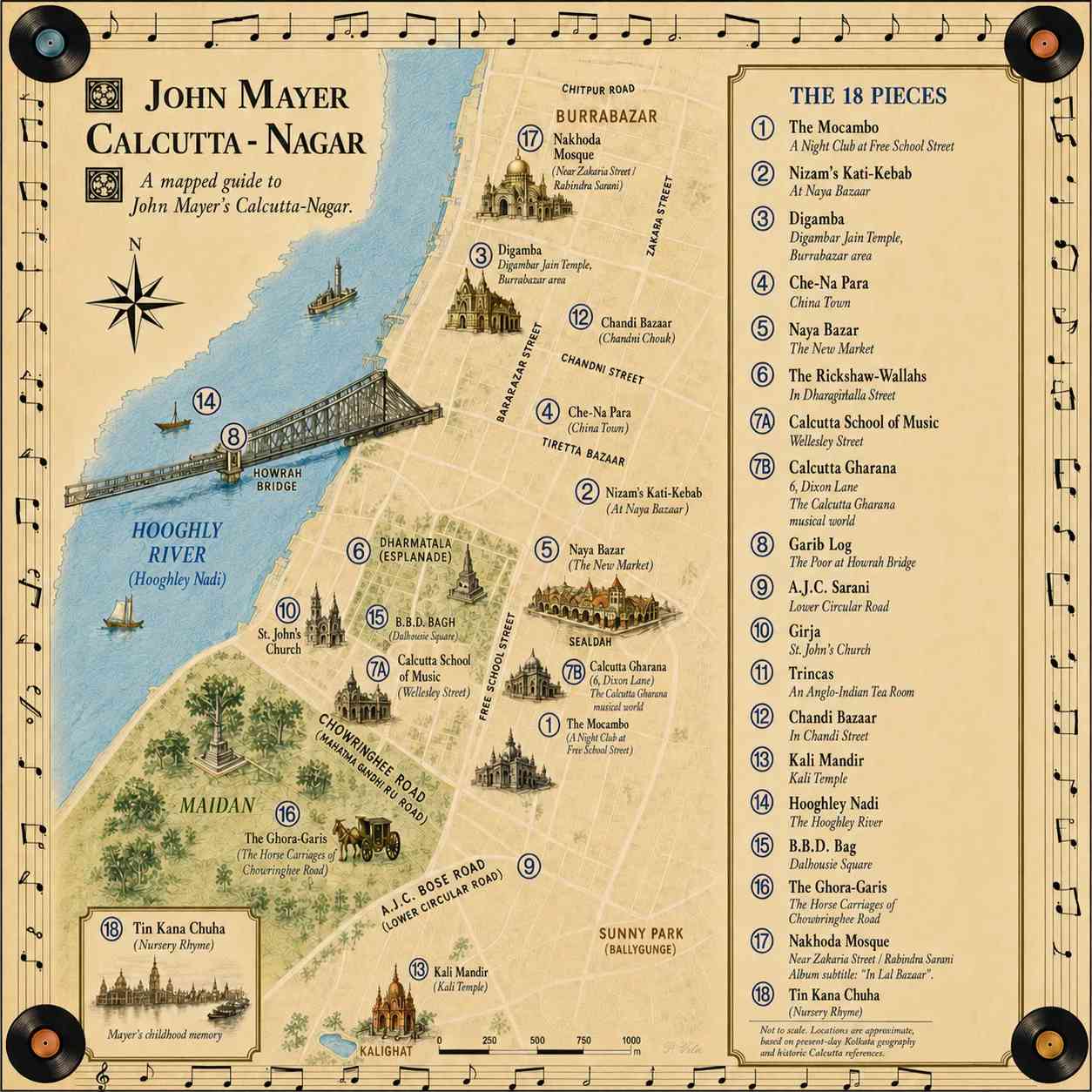
1. The Mocambo
A night club at Free School Street
Mayer begins on Park Street, and the choice feels right. The Mocambo piece has polish, swing, and a trace of old Calcutta nightlife. You can almost imagine the dining room: waiters moving between tables, conversation rising and falling, a band somewhere in the room keeping things elegant.
Mocambo's jazz history makes the reference even richer. It was among the early Indian nightclubs associated with live jazz in the 1950s, so Mayer is not just naming a restaurant. He is opening a door to a whole Park Street sound world.
Trincas and Blue Fox may get the jazz glory that they rightfully deserve, but Mocambo has its story. The legendary Pam Crain was hired before it opened in April 1956 and sang there for over a decade with a six-piece band.
2. Nizam’s Kati-Kebab
At Naya Bazaar
At clocking just 19 seconds, this small piece moves quickly, like a cook working the tawa at rush hour. The rhythm has the heat and impatience of Nizam’s, the legendary food stop associated with the kati roll. Nizam's is closely tied to the story of the kati roll, supposedly created to make kebabs easier to eat on the move. The detail matters because Mayer's music catches exactly that mood: food as speed, comfort and a theatre favourite.
3. Digambaa
An Ornate Jain Temple
After the food-stall rush, Digamba pulls the suite inward. It is quieter, more stripped down, and almost deliberately still. The title points to the Digambar Jain tradition, where renunciation is pushed to its sharpest edge.
Mayer does not decorate the idea. He gives the piece breathing room. That restraint is what makes it work.
4. Che-Na Para
China Town
Here the old Chinatown enters the suite. The music hints at the market movement, but it avoids the typical 'Chinese' postcard effect. The piece carries a hint of Tiretta Bazaar’s early-morning Chinese breakfast scene, kept alive by Calcutta’s shrinking Hakka Chinese community, a fragile city tradition we hope will somehow survive.
5. Naya Bazar
The New Market
Naya Bazar is crowded in the best way. The music seems to bump into itself, just as a market should. There are stalls, voices, bargaining, movement, confusion The funny thing is that New Market is old. Its Victorian red-brick character, damaged and rebuilt across decades, gives the name a nice little contradiction.
6. The Rickshaw-Wallahs
In Dharamtalla Street
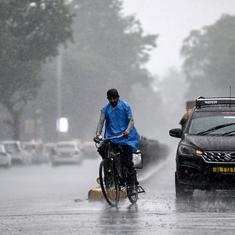
This is probably the most physical piece in the suite. The rhythm is of feet on a hot road, wheels through lanes, the pull of weight through a city that never quite stops. Hand-pulled rickshaws are easily romanticised images of Calcutta, but the reality is harsher. There is a kind of heaviness to Mayer’s piece. It doesn’t make the image too pretty.
7. Calcutta Gharana
Calcutta School of Music
Mayer’s Indian classical ear comes forward here. Though referring to a style of Hindustani classical music, the piano remains unmistakably Western. That mixture was Mayer’s natural territory. A gharana, after all, is not just a style: it is memory, lineage, discipline and taste, passed from one musician to another.
The subtitle of this piece may also be a clever musical hint at Calcutta School of Music, then situated at Wellesley Street, where a seven-year-old Mayer studied violin under Phillipe Sandre.
8. Garib Log
The Poor at Hawrah Bridge
Garib Log is where the suite stops smiling. The title means “poor people” and Mayer lets the music slow down enough for that to register. This is important. A city portrait that gives you only Park Street, churches, markets, and monuments is a tourist brochure. Mayer lets poverty enter the frame. The suite becomes less comfortable and more truthful.
9. AJC Sarani
Lower Circular Road
AJC Sarani brings the city back to speed. The chords feel restless, almost traffic-like. The road, formerly known as Lower Circular Road, carries a long colonial history, including its old defensive function around the city. Mayer does not spell all that out. He turns it into a pulse.
10. Girja
St. John’s Church
Girja changes the air. Bells, hymns, church stone and tropical humidity seem to meet in a small, reflective piece. The word comes from the Portuguese “igreja”, meaning church. This is a reminder of how many histories are packed into the city before the music even begins.
It also reflects the fact that Calcutta’s religious soundscape was never one thing. St Paul’s Cathedral and other colonial-era churches sit inside the same city as the Kali Mandir and Nakhoda Mosque that are invoked later in the suite.
11. Trincas
An Anglo-Indian tea room
My favourite piece of the album is titled Trincas. Trincas swings. It has that bright Park Street-at-night feeling, the kind of old glamour that is both memory and myth.
Indian jazz fans are aware of Calcutta’s iconic restaurant, Trincas, and its glorious jazz history of British and Indian musicians playing there in the 1960s and 1970s.
The venue witnessed the residency of several notable jazz musicians like the British jazz greats Dick Morrissey and Ashley Kovac as well as India’s jazz greats like Benny Rozario, Pam Crain, Braz Gonsalves, Louis Banks, and Usha Uthup, among others. Thanks to its current owners, Trincas remains alive while still holding on to its old-world charm.
12. Chandi Bazar
In Chandi Street
Chandi Bazar is another market piece, but it feels more compact, sharper, and more restless. You can almost hear the quick overlap of bargaining voices, metal, hardware, electronics, and street noise. British pianist Peter Jacobs later included this vignette in his anthology of twentieth-century British piano music, which says a lot about the strength of the piece even when standing alone.
13. Kali Mandir
Kali Temple
Kali Mandir is moodier, more charged. Mayer suggests bells, incense, crowds and devotion without flattening the temple into an exotic atmosphere. The Kalighat association is important here. It is one of the major Shakti Peethas and the music seems to know that this is not a tourist stop. It is trust and devotion.
14. Hoogley Nadi|
The Hooghly River
The river brings flow back into the suite. Hoogley Nadi moves with ferries, bathers, offerings, and trade. The Hooghly was the route that made Calcutta possible as a colonial city, but Mayer does not turn the river into a textbook note. He lets it flow.
15. BBD Bag
Dalhousie Square
BBD Bag is formal, square-shouldered, and administrative. This was Dalhousie Square, the old power centre of the colonial era, and the Writers’ Building still carries the weight of bureaucracy and revolt. The name now commemorates three young revolutionaries – Benoy, Badal and Dinesh – who took part in the infamous 1930 attack inside the Writers’ Building.
16. The Ghora-garis
The Horse Carriages of Chowaringhee Road
It is one of the most visual miniatures of the suite, with horse-drawn carriages near the Maidan and Victoria Memorial and the clip-clop rhythm. It could have very easily become sentimental. Mayer gives it enough pace to look alive, more like a moving street scene than a faded old postcard.
17. Nakhoda Mosque
In Lal Bazaar
Nakhoda Mosque has a deep, grand sound. The red sandstone, the scale, the call to prayer are all in the background. The architecture is often said to recall Akbar’s tomb at Sikandra, giving the piece a pleasant historical echo: a fragment of Mughal memory buried deep within the metropolis of Bengal.
18. Tin (Teen) Kana Chuha
Nursery Rhyme
The suite ends with Tin Kana Chuha, which means “Three Blind Mice”, turning a familiar Western nursery rhyme into a playful Hindi-Indian closing gesture. After temples, roads, markets, poverty, restaurants, and mosques, the ending feels almost cheeky. It leaves the city alive, not like something in a museum.
Calcutta-Nagar is best heard like a map drawn from memory. Mayer does not try to explain Calcutta or make it neat for the listener. He lets the city stay exactly as it is: noisy, sacred, hungry, poor, colonial, playful and modern, often in the same breath.
That clutter is not a flaw. It is the music’s real subject. And in Fali Pavri’s hands, these small piano pieces begin to feel like something rare: a city remembered, not in words or photographs, but through the piano.
Legacy of Calcutta-Nagar
Calcutta-Nagar still matters because it shows how naturally John Mayer could bring two musical worlds together without making either one feel secondary. His music found strong advocates in artists such as Fali Pavri, Peter Jacobs, and Rohan de Saram, who helped more listeners hear the distinct Anglo-Indian voice inside his Western classical writing.
Mayer’s influence also reached younger musicians and teachers, especially through his work in Birmingham, where Indian and Western music could sit side by side as part of the same conversation.
Calcutta-Nagar continues to speak to modern listeners. A recording by Singaporean pianist See Ning Hui in 2013 brought fresh attention to the work.
Another fine, more recent recording is Peter Jacobs’s version on The Peter Jacobs Anthology, Vol. 2, released by Heritage Records in 2025. He lets Mayer’s tiny scenes of markets, temples, streets, and river life speak for themselves, like old Calcutta postcards suddenly finding a voice.
Jacob had earlier released three pieces from Mayer’s Calcutta-Nagar in his first anthology, and here he does the complete suite. voice. Listen here
John Mayer was not the only Indian, or Indian-born, composer drawn to Western classical forms. Naresh Sohal, Ravi Shankar, Param Vir, Vanraj Bhatia, Reena Esmail and now Ilaiyaraaja all crossed that line in their own ways. But Calcutta-Nagar feels different because it is so rooted in a particular city. Mayer is not trying to make a grand East-meets-West statement. He is simply remembering Calcutta, one piano miniature at a time.
Sujit Sinha is an IT professional by day and an enthusiastic music collector and researcher after hours.
This article first appeared on Sujit Sinha’s substack.
