






The victory of the Bharatiya Janata Party in the elections in West Bengal came as a surprise to many. The party’s campaign had foregrounded issues of Hindu identity, demographic anxieties stemming from a claimed rise in the population of infiltrators and harped on the politics of Partition. It was thought that this would have limited appeal in a state long perceived to be associated with secular politics.
However, a peek into Bengal’s colonial history makes it obvious that the state was no stranger to communal politics. During the 1930s and ’40s, Hindu nationalist ideas shaped the political discourse of the Bhadralok upper-middle classes and political parties harped on contentious, religion-based issues in their political campaigns.
The Hindu identity in Bengal emerged in the early part of the 20th century as a counter to an increasing religious consciousness among Bengali Muslims. In his book Communal Riots in Bengal 1905-1947, historian Suranjan Das underscores the role of overzealous religious preachers in the Bengal countryside and ulema in the cities, who sought to purge Islam of all the Hindu rituals and practices.
Bengali Hindus responded to these changes in Muslim society by forging a common Hindu identity, spurred by the growth of Hindu religious organisations and voluntary associations. They were inspired by the cultural influences of the writings of Bankim Chandra Chattopadhyay, Aurobindo and Sarat Chandra Chattopadhyay.
Bengali Hindus also felt threatened by the fact that the population of Muslims in the province was larger. According to the 1911 census, Muslims formed 52.3% of the population and Hindus 45.2%. (The figures exclude the population of Bihar and Orissa which till then were part of the Bengal province.)
This disquiet of Bhadralok Hindus found an expression in the book Hindus a Dying Race? by Col UN Mukhopadhay, who compared demographic decline to a civilisational loss of Bengali Hindus.
This demographic situation was reflected in the Communal Award of 1932 announced by the British Prime Minister, Ramsay MacDonald. The award created separate electorates for minority communities and “Depressed Classes” or Dalits.
It drastically altered the religious composition of the Bengal legislature, increasing the proportionate share of Muslim seats in the legislature from 40% to 50.4% and reducing the share of Hindu seats from 50% to 37.2%.
It proved to be a turning point in the waning political influence hitherto enjoyed by Bengali Hindus.
The introduction by Bengal’s Muslim League-Krishak Praja Party of two bills – the Calcutta Municipal Amendment Act (1939) and the Secondary Education Bill (1940) was also a cause of anxiety.
Hindus believed it would undermine their economic and cultural privileges. The first bill would undermine their ability to allot municipal jobs and contracts in the Calcutta Municipal Corporation to their kith and kin. The second was designed to regulate the affairs of higher and secondary education by a Bhadralok-dominated Calcutta University.
The Hindu Mahasabha, which was resuscitated as a political party in 1939, was quick to seize the simmering discontent of Bengali Hindus and carve out a space for itself in the politics of the province.
The Bengal Pradesh Congress Committee, too, defying the ambivalence of the All India Congress Committee, openly aligned with the Hindu cause and emerged as a significant political platform for airing the grievances of the Hindus.
On several occasions, the Hindu Mahasabha and the Congress party collaborated by organising protests, demonstrations, and meetings, and even contesting elections as allies to become a united political voice for Hindus and confront the policies of the Muslim League-supported government.
Ethnic massacres, the Partition of Bengal
The frustration of Bengali Hindus took a new turn with the communal fires in Calcutta, Noakhali, and Tippera in 1946-’47 as Partition grew near. Fearing the loss of lives and the reality of being displaced from their homes, Bengali Hindus from Calcutta and the mofussil towns of Bengal orchestrated a popular campaign to press for the creation of a Hindu-majority state of West Bengal with Calcutta as its capital.
The campaign was conducted through petitions to the country’s political leadership by numerous clubs, bar associations, voluntary bodies, civil society organizations, and industrial and commercial ventures.
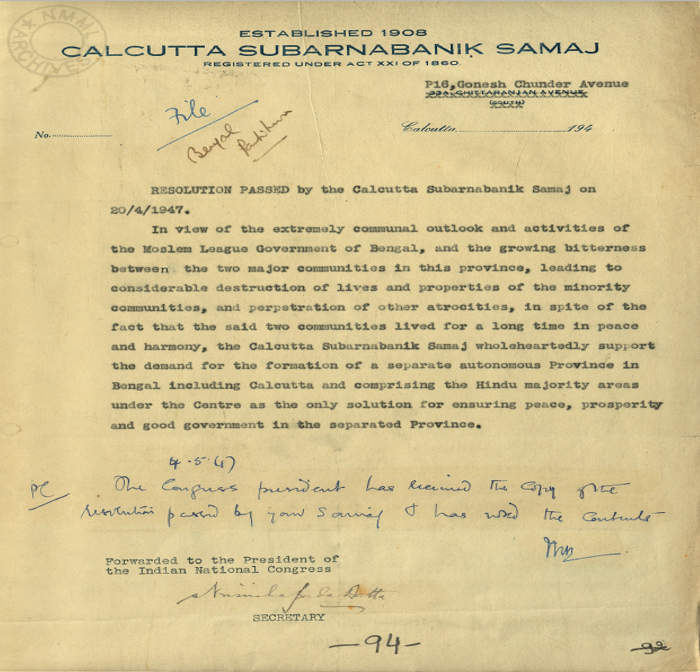
The rank and file of the Hindu Mahasabha unanimously passed a resolution demanding the formation of West Bengal by dividing the Bengal province at its session in Tarakeshwar on April 15, 1947. (The British did not announce Partition until June 3.)
Honoring their political partnership, the provincial leadership of the Congress Party and the Hindu Mahasabha coordinated and jointly organised meetings in Calcutta and Delhi to generate political momentum for the creation of West Bengal.
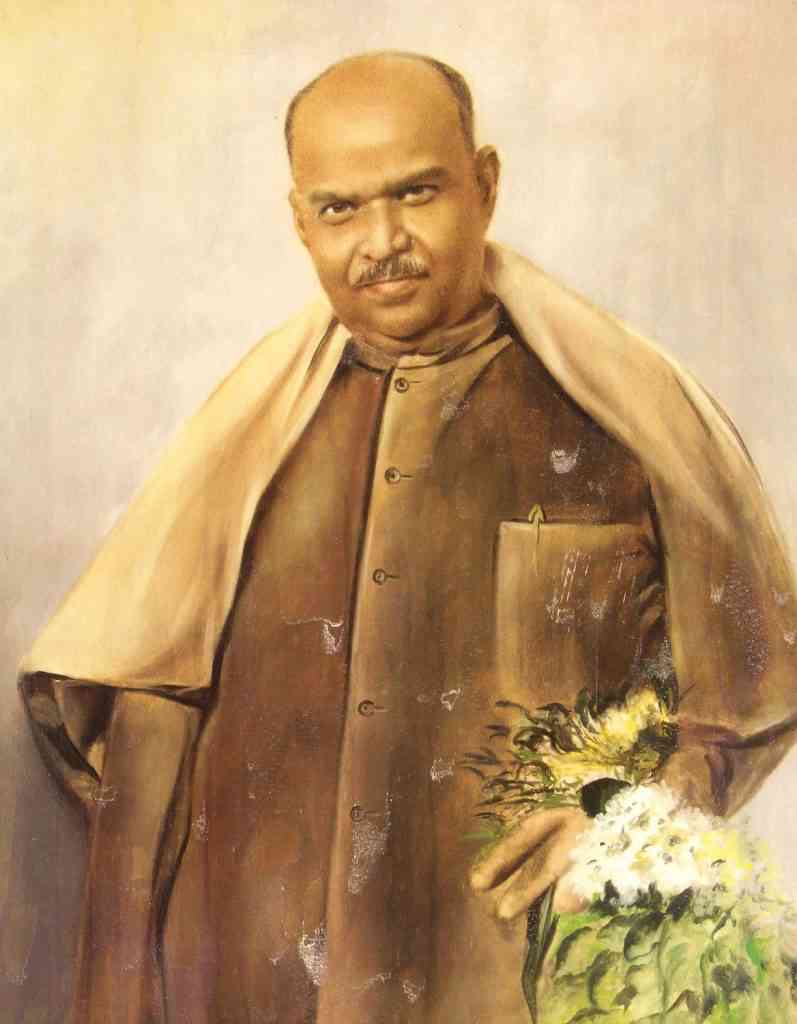
One prominent meeting was the inaugural session of the Jatiya Banga Mahasammelan at Singhee Park in Calcutta’s Ballygunge on May 10, 1947. It was attended by Congress leaders Dr Prafulla Chandra Ghosh, Kalipada Mukherjee, Lakshmi Kanta Moitra, and Dr Shyamaprasad Mookherjee representing the Hindu Mahasabha.
The popular movement for West Bengal culminated in an overwhelming number of legislators from the province’s western districts voting in favor of the division of Bengal, formally rejecting the inclusion of Bengal in Pakistan as well as the United Bengal Scheme championed by Huseyn Suhrawardy and Sarat Chandra Bose. They proposed an independent, sovereign state of Bengal that would neither join India nor Pakistan.
History and historical events have the capacity to shape political attitudes, voting patterns and changes in party systems. It is jokingly said that Bengalis are nostalgic and love to reminisce about their past.

Since taking office, the BJP has decided to erect a statue of Shyamaprasad Mookherjee and rename Suhrawardy Avenue in Kolkata as Gopal Mukherjee Road.
For the BJP-led West Bengal government, the resurrection of colonial-era memories and the invocation of historical figures may well be a strategy to craft an enduring, consolidated Hindu constituency for years to come.
Souradeep Banerjee is a doctoral candidate at the department of political science at Temple University in Philadelphia.
