




The dangerous work environment of Indian workers is symptomatic of the global decline of organised labour and the corresponding rise of what’s now widely called the “precariat”. India’s new slavery is an egregious version of this trend. A global class of labour that lives perpetually in economic uncertainty and moves in and out of jobs that give little meaning to their lives, the precariat are characterised by volatile earnings, chronic debt, and a lack of non-wage and rights-based state benefits.
In the global hierarchy of labour, they come below the traditional working class, for whom welfare states were built and trade unions acted. In India, where welfare provisions are poor and more than 90% of workers are in the informal sector, the social foundations of working life have historically been degraded. The shrinking space for unionisation has further degraded social life and working conditions. Like elsewhere, the power of organised industrial workers, among the most potent modern agents of social dignity and democratisation, has been systematically eroded in India.
During the post-1945 years, in advanced West European economies, trade unionism helped narrow pay gaps. The power of organised labour in India may have had the same effect, but since the mid-1970s, trade union membership has been shrinking and unions have lost power to their parent parties (Indian unions are all linked to political parties). Since the onset of economic liberalisation, the power and social influence of trade unionism has waned precipitously. Trade union density (defined as the percentage of union members and associations in the total workforce) in India plunged by nearly a fifth between 1993–94 and 2011–12 to 28.8%. It currently stands at just 13.4%. The labour income share as a percentage of GDP has been falling, much more steeply than in the rest of the world. While internationally, it has declined modestly from 52.2% to 51.4% in the seven years to 2017, in India it has plunged from 56.8% to 49% over the same period.
With even the tiny formal sector increasingly using informal labour, collective bargaining is fast becoming a relic from the past. In just one decade between 1999 and 2011–12, the percentage of casualised workers in the formal sector jumped from 38% to 51%. A recent government labour force survey shows that less than half of the working-age population is employed. Among them, only about 25% get a regular salary or wage. Of those who do, more than 70% don’t have a job contract, while more than half aren’t eligible for paid leave or social security benefits. The state itself increasingly hires informally, thus compounding the new slavery.
The 2020 pestilence provided the powerful with an opportunity to trample what remains of labour rights. Amid widespread job losses (a fifth of salaried jobs in one year), the federal government in September 2020 introduced new labour codes that make it easy for companies to convert permanent jobs into fixed-term contracts. Companies no longer need to outsource contract jobs to other companies; they can directly hire temporary workers themselves. Several state governments have chosen to do away with pesky labour laws to help businesses shake off the economic slump. Businesses in those states were legally allowed to force workers to do 12-hour shifts, and to abolish minimum wages and obligations to provide ventilation, toilets, rest breaks, lighting, protective equipment, canteens, and first aid. The “boldest” measures were taken by Uttar Pradesh, which suspended 35 of its 38 labour laws and even decreed that other states would need permission to hire people hailing from Uttar Pradesh.
Uttar Pradesh and Bihar, two of the most underdeveloped states, are among the biggest exporters of migrant workers. Migration, especially long-distance migration, is never an easy decision, as people are naturally reluctant to leave their communities for work. Distress migrations for slave wages are a symptom of the despair stemming from the bleakness of opportunities at home.
There’s always been plenty to despair about in Uttar Pradesh’s Gorakhpur city, where 63 children died in a hospital in 2017 because the government failed to pay the bills for oxygen supplies. “There’s no village in Gorakhpur that doesn’t have families whose members are working elsewhere because there’s zero work here, apart from crime,” said Sunil Singh, who once headed the Hindu Yuva Vahini (Hindu Youth Army), a right-wing youth militia, before he fell out with the Vahini’s founder, Yogi Adityanath, the BJP’s rabble-rousing priest-politician from Gorakhpur and now the chief minister of Uttar Pradesh.
The degradation of social life in Gorakhpur isn’t such a bad thing for politicians like Adityanath and Singh. There are always enough angry young men around with nothing much to do, and waiting for just the sort of muscular action that types like them offer. The saffron-draped Vahini cadre, armed with swords and sticks, made their name with vigilante violence aimed at Muslims. Its leaders were regularly charged with rioting and arson, but that only helped raise the profile of Adityanath and his Vahini, high enough to force the BJP to make him the chief minister of India’s biggest state, which has the same population as Brazil’s. At its peak, the Vahini had more than 1.5 million members. When Adityanath became chief minister in 2017, the application for membership passed 5,000 a day. As the new chief minister needed to underplay the violent ways of his past, the Vahini began easing off on enlisting new volunteers.
There are 3 million people in Gorakhpur district, yet it has just one engineering college and university. This is how joblessness and angry disaffection are nurtured, Sunil Singh pointed out. Unemployment helped swell the ranks of Hindu Yuva Vahini, he said. “If you start a show in Gorakhpur, you’ll find a crowd because no one has anything better to do here.” That’s why Singh has started his own show. It’s called Hindu Yuva Vahini Bharat, a brand-new militia that will take up where Adityanath’s private army left off. Just like its predecessor, Hindu Yuva Vahini Bharat hasn’t had problems filling its ranks. There aren’t, after all, that many recruiters in town.
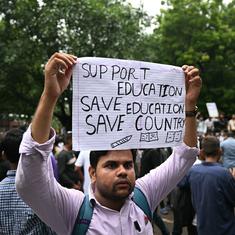
Persistent unemployment leads to a drop in labour force participation rates as more and more people who are unable to find work simply stop looking for it. The consequence of this has wider socioeconomic implications beyond the job market, as youths in the 15–29 age bracket are basically reduced to idleness. The trend isn’t confi ned to Uttar Pradesh. The number of India’s NEET, or “Not in Employment, Education and Training”, rose from 70 million in 2004–5 to over 115 million by 2017–18. This is more than 30% of the youths in this age group, compared with China’s NEET of 11.6% and Brazil’s 20%. Growing at about 2 million a year in the decade to 2011–12, India’s NEET has since been increasing by about 5 million a year. The UN puts the percentage of NEET youths in India even higher, at 40%. Those are all-India estimates. For backward states such as Uttar Pradesh, the problem of NEET is much grimmer.
Studies by historians and statisticians armed with large country samples show that personal joblessness experience often translates into political cynicism and yearnings for strong-armed leadership. When promised equality but given slavery, people are tempted to conclude that democracies are indecisive and breed too much quibbling, and that a leader who doesn’t bother with the niceties of Parliament and elections is preferable.
It should come as no surprise that this popular yearning for despotic rulers and a strong state is alive and well in India. At all levels of government, the corrosive sense of bitterness felt by the victims of social degradation is fodder for despots looking to prey on popular resentments, such as the antipathy towards Muslims tapped by the various avatars of Hindu Vahini.
Political recruitment is an escape from a life of slave wages and social degradation. For the disesteemed, the remedy for indignity is a party bike, money, and the indulgence of law enforcers. It’s the protection of local power networks, the licence to extract protection money from small businesses, and the power to inflict indignity onto others. Political enlistment offers reassurance, a whiff of power. The educated are especially vulnerable. Raised to be more aspirational and resistant to a life of modern servitude, they are more likely to fall prey to disappointment and disaffection. Jobless figures in India show that, compared with other groups, people with a graduate degree are more than twice as likely to be unemployed, as they are more resistant to slave labour and can afford to wait for more suitable career openings. An ever-bulging number of educated unemployed youths is raw material for political parties and private armies of politicians.
Bike and car cavalcades of young men brandishing weapons and party flags are common sights in India, especially around the time of elections. The thousands of young people who mill about in the middle of workdays easily become the hired hands and foot soldiers of despotic politics. They are the ones who make Indian elections the greatest show on earth – rallying, canvassing, fighting, killing, and getting killed for leaders who give them ready access to cash and power, rather than manifesto promises of a rich future. The recruitment of disaffected youth certainly brings energy to politics. It serves as a proxy for gainful employment. It raises hopes and expectations of betterment. But it also hands razor-sharp weapons to local and national despots – political demagogues like Adityanath who prove by their deeds that shortages of meaningful work are deep gashes on the body of a democracy already suffering a thousand social cuts.
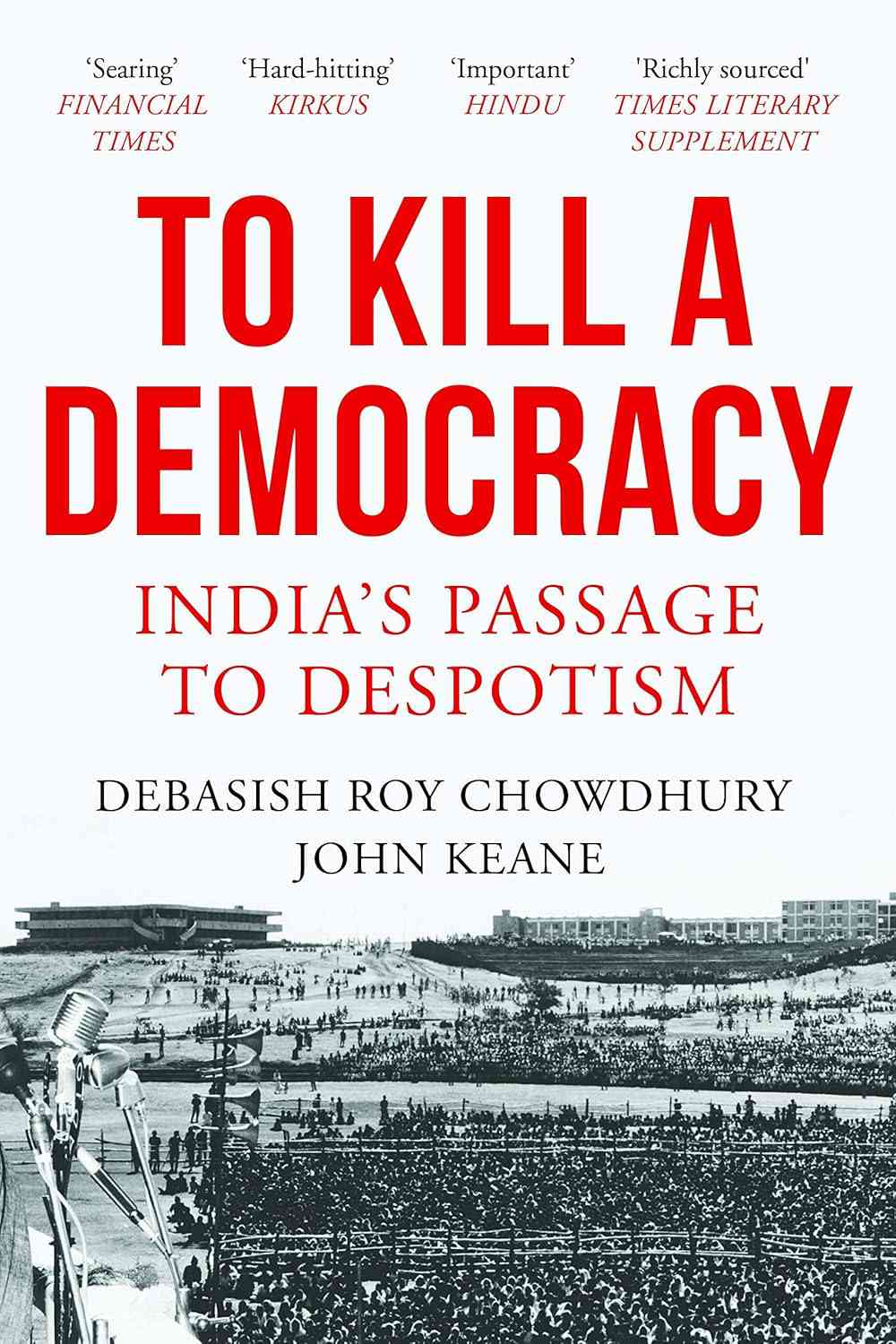
Excerpted with permission from To Kill a Democracy: India’s Passage to Despotism, Debasish Roy Chowdhury and John Keane, Pan Macmillan.
