





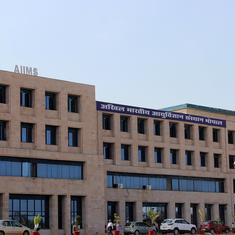


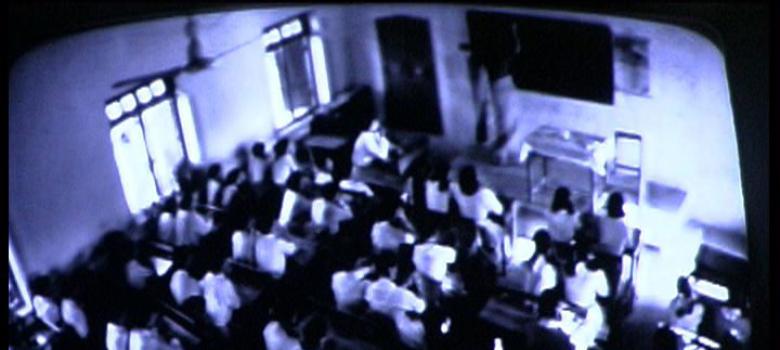
As the central government launched a biometric system this week to track employees' attendance records, many have begun to debate the pros and cons of mass surveillance. It is a discussion with long roots in India, as is evident from Avinash Deshpande’s documentary The Great Indian School Show.
Deshpande's film, shot in 2005, is about the massive surveillance programme undertaken by the Mahatma Gandhi Centennial Sindhu High School in Nagpur, where over 300 CCTV cameras were placed in classrooms, corridors, verandahs, playgrounds and laboratories watch over students and the staff. The CCTVs feed into screens located in the office of principal Deepak Bajaj, who doesn’t only keep an eye on the staff and wards, but also issues information, instructions and admonitions through the public address system.
The system is computerised to the extent that its operator can keep an eye on the school even when away from it.
From his perch, the principal is second only to God in his omniscience. “The students are sitting at the back of the class, and whether what they are writing is related to what the teacher is teaching can be checked here by zooming in,” Bajaj tells Deshpande. (He has since been replaced by his wife, Usha, after being dismissed under the Right to Education Act for denying a student admission).
Bajaj says he is producing “the perfect citizen” through his unrelenting scrutiny. His assertions, made against a backdrop of constantly updating screens, are parroted by his staff (a teacher explains that monitoring is necessary in a co-educational school where “anything can happen”) and students (a girl says that it saves time and helps them build a direct relationship with their principal).
“If you exploit someone over a period of time, it becomes a habit,” observed Deshpande, the Pune-based filmmaker who revisited the theme of school discipline in his screenplay for the National Award-winning Marathi feature Shala in 2011.
He shot his film at the educational institution for a few days before persuading the management to share the CCTV feed with him. "To give Bajaj his due, he had the courage of his convictions," Deshpande said. The 52-minute documentary mixes together the phantasmal images visible on the monitors with actual footage of the students in class and at functions.
A sequence towards the end, in which young boys gawk at Deshpande's camera, can be interpreted in two ways. One is that they haven't lost their innocence and remain self-conscious about being filmed. The other is that they have become so inured to cameras placed above their heads that they are startled when they are actually confronted with the equipment.
Perspectives on surveillance have changed since he made his film, Deshpande said. Unease over too much monitoring has been replaced by unease over too little of it. "These days, we don’t look at CCTV cameras as surveillance at all,” he said. “In the name of do-gooding and saying that surveillance is good for children and society, the issue of privacy has been swept under the carpet.”
We welcome your comments at
letters@scroll.in.
Deshpande's film, shot in 2005, is about the massive surveillance programme undertaken by the Mahatma Gandhi Centennial Sindhu High School in Nagpur, where over 300 CCTV cameras were placed in classrooms, corridors, verandahs, playgrounds and laboratories watch over students and the staff. The CCTVs feed into screens located in the office of principal Deepak Bajaj, who doesn’t only keep an eye on the staff and wards, but also issues information, instructions and admonitions through the public address system.
The system is computerised to the extent that its operator can keep an eye on the school even when away from it.
From his perch, the principal is second only to God in his omniscience. “The students are sitting at the back of the class, and whether what they are writing is related to what the teacher is teaching can be checked here by zooming in,” Bajaj tells Deshpande. (He has since been replaced by his wife, Usha, after being dismissed under the Right to Education Act for denying a student admission).
View this movie at cultureunplugged.com
Bajaj says he is producing “the perfect citizen” through his unrelenting scrutiny. His assertions, made against a backdrop of constantly updating screens, are parroted by his staff (a teacher explains that monitoring is necessary in a co-educational school where “anything can happen”) and students (a girl says that it saves time and helps them build a direct relationship with their principal).
“If you exploit someone over a period of time, it becomes a habit,” observed Deshpande, the Pune-based filmmaker who revisited the theme of school discipline in his screenplay for the National Award-winning Marathi feature Shala in 2011.
He shot his film at the educational institution for a few days before persuading the management to share the CCTV feed with him. "To give Bajaj his due, he had the courage of his convictions," Deshpande said. The 52-minute documentary mixes together the phantasmal images visible on the monitors with actual footage of the students in class and at functions.
A sequence towards the end, in which young boys gawk at Deshpande's camera, can be interpreted in two ways. One is that they haven't lost their innocence and remain self-conscious about being filmed. The other is that they have become so inured to cameras placed above their heads that they are startled when they are actually confronted with the equipment.
Perspectives on surveillance have changed since he made his film, Deshpande said. Unease over too much monitoring has been replaced by unease over too little of it. "These days, we don’t look at CCTV cameras as surveillance at all,” he said. “In the name of do-gooding and saying that surveillance is good for children and society, the issue of privacy has been swept under the carpet.”
