








West Asia conflict: As Centre prioritises LPG supply for households, businesses face disruptions
The minimum waiting period for booking an LPG cylinder was also raised to 25 days from 21 days to ‘avoid hoarding/black marketing’, said the Union government.
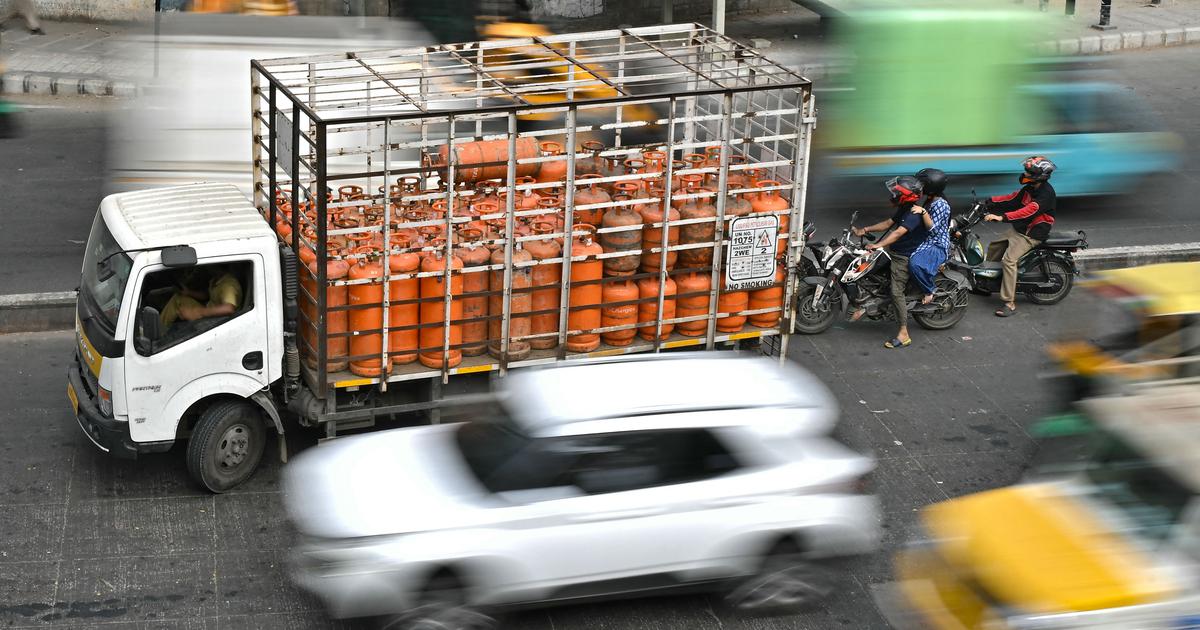
The Union Ministry of Petroleum and Natural Gas said on Monday that the Centre was prioritising the supply of liquified petroleum gas, or LPG cylinders, for domestic use amid disruptions to fuel imports due to the war in West Asia.
“Non-domestic supplies from imported LPG is being prioritised to essential non-domestic sectors such as hospitals and educational institutions,” stated the ministry.
It added that a committee of three directors of oil marketing companies had been constituted to review the representations for LPG supply to restaurants, hotels and other industries.
The Indian Oil Corporation, the Bharat Petroleum Corporation and the Hindustan Petroleum Corporation are three major oil marketing companies in India.
For domestic supplies, the Union government had also raised the minimum waiting period for booking an LPG cylinder to 25 days from 21 days to “avoid hoarding/black marketing”, stated the ministry.
The Centre’s move to prioritise domestic use has led to the oil marketing companies tightening the supply of LPG for restaurants, hotels, bakeries and small industries that rely on 19-kg and 47.5-kg cylinders, CNBC reported.
Stating that the supply of commercial gas cylinders to hotels had been stopped, the Bangalore Hotels Association warned on Monday that restaurants in Bengaluru may have to shut down temporarily, The Hindu reported.
The association urged the Union government to intervene and restore commercial LPG supply at the earliest.
In Pune, the municipal corporation temporarily closed gas crematoriums following restrictions on the use of LPG components such as propane and butane, PTI reported.
The supply of commercial cylinders has also been halted in Punjab, reported The Indian Express.
This came as the war in West Asia entered its eleventh day. Escalating tensions have raised concerns about possible disruption to shipments through the Strait of Hormuz, the narrow waterbody connecting the Gulf to the Arabian Sea. About 20% of global petroleum liquids consumption passes through the maritime chokepoint.
On Monday, global oil prices crossed the $100 per barrel-mark, the highest since July 2022. The oil prices have risen by about 20% since the conflict broke out.
Despite crude oil prices skyrocketing, The Indian Express quoted unidentified officials as saying that there were no immediate plans to raise retail prices of petrol and diesel.
The government has also invoked emergency powers derived from the Essential Commodities Act to direct refiners to maximise LPG production and ensure all supplies to domestic LPG consumers, according to the newspaper.
Soon after the conflict broke out, the price of commercial LPG was increased by Rs 114.5 per 19 kg cylinder. It costs Rs 1,883 in Delhi.
The price of domestic LPG cylinders was hiked by Rs 60 last week.
The conflict in West Asia began after Israel and the United States launched a joint operation to “degrade the capabilities” of the Iranian government. Tehran retaliated by striking Israel and US military bases in the region, and targeting major cities in other Gulf countries and some ships.
The joint attacks by Israel and the US on Iran came amid tensions between the three countries over Tehran’s nuclear programme. Washington acts as a guarantor of Israel’s security. Israel has been claiming that Iran is close to obtaining a nuclear weapon, which could alter the regional security balance.
Tehran has long maintained that its nuclear programme is for civilian purposes.
Also read:
