



Top updates: PM Modi says he is ‘willing to guarantee’ delimitation will not be unfair to any state
The government introduced bills on redrawing the boundaries of electoral constituencies and expedite the implementation of women’s reservation in Parliament.
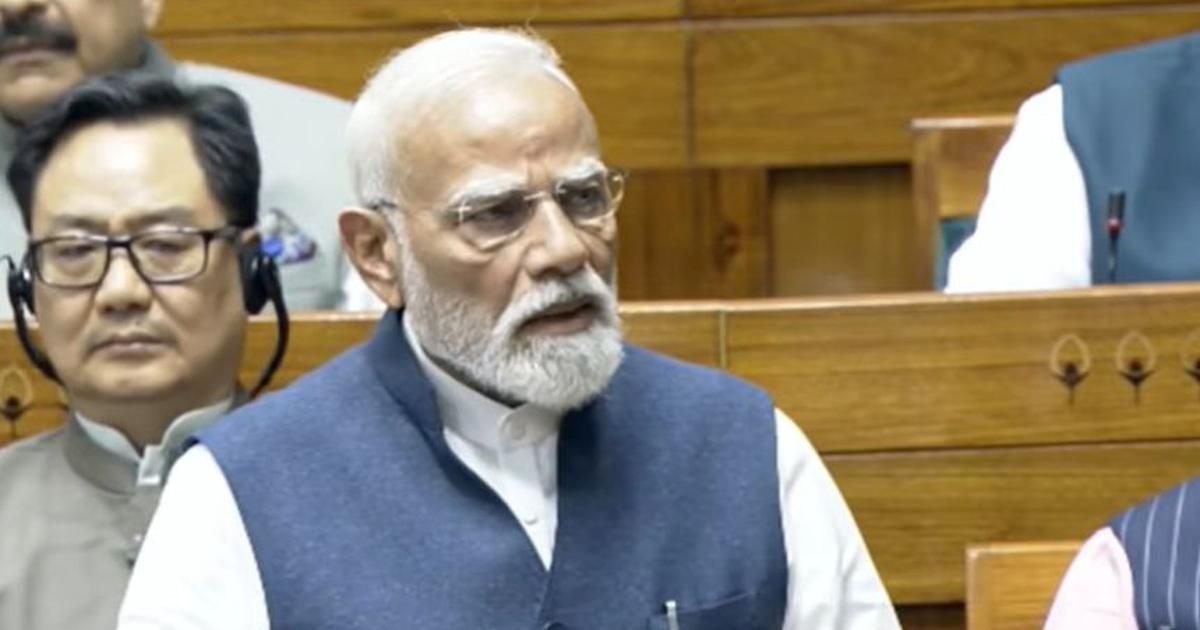
Prime Minister Narendra Modi on Thursday said he was “willing to guarantee” that no injustice will be meted out to any state through the proposed delimitation of Lok Sabha constituencies.
Modi said he wanted to assure the House that no part of the country would be discriminated against during the process, and no state’s proportion of representation in the Lower House of Parliament would be altered.
When an Opposition MP asked if he could guarantee this in the bills, the prime minister said that he was willing to verbally use the words “guarantee” or “promise” if needed.
Earlier in the day, the Union government introduced in the Lok Sabha three bills on redrawing the boundaries of electoral constituencies and expediting the implementation of women’s reservations in Parliament and state Assemblies.
Here are more top updates from the special session of Parliament:
- Bills introduced: Union Law Minister Arjun Ram Meghwal had earlier on Thursday told the Lok Sabha that through the bills introduced by the Centre, there will be an “equal, 50% increase” in the strength of the Lower House of Parliament, which will translate to 815 seats, ANI reported.
- Of these, 272 seats, or one-third, will be reserved for women, the minister said, and claimed that no state will face any reduction in its representation.
- While Meghwal introduced the 2026 Constitution One Hundred and Thirty-First Amendment Bill and 2026 Delimitation Bill, Union Home Minister Amit Shah tabled the 2026 Union Territories Laws Amendment Bill.
- Division of votes: Voting took place in the Lok Sabha on Thursday on the introduction of the three bills. Of those present in the House, 251 voted in favour and 185 opposed introducing the bills, based on a count of vote slips.
- ‘Delink women’s bill and delimitation’: Congress MP Gaurav Gogoi alleged that the intention of the government was not to implement women’s reservation, but to introduce delimitation “through the backdoor”. He remarked that Meghwal was merely repeating what Shah had said three years ago during the discussion on the Women’s Reservation Bill.
- Gogoi said: “At the time too, the Congress had supported women’s reservation, but had asked for the process to be simplified so that it would be implemented immediately. At that time too, we had demanded that the quota should not be linked to delimitation, and our stand is the same today.”
- Congress MP Venugopal alleged that the government’s intention behind introducing the delimitation bill was to take away protections introduced by former Prime Ministers Indira Gandhi and Atal Bihari Vajpayee. Venugopal was referring to the freeze on delimitation that was put in place in 1976 and extended in 2001.
- Muslim quota demand: Samajwadi Party MP Akhilesh Yadav asked whether the government considered Muslim women also to be part of “aadhi aabadi”, or half the population, The Indian Express reported. In response, Shah remarked that the Samajwadi Party could give all its election tickets to Muslim women if it wanted. Parliamentary Affairs Minister Kiren Rijiju said that speaking about Muslim women’s reservation is unconstitutional as a quota cannot be granted based on religion.
- Stalin protests: Earlier on Thursday, Tamil Nadu Chief Minister MK Stalin burnt a copy of the delimitation bill in Namakkal as part of the statewide protest against the proposed amendments to the law, The Hindu reported. The Dravida Munnetra Kazhagam chief described it as a “conspiracy and a black law”. He urged people to hoist black flags in every home and public place on Thursday.
Delimitation bill
The Union government is seeking to increase the strength of the Lok Sabha to 815 from 543 and to operationalise the 33% quota for women in the Lok Sabha and Assemblies under the 2023 Women’s Reservation Act. A three-day special session of Parliament to discuss these bills began on Thursday.
The Opposition INDIA bloc has said that while it supports women’s reservation, it will oppose the bill for delimitation of Lok Sabha seats.
Opposition parties have said that population-based delimitation would give an undue advantage to northern and central states in the Lok Sabha, as the proportion of seats in the North would be higher. They also noted that the ruling Bharatiya Janata Party has greater support in northern states than in the South.
Although speculation about the amendment to the law had been rife in political circles for the past two weeks, copies of the draft legislation were shared with MPs for the first time on Tuesday.
Article 82 of the Constitution states that after every census is completed, the allocation of Lok Sabha seats to each state must be adjusted based on changes in its population.
The current composition of the Lok Sabha is based on the 1971 Census. According to the 84th Amendment Act of 2001, constituency boundaries were frozen until the first census after 2026.
The census, which began on April 1, is expected to conclude in 2027.
The bill that will be introduced in Parliament proposes to amend Article 82 of the Constitution to remove the entire proviso. This will pave the way for delimitation to take place based on the latest census, which was held in 2011.
Also read:
- How Modi government aims to use women’s representation to expand Lok Sabha using 2011 census numbers
- ‘Unconstitutional’: Opposition says delimitation must not weaken voice of southern states
