


In 1929, when civil servant KPS Menon was posted in Peshawar, he received an offer to become the Agent of the government of India in Ceylon. The 31-year-old bureaucrat, who would later become independent India’s first foreign secretary, was initially hesitant about the move.
“I had begun to like the [Northwest] Frontier and would have preferred to stay on there, but the appointment in Ceylon, I was told, carried a pay of Rs 1,750 against Rs 1,150 for the Frontier appointment,” Menon wrote in his autobiography Many Worlds.
The raise made the decision easier. “To a man in the sixth year of his service with six children,” he wrote, “a difference of Rs 600 in his emoluments was not negligible. So we went to Ceylon.”
Menon arrived in Ceylon, now Sri Lanka, at a time when the island’s plantation economy was booming, even as complaints were growing about poor working conditions and the exploitation of Indian labourers on tea and rubber estates.
The estate economy was heavily dependent on Indian labour. “The fact is that the Sinhalese in certain strata of society, especially in the southern part of the island, were inclined to take life too easily and to avoid hard work,” Menon wrote. “It was this that necessitated the import of labour from India to work in the plantations.”
Accounts of the harsh conditions faced by these labourers frequently appeared in the Indian press. “In the twentieth century, Indian public opinion became increasingly alive to the lot of their countrymen overseas,” Menon noted. “The Government of India abolished the indenture system, took power to regulate, control or even forbid emigration and obtained the right to appoint an Agent of the Government of India in Ceylon to look after the interests of Indian immigrants, and particularly Indian labourers.”
Menon was the third person to occupy this post. “For four years I was perpetually on the move, visiting estates, talking to labourers as well as to managers and trying to redress their complaints,” he wrote. “I found many enlightened men in the planting community; and on the whole they were cooperative.”
This attitude shifted after the Great Depression hit Ceylon in 1932. As tea and rubber estates shut down or struggled to survive, plantation owners demanded that the minimum wage be scrapped.
“The position taken up by the planters was that now that the profits of the estates had gone down and the salaries of managers, superintendents and clerks had to be cut, there was no reason why the wages of Indian labourers alone should be treated as sacrosanct,” Menon wrote. “My reply was that minimum wage was after all a minimum wage – a wage below which a labourer could not maintain his way of living, low enough as it was already in all conscience; and this if employers were unable to pay even the minimum wage, it was better for our labourers to return to India, and that we would rather have our people starve in India than outside.”
Though the planters were “unconvinced” and enjoyed the “tacit support” of local authorities, the government of India’s firm stance ensured that minimum wages continued to be paid.
Natural beauty
Menon’s administrative abilities were recognised by the Raj, but officers such as Norman Bolton, chief commissioner of the North-West Frontier Province, also took note of his “literary flair”, encouraging him to record his impressions of the places where he served.
In Ceylon, Menon regularly took notes on the landscapes he visited, describing the colours, customs and traditions of its people. He believed that the Persian couplet inscribed at the Diwan-e-Khas of Delhi’s Red Fort – “If there is Paradise on Earth, it is this, it is this, it is this” – should have been placed at the port of Colombo.
“In fashioning Ceylon, nature seems to have let herself go,” he wrote. “Ceylon has everything – hills and peaks, woods and forests, downs and dales, plains and meadows; and this beautiful mosaic is set in the silver sea.”
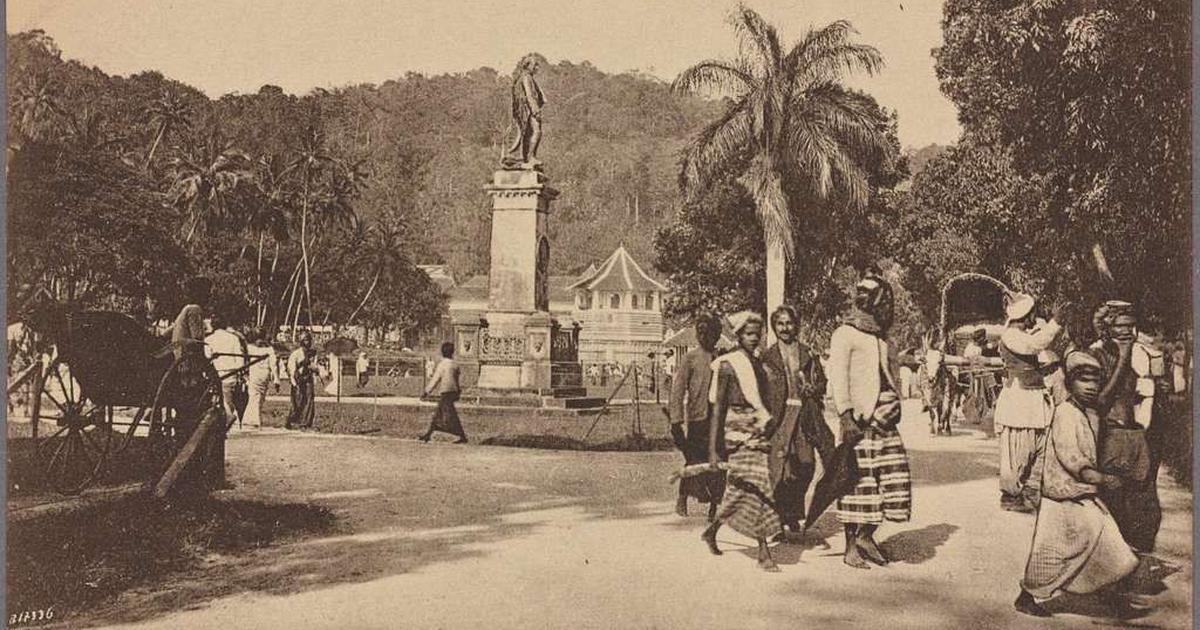
The longer his family stayed, he noted, the more enchanted they became. Menon especially loved the road and rail journeys from Colombo to Kandy. “I must have driven over this road over a hundred times,” Menon wrote. “Every time I felt as if I was driving through the Garden of Eden with a dozen Eves, quite needlessly clothed, sitting by the roadside and selling sugarcane, cashew-nuts, tender coconuts and that delicious but foul-smelling aphrodisiac, the durian.”
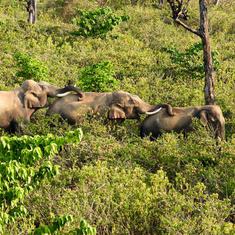
He also enjoyed drives to the hill station of Nuwara Eliya and to the ancient capital of Anuradhapura, recounting stories of wild elephants emerging from the forests to block and even overturn cars.
Feelings of home
Menon’s long-serving head servant, whom he called “Nani Amma”, felt right at home in Ceylon. She disliked wearing a blouse, having never worn one in her native Malabar.
“At first, she was stubborn and declined to wear one; and it was not until we threatened that we would refuse to take her with us to the Frontier unless she wore a blouse that she gave in,” he wrote. “But whenever we went on leave to Malabar, as soon as we crossed the Western Ghats into Palghat, she would throw off her blouse and be gloriously free.”
With her “vague” notions of geography, Nani Amma assumed that Ceylon was simply another part of Malabar. “When we went to Ceylon, the place looked so much like Malabar that she asked whether it was really necessary for her to put on her blouse,” Menon wrote. “Ceylon was indeed like Malabar; nowhere else in India or outside have I felt so completely at home.”
After three years in the “bleak and bare” Frontier, Menon said, it cooled his eyes and gladdened his heart to behold the island’s tropical vegetation, “the tall coconut trees, the slender areca-nut, the waving banana and the spreading mango trees; the tea, rubber and cocoa estates; the herbs and ferns, the crotons and orchids”.
Menon himself felt the urge to dress as he would in Kerala. “If Nani Amma felt like discarding her blouse, I felt like discarding my coat, shirt and trousers, and putting on just a loin-cloth, which indeed I did during my siesta in the afternoon,” he wrote. “At night, however, I always wore western-style pyjamas. This was symbolic of the double-life I had to lead in the ICS – ‘heaven-born’ and earth-bound, a sahib and a native, a sun-dried bureaucrat and a man of the people.”
Ceylon was also home to a vibrant community from Malabar and other parts of Kerala. Menon wrote about Umbichi, a wealthy Muslim businessman who had arrived on the island with only a few annas in his pocket. “Now he was worth lakhs or rupees,” Menon wrote. “His wealth came from the import of a single commodity, fish from the Maldive Islands, which gave a delicious flavour to Ceylon curries.”
Many Malayali men, known as Kochiyans, worked for the municipal council and harbour authorities, often without bringing their wives. “Even in Malabar, it was not the practice for the Malayali woman to go and live with her husband; he had to go to her – but the Malayalis often took Sinhalese women whom they treated with the consideration natural to men belonging to a matrilineal society,” Menon wrote. “This very consideration, which made them desirable in the eyes of local women, made them disliked by local men.”
Public speeches
It was in Ceylon that Menon discovered his talent for public speaking. “I felt specially happy in the company of students and professors,” he wrote. “I visited scores of schools and colleges and addressed them.”
His talks ranged from Rabindranath Tagore and Kalidasa to the North-West Frontier, the Taj Mahal and even the “Evolution of Law, Life and Literature”. The colonial authorities were not always pleased, occasionally complaining to their counterparts in India. Menon received three mild reprimands, “two of them from an Indian Secretary to the Government of India”. These were the only reprimands he got in his nearly 40 years of service, 25 of which were under the British Raj.
“The Government of India must have been fully aware of my nationalistic leanings,” he wrote. “But they had the sense to realise that in those days, it was impossible to find any Indian with spirit who was not nationalist at heart. Only some Indians flaunted their patriotism, others cherished it discreetly and some others concealed it carefully.”
The most memorable moment of his four-year stay came when he saw Jawaharlal Nehru, the man “who, next only to Mahatma Gandhi, was responsible for bringing British rule to an end”. Nehru was addressing a massive gathering in Kandy, but Menon felt it would have been “indiscreet” for him to attend. Instead, he sat on a bench overlooking the city’s lake.
A few hours later, a small convoy arrived. “One of the cars stopped near me; and a good friend of mine, George de Silva, got out and introduced me to Jawaharlal Nehru,” Menon wrote. “I felt as if an idol had suddenly come to life, for Nehru was the idol of Indian youth, including even members of the ICS.”
“What!” Nehru exclaimed. “Meditating! A good spot for it!”
Menon would return to Ceylon in 1962, maintaining friendships forged during his earlier stay. His feelings for the island’s people were best summed up in his own words: “I felt that the Ceylonese were the flesh of my flesh and blood of my blood. Though twenty-five miles of water separated India and Ceylon, and though politically each would always remain a separate entity, they were culturally and spiritually one.”
Ajay Kamalakaran is a writer, primarily based in Mumbai. His latest book, Colombo: Port of Call, has been published by Penguin Random House.
