





Every afternoon for three weeks, a spry man trekked hundreds of feet down Karnataka’s Ghats to paint a waterfall.
One day, the gates of the dam built across the cascading river opened without warning, causing the mist rising from the water to blur the familiar vista. The artist now faced a challenge: with the painting nearly complete, how might he depict the transformed natural mise en scène with optical fidelity?
Before long, he improvised a technique. Using a razor, he scratched the painting’s surface, evocatively capturing the waterfall’s hazy, moist shimmer.
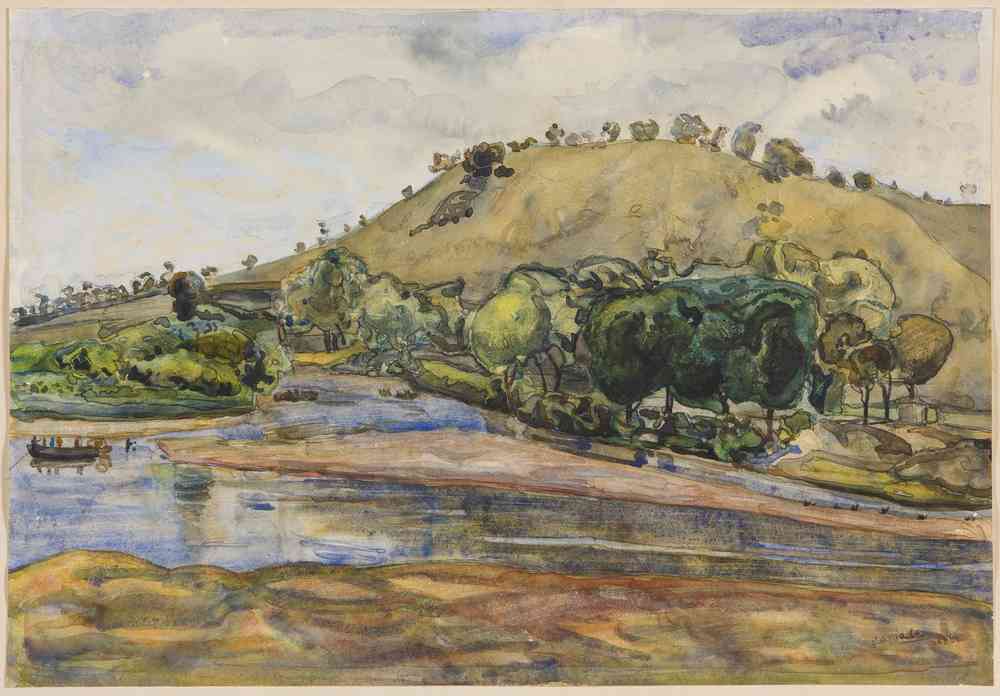
This is an account of one of independent India’s most important landscapists, Rumale Chennabasaviah, painting the majestic Jog Falls in 1956. While that particular piece was gifted to the United States embassy a decade later, another work from the same period and of a similar mood was recently on view at Hyderabad’s Salar Jung Museum as part of the latest iteration of Chennabasaviah’s long-term retrospective series Varna Mythri. Titled Karighatta Hill near Srirangapattana (1952), the watercolour uses dapples of greens, blues and browns to evoke, from a distance, the tranquil environs of the titular hill and the Lokapavani river winding past its base.
The story about Chennabasaviah painting Jog Falls was originally excerpted from his autobiography by curator KS Srinivasa Murthy in an essay for the inaugural Varna Mythri exhibition in 2011 at the National Gallery of Modern Art, Bengaluru. A subsequent, slightly updated iteration was mounted at NGMA Mumbai in 2024. Together, these exhibitions mark some of the most significant moments in the artist’s gradual re-emergence from regional prominence into the national mainstream over the past 15 years. This renewed visibility has been driven in large part by Sanjay and Shabala Kabe, current administrators of the Rumale Art House, which Chennabasaviah founded in 1973 and which loaned the works exhibited at both venues.
Satyagraha and silence
A chronicler of nature, primarily in his home state of Karnataka, Chennabasaviah painted a range of landscapes: rivers, forests, coastlines and hills. Yet, his compositions frequently hint at human intervention, whether in government-commissioned documentation of large-scale waterworks or in urban scenes where trees interact with architecture.
Particularly celebrated for his late 20th-century depictions of Bengaluru’s vibrant flora, Chennabasaviah was dubbed the Garden City’s “painter laureate” by Kannada writer and educationist VK Gokak. Today, much of the artist’s oeuvre, encompassing both watercolours and oils, remains on display in Bengaluru’s Rajajinagar neighbourhood, at Rumale Art House, the gallery he founded to house his works.
Murthy’s 2011 essay remains perhaps the most accessible and comprehensive English-language account of Chennabasaviah’s life and practice. Born in 1910 into a family of jewellers in Doddaballapura, around 50 kilometres north of Bengaluru, he completed his schooling there before studying at two of the region’s foremost art institutions. In 1931, he trained in watercolour and oil painting at the Chamarajendra Technical Institute, established by Mysore’s Maharaja Krishnaraja Wodeyar as part of his modernising agenda. But it was the preceding year that Chennabasaviah had spent at Kalamandira that may have influenced his trajectory more profoundly. A pioneering swadeshi art school founded by artist AN Subbarao in 1919 – the same year Rabindranath Tagore set up Kala Bhavana at Santiniketan – Kalamandira was where, as a student, Chennabasaviah decided to join MK Gandhi’s Satyagraha against the British empire.
For nearly 25 years, beginning in the mid-1930s, Chennabasaviah painted only sporadically. During this period, he was a freedom fighter with the Hindustani Seva Dala, then a political prisoner in various Deccan jails and, eventually, after independence, a member of the Mysore State Legislative Council, where he campaigned for financial and housing support for artists. From 1960 onwards, he started making up for lost creative time: between 1962 and 1978, he held a dozen solo exhibitions and went on to win several prestigious honours, including Mysore state’s Lalit Kala Akademi Award in 1972.
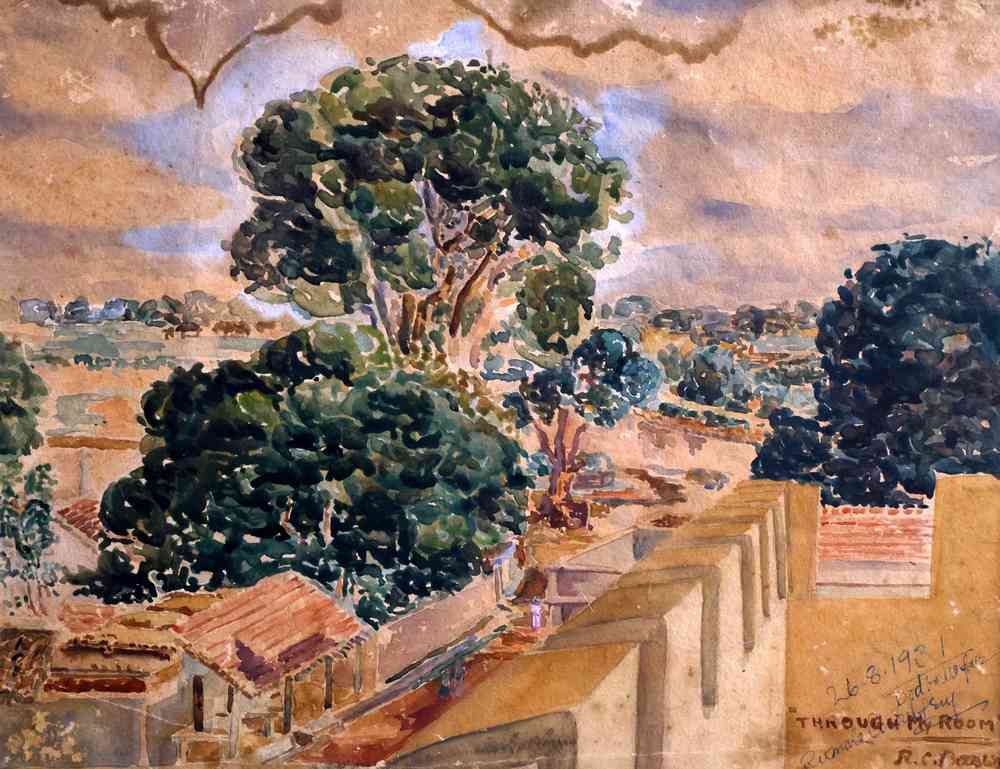
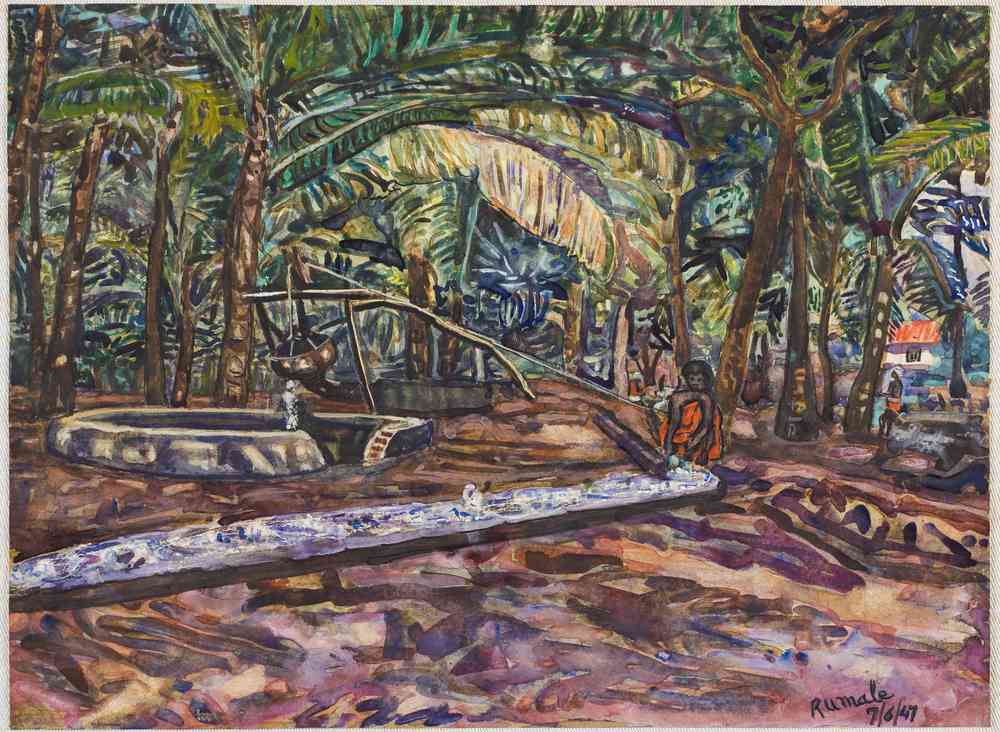
Among the works on display at the Salar Jung Museum were Chennabasaviah’s earliest watercolours from the 1930s and 1940s. Through My Room (1931), made in Doddaballapura, and an untitled circular vignette depicting what appears to be the mosque at Srirangapatna, anticipate the combination of trees and built structures that would become his hallmark. Another watercolour, titled Pump Shed (1947), features lush green foliage, with an orange-clad figure operating a tube well in the foreground, an open well behind him and a village house and tree tapper in the background.
Years later in 1965, in a note for Chennabasaviah’s third solo, Pump Shed was the prompt for abstractionist KCS Paniker, who founded the Cholamandal Artists’ Village near Madras, to comment: “In his water-colours he depends on subdued little patches of luminous colours…to form a harmonious whole which however also assumes a two-dimensional quality.”
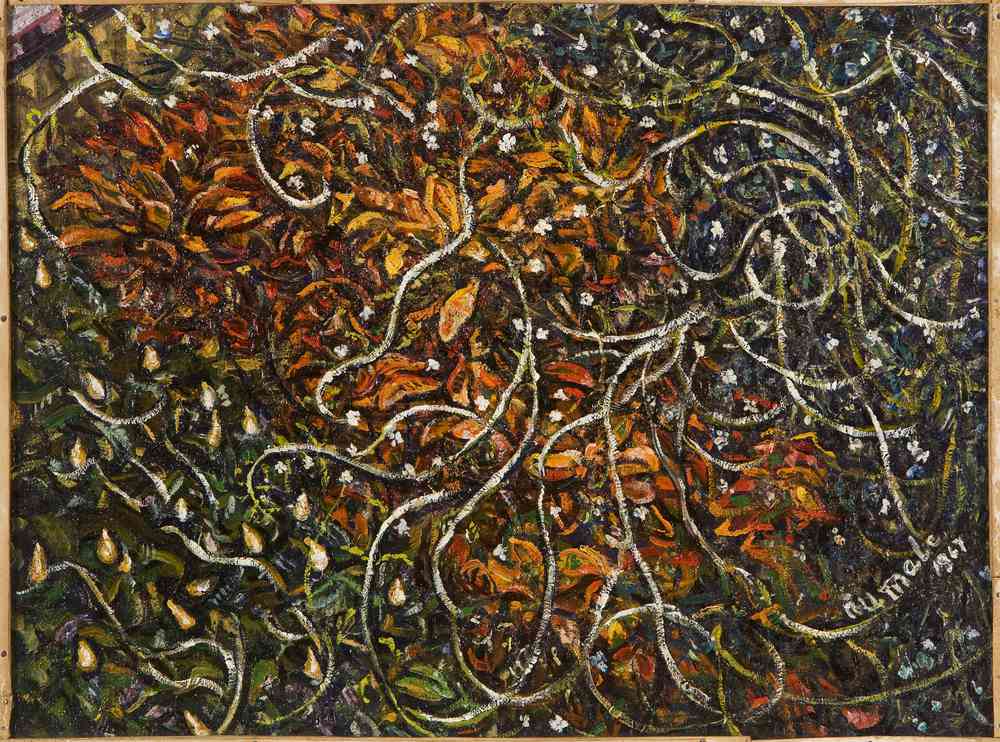
Chennabasaviah translated this chromatic interplay of planes into the medium of oil as well. Varna Mythri (1967), the work that lends its name to the retrospective series, depicts an arabesque of creepers emerging from an unseen plant. A wall caption at Salar Jung Museum summarised its contrasts: “The surface patterning emphasises the flat picture plane. However, the interweaving green and dark brown pigments suggest the possibility of an enigmatic depth.”
Chennabasaviah’s working process has been pieced together by Murthy through insights gleaned from the artist’s notes and interviews conducted with his peers. He tended to be exacting about his materials: a display case at the Salar Jung exhibition reveals he used imported Winsor and Newton watercolours and, Murthy reports, preferred distilled water to activate pigments.
Given the size of his works, he stands among India’s foremost masters of watercolour, a medium central to colonial landscape art but less prominent in the postcolonial period. His responsiveness to changing conditions, exemplified by his Jog Falls painting, recalls the watercolour-based plein air tradition of landscape artists capturing reality through live observation. This affinity is borne out by Murthy’s account that Chennabasaviah counted John Constable and JMW Turner among his favourite artists, and that he was part of the same circle as Svetoslav Roerich, another major 20th-century Indian landscapist.
Blossoms and concrete
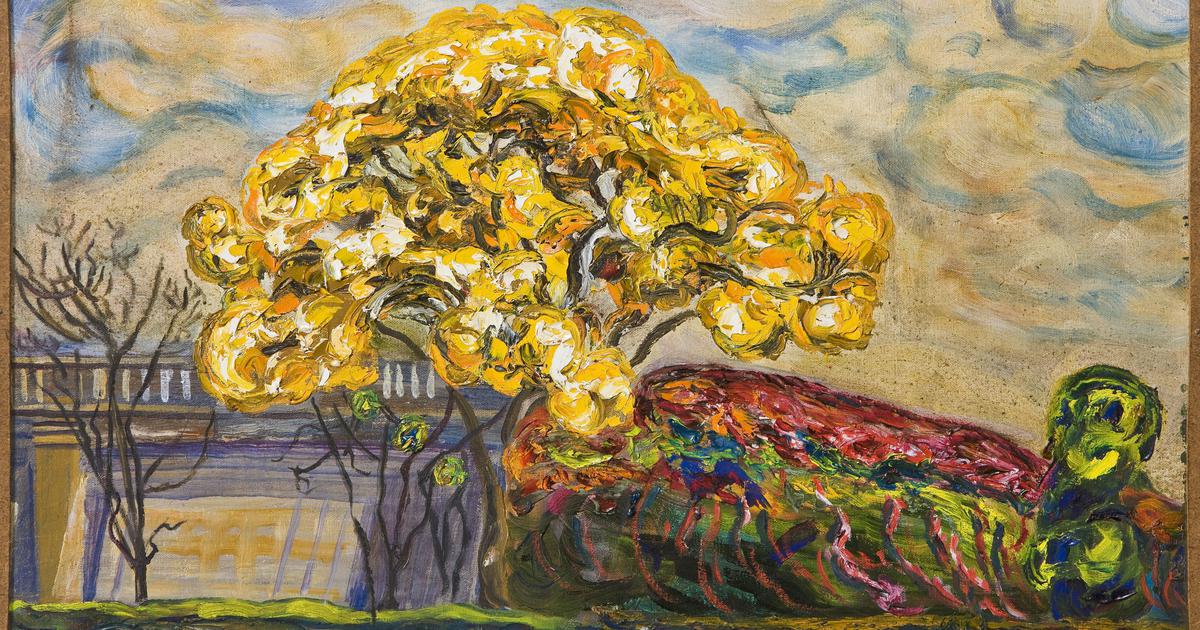
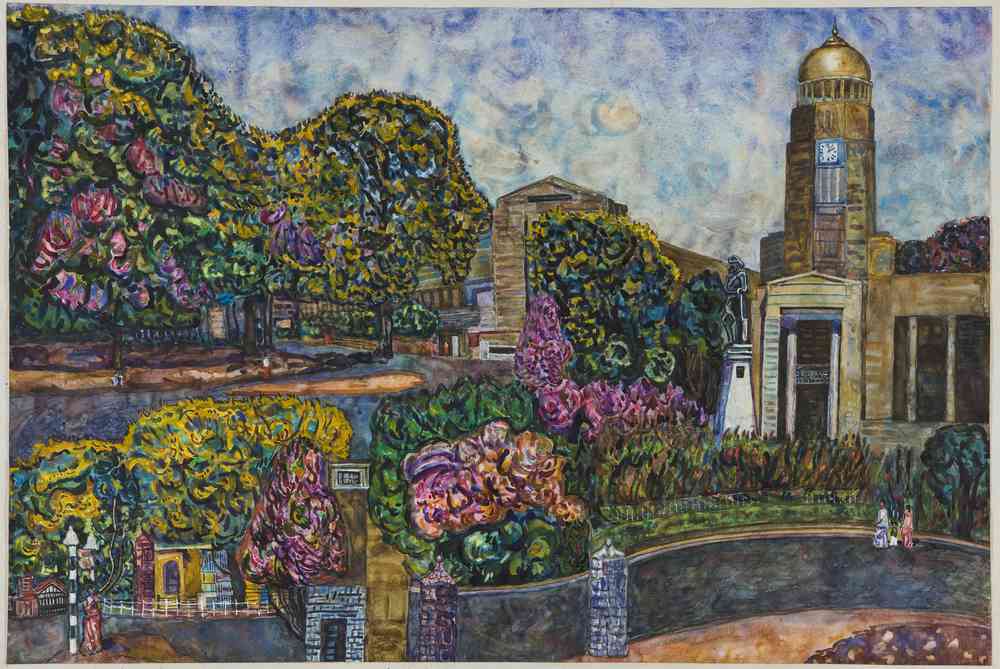
By the time of his Bengaluru city paintings in the 1970s and ’80s, Chennabasaviah’s gestural brushstrokes appear more intense and compositions more stylised, spurring some commentators to liken him to Vincent van Gogh. Yet Shukla Sawant, professor of visual studies at Jawaharlal Nehru University and a scholar of modern Indian landscape painting, points out an important distinction. Van Gogh painted flowers largely as still life, whereas “Chennabasaviah is painting something transient, which might change in a day or two”.
His urban landscapes were no less strenuously and spontaneously produced than his countryside ones. Murthy writes that during the 1970s and ’80s it was “was a common sight…to find Rumale working outdoors in Bangalore, near well known public buildings, street junctions and parks”. Having located a site by foot or moped, he would settle on a folding stool around noon and paint for hour-long stretches. Featuring yellow amaltas, scarlet flame-of-the-forest blossoms, blue jacarandas and purple crotons, these works mapped Bengaluru through a varna mythri of its blooms and buildings. At the Salar Jung retrospective, viewers encountered the effects of light on a Gandhinagar petrol station’s glass, the trees outside the red brick High Court and by the Vidhana Soudha, the layered spatial configuration of KR Circle, the stone front of St Peter’s Seminary and the bougainvillea-accented mosaic facade of a Rajajinagar house.
Artist and art historian Suresh Jayaram, founder-director of the Bengaluru art space 1Shanthiroad and curator of the 2022 exhibition of Chennabasaviah’s works called Bangalore’s Flora Through the Eyes of an Artist, observed: “He was using watercolor with the same kind of spontaneous brushstroke which captured the essence of the life force of these blossoming trees. It’s not very intellectualised, but immediate.”
Jayaram, who authored the book Bangalore’s Lalbagh about the garden, contextualised Chennabasaviah’s lush paintings of urban nature in terms of the history and landscape of the Garden City: “He started looking at the landscape of Bangalore – there is serial blossoming at different times of the year, causing perpetual spring. He located it in the landscape he traversed every day – Cubbon Park, Lalbagh, or a street corner in Rajajinagar.” Citing the “flamboyance” of the Argentinian tabebuia, the African tulip and the American jacaranda, Jayaram interprets Chennabasaviah’s practice through the process of “botanical globalisation” and the transformation of Bengaluru’s landscape over the 20th century. Referring to colonial-era interventions, especially by German botanist GH Krumbiegel, and to the broader Mysore Modern vision associated with Diwan Mirza Ismail, Jayaram stated, “Rumale’s paintings indirectly paid homage to this legacy of urban development and progressive government.”
At a time when artists across India were developing diverse visual languages for representing urban and rural environments – from Sudhir Patwardhan’s Bombay and Madan Lal Nagar’s Lucknow to Gopal Ghose’s pastoral watercolours – Chennabasaviah pursued a distinct engagement with landscape.
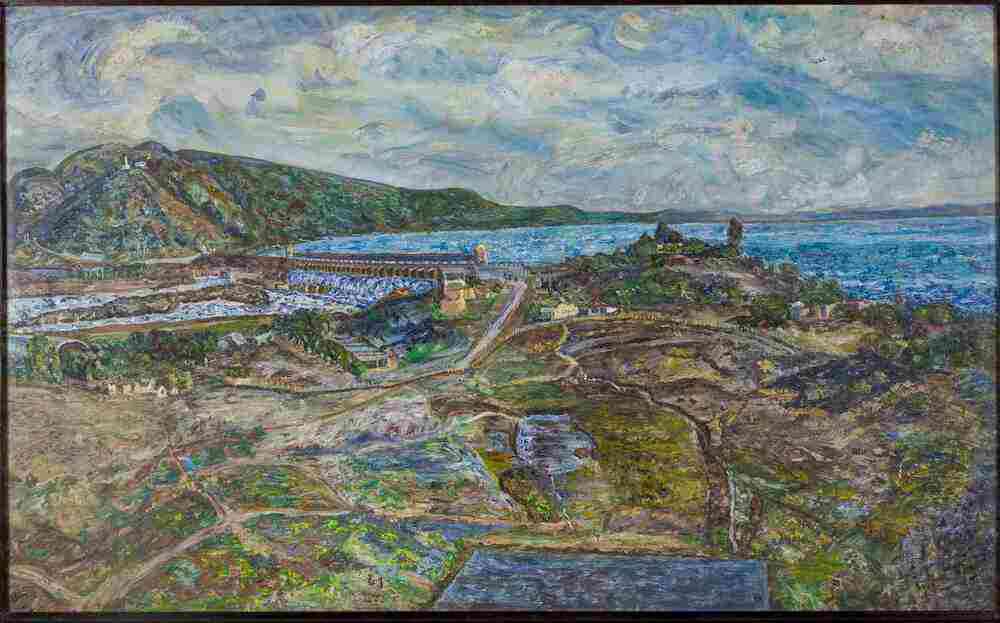
Sawant speculates that his commitment to the genre may have been shaped by his years of imprisonment. “He spent a lot of time in and out of prison,” she suggested, “and so now suddenly there is this sense of freedom.” She identifies two major strands in his oeuvre: the predominantly watercolour botanical paintings, and the oil paintings of dams and irrigation projects, commissioned by the government for state guesthouses. For her, the shift in medium from the watercolour Pump Shed to the large oil on canvas panorama of the Tungabhadra dam (1971) is significant. Although both depict public water infrastructure, the oil one signalled the gravitas of “heroic” painting.
According to Murthy, Chennabasaviah first undertook sarkari documentation projects in 1969, as India expanded its hydroelectric network, often at the cost of agricultural land and archaeological heritage. Murthy interprets the absence of humans and technology in these paintings as evidence of Chennabasaviah’s disinterest in the “destructive processes”. Sawant, by contrast, reads them through the lens of the “industrial sublime”, the awe induced by the sight of massive human intervention, albeit indexically. “He maps the churning water, the bridges,” she noted, “but also the remnants of older civilisational legacies on the banks of the river – temples and archaeological sites that were going to go underwater, and the water bodies that were now being created.”
Water was one of Chennabasaviah’s enduring subjects. He painted the lake near Hampi, the rivers at Dandeli and Bandipur, and farther afield, the seascapes of Sri Lanka. Some water bodies he painted were sites of intense dispute. In 1984, as the long-running dispute between Karnataka and Tamil Nadu over the Kaveri river intensified, he was hired yet again to lend his services to his state and paint the Kaveri from source to mouth, a project that he had already embarked upon in 1980 out of personal desire. Conceived as a 108-part series, it remained unfinished after his death in a bus accident in 1988. Only 20 paintings were completed. In these works, Talakaveri is vivified by the red of the diya’s flame as the river sets forth and Nagateertha muted by the browns and dark greens of its channel.
Continuing legacy
Today, Chennabasaviah remains a major figure in Karnataka’s official art-historical canon, “consecrated by the state”, according to Sawant, “which means that landscape as a genre was important to the making of the new state of Karnataka”. Jayaram, who included Chennabasaviah in his 2017 Bengaluru exhibition Perspectives of Karnataka Modern Art, situates the artist alongside contemporaneous Mysore landscapists such as N Hanumiah. Concurring with Sawant, he characterises the “landscapes of water distribution” as part of a “Nehruvian vision where development of the landscape via dams and irrigation systems was an important aspect of Karnataka’s modernity in the post-princely state identity it was forging”.
As his modest depictions of shrines and temples suggest, Chennabasaviah was spiritually inclined. In 1955, he met MG Kabe, a fellow disciple of Tapaswiji Maharaj and Shivabalayogi. After Chennabasaviah’s death, Kabe’s family – subjects, along with his gurus, of the rare portraits by him – took up the mantle of administering Rumale Art House. Sanjay Kabe describes how the space – for which Chennabasaviah took a bank loan to extend a government-allotted residence – remains unusual: a permanent, non-commercial gallery dedicated entirely to a single artist’s work. He “slept on the floor, surrounded by his works,” Kabe recalled. “As far as art was concerned, he wanted the best in the world – the best colours, canvases, brushes, knives and turpentine oils. But as far as life was concerned, he wore only khadi.”
Since the early 2000s, Kabe has modernised Rumale Art House, installing imported suspension systems and lighting to accommodate and illuminate the artist’s heavy, thick-framed paintings. Given that his other works are in closed government and private collections, Rumale Art House has played a crucial role in generating renewed interest in his work through loans and curatorial collaborations.


His themes, too, continue to resonate in an era marked by ecological loss. Srinivasa Murthy argues that by the 1980s, Chennabasaviah was already registering Bengaluru’s relentless urbanisation: buildings increasingly dominated his compositions and their hard edges grew more pronounced. For Jayaram, these scenes of urban nature retain both local and universal appeal. “But at the same time, viewers are also looking at how this nature which Rumale painted is quietly fading away and is being encroached upon by urban explosion and accelerated change. So there is also a kind of nostalgia that draws people in.”
Whether viewed in Hyderabad, Mumbai or Bengaluru, and whether featuring nature in the city or in the country, Chennabasaviah’s works embody a practice that responded to the elements and to the moment.
Once, while on an expedition to paint the Narasimhaswamy Temple across the Malaprabha river, he almost drowned in a flash flood.
In a letter to an artist friend, he wrote, “Fortunately, I hung onto the painting.”
Kamayani Sharma is an independent writer, researcher and podcaster based in New Delhi. This project was made possible under the Scroll x MMF Arts Writer Grant.
