






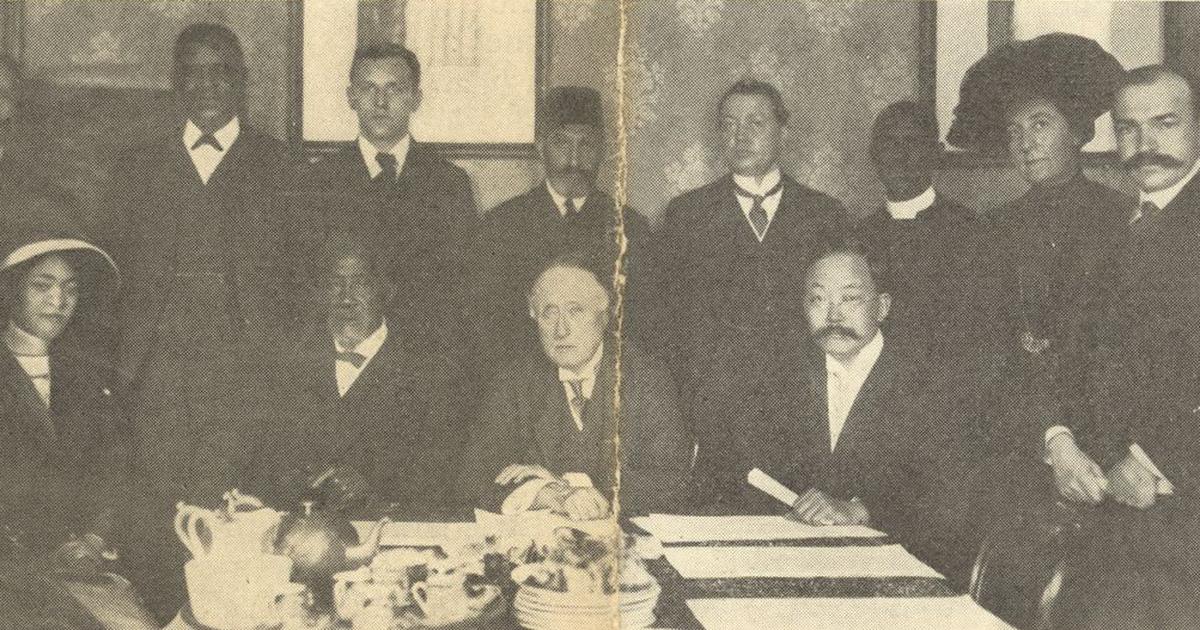
In July 1911, more than 2,000 delegates from 50 countries and 22 governments gathered at the University of London for what was a truly ambitious international conference. The Universal Races Congress, as it was called, had set itself no ordinary task. It sought to examine, “in the light of science and the modern conscience”, relations between the peoples of the West and the East, between “so-called white and so-called coloured peoples”, in the hope of fostering greater understanding, friendship and cooperation.
To many who attended, the Congress embodied cautious optimism. As the globe-trotting Indian journalist S Nihal Singh wrote in the American Review of Reviews, the delegates believed that peace among nations and unity between races could be achieved through sustained collaboration and future congresses. Their faith proved tragically short-lived. Within three years, the First World War had shattered those hopes.
Yet the Universal Races Congress did not emerge in isolation. It was the culmination of nearly two decades of growing international concern over the “race question”. As empires expanded and anti-colonial movements gathered strength, some people across the world searched for ways to address the inequalities that empires had created. The Congress was an expression of that search.
Bold vision
Few people articulated the urgency of the moment as well as WEB Du Bois. Speaking at the 1900 Pan-African Conference, the African American writer and political thinker declared: “The problem of the twentieth century is the problem of the color line, the question as to how far differences of race – which show themselves chiefly in the color of the skin and the texture of the hair – will hereafter be made the basis of denying to over half the world the right of sharing…the opportunities and privileges of modern civilization.”
Du Bois’s warning reflected a world in which racial discrimination continued to flourish despite the formal abolition of slavery in the United States after the Civil War. At the same time, international diplomacy appeared to be entering a more hopeful phase. The Hague Conventions of 1899 and 1907 sought to establish principles for arbitration between nations in times of conflict, suggesting that international cooperation might offer solutions to problems that individual states could not resolve.

Questions of race, empire and political representation were also becoming increasingly difficult to ignore. In 1910, the Nationalities and Subject-Races Conference brought together representatives from colonised societies to London to demand greater self-governance. Among the speakers at the conference was Lala Lajpat Rai, who denounced both imperialism and the racial hierarchies on which it rested. The political reforms promised to India, he said, had achieved little – instead, “the system of government in India is sapping our manhood, driving virtue out of the land, and making patriotism and public spirit a crime”.
Writing in 1911, Nihal Singh returned to these same concerns. Echoing Du Bois, he argued that antagonism between the world’s races had intensified since the 1890s. Neither science, which had demonstrated that differences in colour bore no relation to intelligence or ability, nor religion, with its message of universal brotherhood, had succeeded in overcoming prejudice. The Universal Races Congress, he concluded, was therefore not an end in itself but an idea that required sustenance and commitment.
Indian participation
The Universal Races Congress was the brainchild of two social reformers: Felix Adler and Gustave Spiller.
Adler, born in Germany in 1851, was a professor of social ethics at Cornell University and later at Columbia. He founded the Ethical Culture Movement in 1877, with a simple belief at its core: that human worth did not depend on creed, and that a meaningful life rested on ethical responsibility. In New York, Adler organised visiting nurses for the sick and helped establish kindergartens for children from working-class families. It was the wider political world that convinced him that the question of race could no longer be ignored. The expansion of American imperial power in the late 1890s, particularly the wars against Spain in Cuba and the Philippines, appeared to mark a decisive turn in global relations.
Gustave Spiller, born in 1864, came to similar conclusions by a very different path. A typesetter by trade and largely self-educated, he first worked with Stanton Coit, founder of the ethical movement in Britain. In London, Spiller and Adler collaborated to organise the International Moral Education Congress in 1908, which sought to develop a common code of morality for the world’s peoples. From that effort emerged the idea for something even more ambitious: a congress devoted to the problem of race itself.
The papers presented at the Congress reflected the breadth of that ambition, ranging from science and education to politics and student societies. The nearly 80-member delegation from India offered sharp insights into some of these themes.
The humanist philosopher Brajendranath Seal, in his keynote address, called for the establishment of a “World Humanity League” with branches in different countries meeting regularly to foster international understanding. He also urged the creation of professorships in Oriental civilisations in Western universities and greater attention to anthropology as a means of understanding human diversity.

Another prominent Indian voice was Gopal Krishna Gokhale, who used the platform to make a direct appeal for self-governance: “The first requisite...of improved relations on an enduring basis between Englishmen and Indians is an unequivocal declaration on England’s part of her resolve to help forward the growth of representative institutions in India and a determination to stand by this policy in spite of all temptations or difficulties.”
Other Indian delegates included Sayajirao Gaekwad of Baroda, the art critic Ananda Coomaraswamy, and Mohandas Gandhi, then a barrister in South Africa whose campaign on behalf of Indians in Transvaal had already drawn attention. Annie Besant, speaking at the Congress, condemned the exclusion of Indians from “white countries” that claimed the right to enter and exploit Asia and Africa at will. Similar criticisms of racial discrimination came from the Chinese delegate Wu Ting-Fang.
Beyond the colonial question, other speakers turned to broader proposals for international cooperation. The sociologist Ferdinand Tönnies suggested the adoption of an international language, proposing “Latin in a new form”. He also called for a rethinking of cultural life: “translations of the masterworks of all the national literatures”, international student exchange, academies to promote moral and social sciences, and a reformed press committed to fostering “kindlier feelings between nations and races”.
Support was also expressed for the Cosmopolitan Club movement, which sought to cultivate “a humanity above all nations” through regular gatherings of American university students. Even questions of governance were addressed at the conference. Charles Bruce, former governor of Mauritius, stated unequivocally that the West held no monopoly on enlightened political systems, and that neither European descent nor Christianity nor “so-called white colour” can lay claim to superiority.
Dreams deferred
Yet even at the moment of its expression, the Universal Races Congress was met with criticism. The Times argued that its proceedings contained more sentiment than scientific rigour and suggested that the range of papers and positions presented made its conclusions diffuse.
Some of the objections came from within the Congress itself. Among the speakers was the anthropologist and medical doctor Felix von Luschan, who argued that racial and national antagonism was a good thing. “Nations would come and go, but racial and national antagonism would remain,” he declared. “That was well, for mankind would become like a herd of sheep if they were to lose their national ambition and cease to look with pride and delight on their many achievements.”
In the end, the Congress did not develop beyond a single gathering. Plans for a second meeting were first considered in Europe and later shifted to Honolulu, but they never went anywhere. By then, First World War had broken out in Europe, and in 1917, the United States entered the conflict on the Allied side.
Du Bois, who had placed great faith in the Congress, was disillusioned by the post-war world. The possibility of a just international order seemed, in the aftermath of the war, more distant than ever. Yet he did not dismiss the Congress. On the contrary, he continued to believe that it had confronted the race problem openly and honestly.
In his report on the Congress, Du Bois wrote that established institutions had repeatedly failed to confront racial prejudice. “The Church has repeatedly dodged and temporized with race prejudice,” he observed. “The State has openly used it for conquest, murder, and oppression…Here at last is a full fair frontal attack on the nastiest modern survival of ancient barbarism…The Congress accomplished wonders. It met successfully in peace and concord and yet with unusual freedom of speech. It secured the co-operation of many of the leading people of the world and induced them to stand openly on its platform not simply of ‘Peace,’ but of ‘Good Will Toward All Men.’”
