






Humans in the Loop opens with a dreamy moment in a field. The young girl Nehma is at eye level with a porcupine that’s half-hidden from view and seems to be communing with her. Nature is unpredictable, uncanny even, unlike artificial intelligence, as Nehma realises in her adulthood.
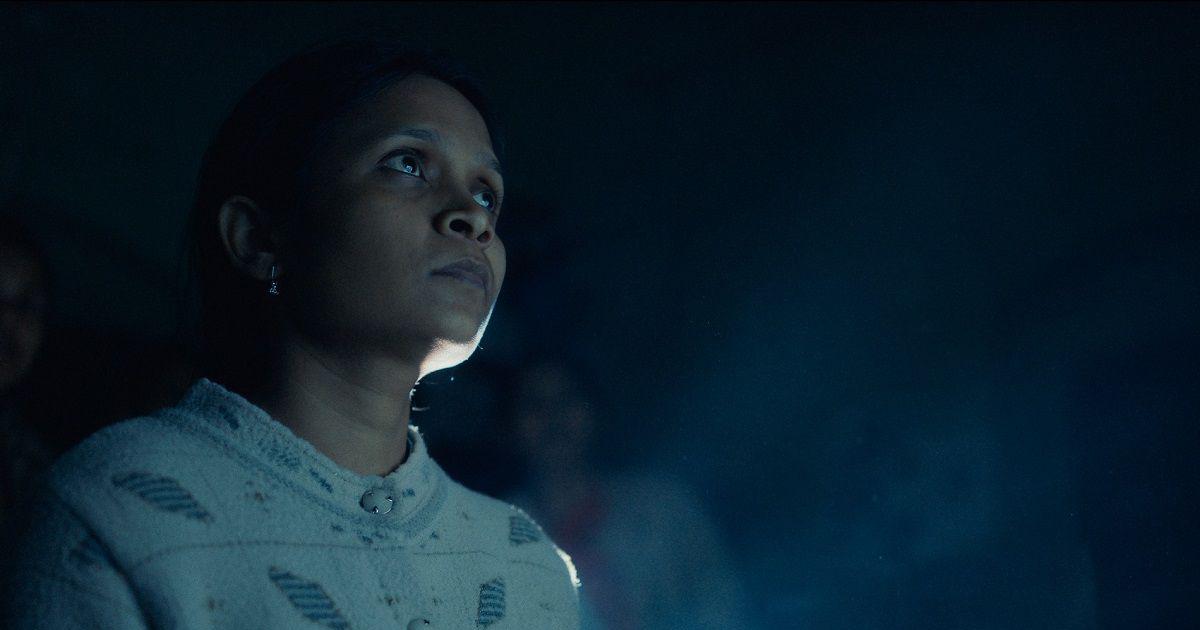
An Adivasi from the Oraon tribe, Nehma (Sonal Madhushankar) has moved back to her village after a fractious divorce. Her 12-year-old daughter Dhaanu (Ridhima Singh) yearns to live with her father. Nehma, who also has an infant son, begins working as a data labeller at an AI centre, where she annotates raw footage so that it can be easily understood by foreign clients.
Is an earthworm a pest or a vital part of the food chain? Nehma finds that AI is inherently biased, especially against non-Western populations. Nehma’s efforts to mould AI into something closer to her reality runs parallel with her efforts to tame her increasingly wayward daughter.
Aranya Sahay’s directorial debut from 2024 will be released on September 5 at the Cinepolis multiplex in Andheri in Mumbai, followed by screenings in Delhi, Bengaluru, Kolkata, Chennai and Thiruvananthapuram from September 12. Humans in the Loop has a fascinating subject inspired by actual AI centres in Jharkhand.
Sahay, who has also written the Hindi-Kurukh movie, not only simplifies but also finds the correct visual scheme to depict the technological processes behind data labelling. Cinematographers Monica Tiwari and Harshit Sahni contrast the cold glare of Nehma’s computer screen with the earthy tones of her domestic settings. The tight compositions especially do justice to Sonal Madhushankar’s moving portrayal of Nehma’s struggle to take control of her new surroundings.
More than Nehma’s encounters with a galloping technology, it is the age-old problems of womanhood – running a family on her own, handling her daughter’s tantrums, child care – that are memorable in Humans in the Loop. The 74-minute film isn’t as convincing in showing how Nehma makes her peace with AI than it is in revealing how Nehma and Dhaanu establish a rhythm. The movie isn’t strongly equipped to reveal the ethical dilemmas posed by AI and its effects on representation.
The upbeat treatment of AI is a tough sell, especially after Sahay’s initially layered exploration of the collision between cutting-edge tech and ancient belief systems. Humans in the Loop suggests that Indians can domesticate all manner of beasts, whether personified or machine-led. The porcupine, as shy as it is spiked, is a symbol of the world that Nehma continues to inhabit, and one that she tries to pass on to her daughter.
The most compelling and thoughtful scenes occur when Nehma is in confrontation mode, facing the unknown and the known. Sonal Madhushankar is especially strong in these moments, channelling Nehma’s doughtiness and fierce intelligence.
