










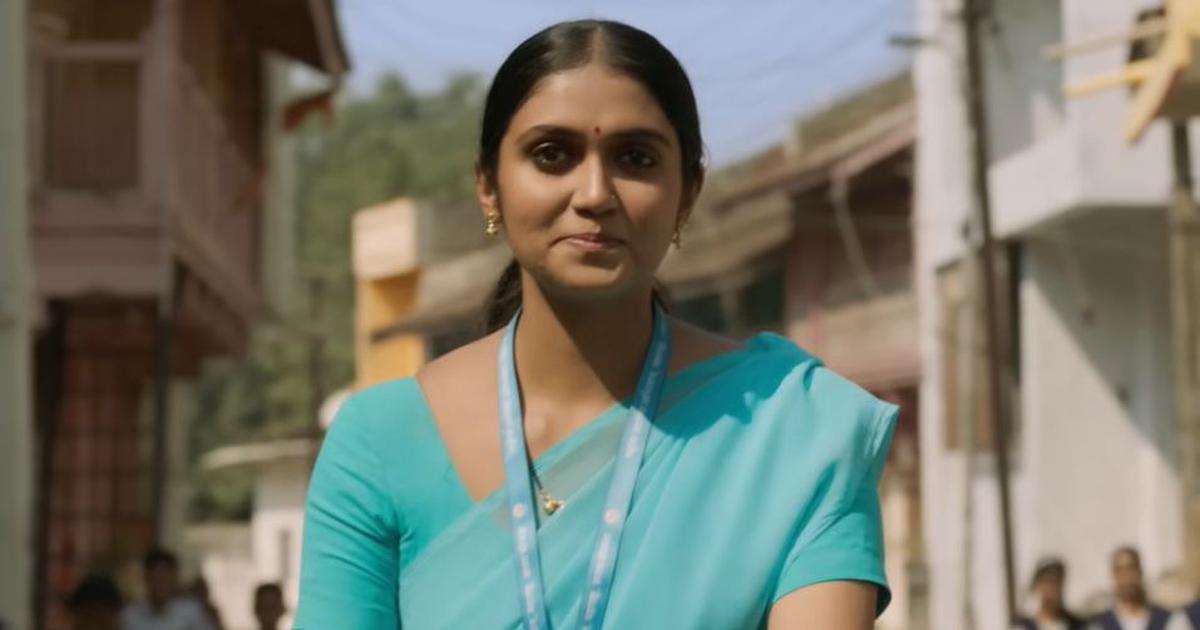
The redoubtable Rinku Rajguru props up a simplistic tribute to Accredited Social Health Activists, or ASHAs. The Marathi-language Asha stars the Sairat star as Malti, whose dedication as a community service worker is Padma Shri-worthy.
Malti sets out every day in her azure-hued sari, cycling distances to shrink the gap between villagers and the public healthcare system. Malti is outspoken as well as resourceful, defying her in-laws (Dilip Ghare and Harsha Gupte) and sweet-talking her husband Nilesh (Sainkeet Kamat) into letting her pursue her passion for public service. When Malti spots the heavily pregnant and clearly distressed Kamla (Shubhangi Bhujbal), she resolves to help her.
It means going against Kamla’s orthodox family. It also means further annoying her in-laws and perhaps losing Nilesh’s trust. Malti soldiers on, with the aid of the elderly Mai (Usha Naik) and the permanently drunk driver Khopdi (Suhas Sirsat).
Deepak Patil’s film, written by Antariksh Srivastava, often feels like a better-looking version of a Union Health Ministry-backed public awareness campaign video. Prime Minister Narendra Modi himself turns up in the form of a Maan Ki Baat radio programme, in which he extolls the ASHA volunteers. The problems they face – excessive workloads, delayed payments – find no reflection in this insistently upbeat movie, except for a stray scene.
The 125-minute Asha does take the trouble of making its idealised portrayal engaging. Humour, fleshed-out characters, and a clear-eyed view of chauvinist attitudes towards women boost what often feels like an extension of an ASHA recruitment drive.
Kamla serves as a case study for the preference for boys over girls, with women like Malti and her colleagues providing role models for a more enlightened view of what women are capable of. Malti’s domestic situation is a reminder that working women in rural areas don’t have it easy.
Rinku Rajguru’s irresistible sincerity and infectious enthusiasm go a long way in making Asha work. Usha Naik is a hoot too as the feisty Mai, who always has a ready scheme to outwit Kamla’s odious family members.
The movie might give women the idea that becoming an ASHA is a great way to serve the country (Malti’s words). Rajguru is perfectly placed to be mascot as well as peddler of hope, even if the ground reality is vastly different.
